Once you achieve Financial Independence, you may choose to leave salaried employment but with decades of vibrant life ahead, it’s too soon to do nothing. The new stage of life between traditional employment and Full Retirement we call Victory Lap, or Victory Lap Retirement (also the title of a new book to be published in August 2016. You can pre-order now at VictoryLapRetirement.com). You may choose to start a business, go back to school or launch an Encore Act or Legacy Career. Perhaps you become a free agent, consultant, freelance writer or to change careers and re-enter the corporate world or government.
The 100% equity ETFs from iShares and Vanguard/Canadian Portfolio Manager
By Mark Seed, myownadvisor
Special to Financial Independence Hub
A reader recently asked me the following based on reading a few pages on my site:
Mark, does it make sense to have 100% of your portfolio in stocks? If so, at what age would you personally dial-back to own more cash or GICs or bonds? Thanks for your answer.
Great question. Love it. Let’s unpack that for us.
Members of Gen Z, which now includes the youngest adults able to invest (born in the late-1990s and early-2000s), represent a cohort that could be investing in the stock market for another 60 more years.
According to a chart I found on Ben Carlson’s site about stuff that might happen in 2023, over 60+ investing years in the S&P 500 (as an example) historical indexing performance would suggest you’d have a better chance of earning 20% returns or more in any given year than suffering an indexing loss. Pretty wild.
Source: A Wealth of Common Sense.
Shown another way as of early 2023:
Source: https://www.slickcharts.com
This implies younger investors, in my opinion, should at least consider going all-in on equities to take advantage of long-term stock market return power when they are younger given:
As you age, your human capital diminishes – your portfolio (beyond your home?) can become your greatest asset.
Younger investors can also benefit from asset accumulation from periodic price corrections – adding more assets in a bear market; allowing assets to further compound at lower prices when corrections or crashes occur (i.e., buying stocks on sale).
Harvest ETFs this week announced its new Harvest Premium Yield Treasury ETF, now available.
By Michael Kovacs, President & CEO of Harvest ETFs
(Sponsor Blog)
Canadian investors have been forced to adapt to aggressive interest rate hikes from the Bank of Canada. This was preceded by a prolonged period of low interest rates that continued since the 2007-2008 Financial Crisis.
Some experts and analysts are projecting that interest rates are at or near the peak of this tightening cycle. In this environment, an optimal investment strategy factors in high interest rates while preparing for the eventual downward move that many analysts expect in 2024 or later. When the period of high interest rates subsides, there may be great potential for capital appreciation and income generation with an investment strategy that captures those benefits/opportunities. That is where the brand new HPYT ETF comes into play!
What is it?
HPYT is an ETF that holds several long-duration US Treasury ETFs and actively manages a covered call write position on those ETFs to generate an attractive monthly income. It has an approximate yield of 15%, representing the highest fixed-income yield in Canada. The approximate yield is an annualized amount comprised of 12 unchanged monthly distributions (the announced distribution of 0.15 cents on Sept. 28 multiplied by 12) as a percentage of the opening market price of $12 on September 28, 2023.Continue Reading…
The column is a frank confession of some rather painful investment losses sustained the last three years, mostly from recent IPOs or SPACs.
When I asked myself where some of these investment “ideas” came from I realized that almost all of them came from investment newsletters published by various American stock pundits, self-proclaimed or otherwise, including two I mention below.
The worst of these is supposed EV play Lordstown [RIDE], down in my account an astounding 100%, following its recent bankruptcy. And no, I did not renew the newsletter responsible, which I have been persuaded I should not divulge here.
Credit another Letter for tipping me to such losers as Matterport (MTTR/Naqsdaq: down 83% after its recommendation), Zoom (ZM), down 80% and Coinbase (COIN), down a whopping 78%. I won’t name his newsletter as it doesn’t matter: the culprit responsible left some time in 2022, his patience exhausted long before the “Hold with strong hands” patience he recommended for his hapless readers.
When I further asked myself how it came about that I subscribed to these newsletters in the first place, I realized that well more than half were the result of email pitches and — typically — a US$49 per year offer. You know the drill: get 3 or 4 “special reports” that divulge the ticker symbols of these moonshots that are as apt to crash your portfolio as they are the hoped-for 10-baggers.
From a risk management perspective, I tend to invest far less in such speculations (for that’s what they are), compared to blue-chip individual stocks, broadly based ETFs or GICs, but those $1,000 or $1,500 per spec losses do add up. The MoneySense column goes into some detail on the hazards of holding such losers in registered accounts, versus tax-loss selling in taxable ones. [The tax tail often waves the investment dog in both directions.}
Stop biting on initial pitches, then stop renewing
So job one is to stop clicking on those email pitches. Second, do not renew them when they come up for it, typically after a year. Beware automatic renewals: you may have to contact the publishers directly to cancel.
A few exceptions
I don’t want to throw out the baby with the bathwater and it’s only fair to say there may be the odd exception, particularly here in conservative Canada. I have long been on the record for reading and sometimes acting on the recommendations of Patrick McKeough of The Successful Investor and his stable of newsletters like Wall Street Forecaster and Canadian Wealth Advisor. Most of Patrick’s stock picks are well-known blue chips. When he does go further afield with foreigner domestic juniors he identifies them as being riskier and suitable mostly for “aggressive” investors. Fair enough! Incidentally, Patrick kindly allows us to run an article here on the Hub roughly on a monthly basis: you can do worse than act on recommendations like this recent instalment: Use these successful investment strategies for your portfolio success.
I also respect the work of fellow Canadian Gordon Pape, who is a regular writer for the Globe & Mail. For the most part I find the Motley Fool to be decent, although I tend to focus on their free audio podcasts rather than their paid-for newsletters. At one point, in fact, I wrote for them.
Minimize media market noise
The MoneySense column also mentions some related topics, like monitoring cable TV all-news channels that also run stock quotes. We’ve looked before on the Hub about steps to take to avoid investment noise and the Fear of Missing Out (aka FOMO: currently, it’s all about AI). CFA and investment advisor Steve Lowrie, also a Hub contributor, and one who I initially met through the aforementioned Pat McKeough, captured this nicely in this blog: SPACs, NFTs and another Tech-inspired Silly Season. Continue Reading…
To shed light on effective wealth-building strategies, we’ve gathered insights from nine experts in the field, including investment specialists, financial advisors, and more.
From the importance of diversifying your portfolio and investing in yourself to the consistent investment in stock indices, these professionals share their top investment opportunities and asset classes that have proven particularly effective in securing financial independence.
Diversify Your Portfolio and Invest in Yourself
Prioritize Exchange Traded Funds (EFTs)
Look into Home Ownership and 401(k) Investments
Make Systematic Progress Across Asset Classes
Generate Passive Income with a Niche Website
Build Wealth through Real Estate
Focus on Healthcare and Nutraceuticals
Seek Rental Property Investments
Be Consistent with Investment in Stock Indices
Diversify your Portfolio and Invest in Yourself
One investment opportunity that has proven particularly effective in building and securing financial independence is a diversified portfolio that includes a mix of equity, bonds, and alternative assets.
This strategy allows for exposure to different asset classes, mitigating risk while aiming for growth. Equities provide the potential for high returns, bonds offer stability and income, and alternative assets such as real estate, commodities, or private equity can add further diversification and potentially enhance returns.
However, it’s essential to emphasize that investing in oneself has been the best investment of all. Personal and professional development, education, and acquiring new skills have consistently yielded substantial returns over time. These investments enhance earning potential, open up new opportunities, and empower individuals to adapt to changing circumstances. — Ahmed Henane, Investment Specialist and Financial Advisor, Ameriprise Financial
Prioritize Exchange Traded Funds (EFTs)
The equity market is the single greatest wealth creator for investors. If someone has 10 years or more as their time horizon for investing, then an equity growth mutual fund or ETF (Exchange Traded Fund) is highly recommended to build wealth.
ETFs are very similar to mutual funds. ETFs typically represent a basket of securities known as pooled investment vehicles and trade on a stock exchange like individual stocks. A growth ETF is a diversified portfolio of stocks that has capital appreciation as its primary goal, with little or no dividends.
One such investment would be the Vanguard Growth ETF (VUG/NYSE Area). This ETF is linked to the MSCI US Prime Market Growth Index, which offers exposure to large-cap companies within the growth sector of the U.S. equity market. Investors with a longer-term horizon ought to consider the importance of growth stocks and the diversification benefits they can add to any well-balanced portfolio. — Scott Krase, Wealth Manager, Connor & Gallagher OneSource
Look into Home Ownership and 401(k) Investments
There isn’t any one asset class or investment opportunity I’d recommend over the other for the general populace. Those types of financial decisions are circumstantial and based on the needs of the client.
Nonetheless, the two ways to “Build Wealth for Dummies” would be to purchase your home and invest in your 401(k). From a behavioral-finance perspective, the automatic contributions to these two vehicles have, more often than not, created better outcomes for clients. — Rush Imhotep, Financial Advisor, Northwestern Mutual Goodwin, Wright
Make Systematic Progress across Asset Classes
A systematic progression across multiple asset classes has been successful in developing wealth and financial freedom. A cash-generating firm provides a stable financial basis for future projects.
Real estate investing offers passive income and property appreciation, boosting financial security. Diversifying the portfolio with equities and other assets follows, harnessing the potential for exponential growth and mitigating risk through a well-balanced mix. However, amidst this multifaceted approach, it is crucial not to overlook the most pivotal investment: oneself.
As Warren Buffett wisely advised, “Be fearful when others are greedy and be greedy only when others are fearful.” Investing in self-improvement, education, and personal development enhances decision-making acumen and emotional resilience, providing the intellectual foundation to navigate the ever-evolving landscape of wealth accumulation. — Galib A. Galib, Principal Investment Analyst
Generate Passive Income with a Niche Website
A few years back, an affiliate website was launched in the personal finance niche. The payoff? Consistent ad revenue and affiliate commissions with minimal oversight, essentially becoming a self-sustaining income stream.
Running a website is not as time-consuming as commonly believed. After the initial setup and content, it just needs occasional updates. Soon enough, it turned into a low-maintenance income source. Continue Reading…
Crazy People is a 1990 American comedy starring Dudley Moore and Daryl Hannah. Moore plays advertising executive Emory Leeson. Leeson experiences a nervous breakdown, which causes him to design a series of “truthful” advertisements that are blunt and bawdy.
By mistake, his ads get printed and turn out to be a tremendous success. One of Leeson’s more memorable campaigns is for Volvos, which includes the tagline “Volvo — they’re boxy but they’re good.”
Dividend-paying stocks are like the Volvos of the investing world. They are not fancy or exciting, nor do they produce windfall profits over the short term. However, they have a lot going for them when you take a deeper look under the hood.
This month, I explore the historical performance of dividend-paying stocks, including the conditions under which they have tended to outperform their non-dividend-paying counterparts. Relatedly I will also discuss whether the current market environment is supportive of future outperformance.
A Caveat to the Volvo Analogy: Having your Cake and Eating it Too
The “Volvo — they’re boxy but they’re good” tagline implies a clear tradeoff: the suggestion being that one needs to sacrifice performance for reliability. However, the historical data imply that this has not been the case with dividend-paying stocks. Not only have they exhibited greater stability than their non-dividend-paying counterparts, but they have also produced higher returns, thereby providing investors with a “have your cake and eat it too” proposition.
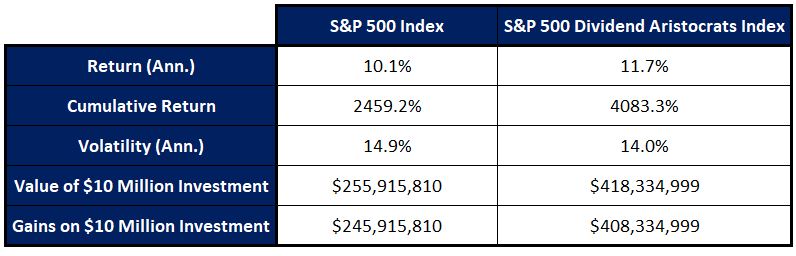
S&P 500 Index vs. S&P 500 Dividend Aristocrats Index (1990 – Present)
Since the beginning of 1990, the S&P 500 Index Dividend Aristocrats Index has produced an annualized total return of 11.7% vs. 10.1% for the S&P 500 Index. This difference in annualized performance has amounted to a tremendous difference in cumulative long-term returns, with the S&P 500 Dividend Aristocrats Index producing a cumulative return of 4,083% vs. a far less impressive 2,459% for the S&P 500 Index. In dollar terms, a $10 million investment in the S&P Dividend Aristocrats Index would have produced $408,334,999 in returns, which is 1.66 times more than the corresponding figure of $245,915,810 for the S&P 500 Index.
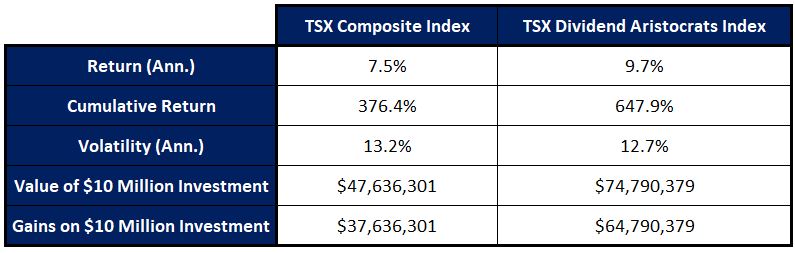
TSX Composite Index vs. TSX Dividend Aristocrats Index (2002 – Present)
The numbers for Canada tell a similar story, albeit over a shorter period due to historical data limitations for the TSX Dividend Aristocrats Index. Since 2002, the TSX Dividend Aristocrats Index has produced an annualized total return of 9.7% vs. 7.5% for the TSX Composite Index. In terms of cumulative performance, the TSX Dividend Aristocrats has produced a total return of 647.9% vs. 376.4% for the TSX Composite Index. In dollar terms, a $10 million investment in the TSX Dividend Aristocrats Index would have produced $64,790,379 in returns, which is 1.72 times more than the corresponding figure of $37,636,301 for the TSX Composite Index.
As an aside, the tremendous difference from 1990 to the present in the 2,459% cumulative return for the S&P 500 Index and that of 1,120% for the TSX Composite Index is largely attributable to the former’s far larger weighting in technology stocks. Between 1990 and 2010, the two markets were neck and neck, with the S&P 500 delivering a total return of 457% vs. 453% for the TSX. Since then, the S&P 500 went on to crush its northern neighbour, with a total return of 359% vs. 120%. During the same period, the mega-cap tech-heavy Nasdaq 100 knocked the lights out, returning 675%.
Tech stocks, and in particular mega-caps, have experienced tremendous earnings growth and trade at premium valuations. Whether their rates of growth continue, or premium multiples will persist, is beyond the scope of this commentary. That being said, there is no guarantee that these trends will persist, and relatedly whether the U.S. stocks will continue to outperform their Canadian counterparts.
Nice to Have in Strong Markets and Essential in Others
Dividends have historically been an integral part of equity market returns. Going back to 1990, a full 52.2% of the total return of the S&P 500 Index since 1990 can be attributed to the power of compounding reinvested dividends. On a relative basis, Canadian dividends have been even more prominent than U.S. ones, with reinvested dividends responsible for an astounding 63.3% of the total returns of the TSX Composite index.
Although dividends’ contributions to total market returns have been substantial over the past several decades, this contribution has tended to vary substantially over shorter sub-periods. As the table below demonstrates, dividends tend to play a smaller role in times of strong price appreciation. By contrast, during periods when capital gains have been muted, dividends play a far more substantial role in overall returns.
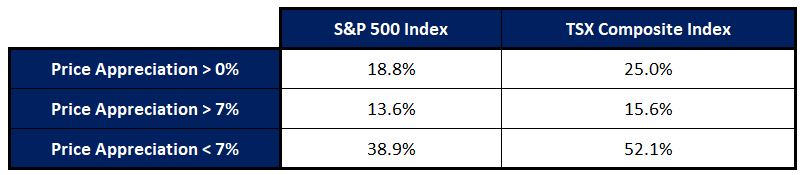
Contribution of Dividends to Total Returns: Rolling 12-Month Periods (1990 – Present)
Taking all 12-month rolling periods since 1990 in which the S&P 500 experienced price appreciation, dividends on average accounted for 18.8% of total returns. However, in periods where prices rose by 7% or more, dividends were responsible for only 13.6% of the total return pie vs. 38.9% when prices rose between 0% and 7%.
In Canada, the relative importance of dividends has also varied with capital gains. In all rolling 12-month periods since 1990 in which the TSX Composite Index experienced price appreciation, dividends were on average responsible for 25% of total returns. In those periods where prices rose by more than 7%, dividends’ share of total returns was only 15.6% as compared to 52.1% when prices rose between 0% and 7%. Continue Reading…


 Posted By



 Posted By