Once you achieve Financial Independence, you may choose to leave salaried employment but with decades of vibrant life ahead, it’s too soon to do nothing. The new stage of life between traditional employment and Full Retirement we call Victory Lap, or Victory Lap Retirement (also the title of a new book to be published in August 2016. You can pre-order now at VictoryLapRetirement.com). You may choose to start a business, go back to school or launch an Encore Act or Legacy Career. Perhaps you become a free agent, consultant, freelance writer or to change careers and re-enter the corporate world or government.
Vanguard Canada has released an interesting study on home country bias around the world, and makes the familiar case that most Canadian investors are woefully overweight Canadian equities and underweight the rest of the world. You can find the full report (PDF), by clicking here.
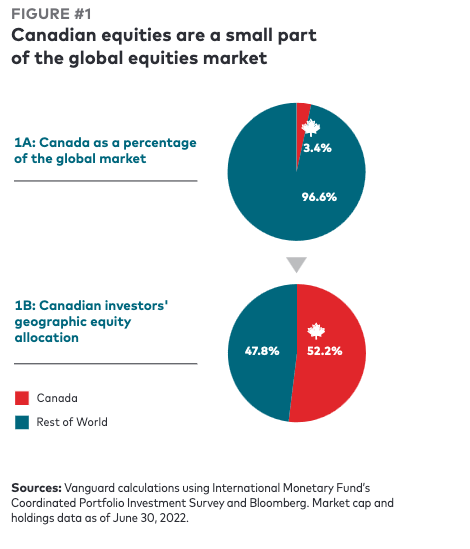
The report is written by Bilal Hasanjee, CFA®, MBA, MSc Finance, Senior Investment Strategist for Vanguard Investments Canada. He points out that Canadian stocks account for only 3.4% of the total global stock market as of June 30, 2022, but as the chart to the left shows, the average Canadian investor is more than 50% in domestic (Canadian) equities. That’s a whopping overweight position of 15 times!
“There are good reasons to have some overweight to Canada for domestic investors, including future return differentials, preference for the familiar, favourable tax considerations, the need to hedge domestic liabilities and currency risk,” writes Hasanjee, “However, Vanguard believes the optimal asset allocation for Canadian investors is 30% vs 70% allocation to Canadian versus international equities, based on our research …”
In other words, it’s okay to be overweight Canada by a factor of nine (30% versus 3.4) but most of us still need to boost our foreign content by roughly 50%: from 47.8% to 70%.
Home Country bias is hardly unique to Canada
Home country bias is hardly unique to Canada, the report says: it’s certainly the case in the United States and many developed countries, as Figure 2 demonstrates:
Americans are also overweight their home market — the United States — but they can get away with it, as more than half the global market capitalization is in American stocks, plus many of those are blue-chip corporations that have the world as their market. If anything, Interestingly you can see from the above that Australia, which is similar to the Canadian stock market in being focused mostly on energy/resources and financials, suffers even more than Canada from home country bias. Continue Reading…
By now, you’ve likely heard the term FOMO: the Fear of Missing Out. You’ve likely also heard the term TINA: There Is No Alternative.
Taken together, these handy little pop culture acronyms explain a good deal of what has gone on in capital markets over the past three years or so. I’d like to take this opportunity to push back a little on the second one. Based on current valuations, there may not be a sensible alternative to stocks, bonds, and real estate, but there may well be an alternative in …. wait for it…. alternatives.
Alternative assets are varied and the term ‘alternative’ could mean different things to different people. The asset class is known on a non-correlated basis by offering opportunities in such varied assets as infrastructure, liquid alternatives, structured notes, and hedge funds. While I personally dislike the last option due to high fees, illiquidity, and opaque reporting, depending on client objectives and risk tolerance, I believe there’s often a strong case that can be made for adding alternatives to your portfolio. As such, here’s a new term: TIARA. It stands for: There Is A Real Alternative. You’re not stuck with having to only choose between some combination of stocks and bonds. [Editor’s Note: John De Goey coined this term.]
A third major Asset Class
In the past half decade or so, many more traditional asset allocation strategies have changed significantly as bond yields have declined. The asset class that has been gaining the most traction is alternatives. Continue Reading…
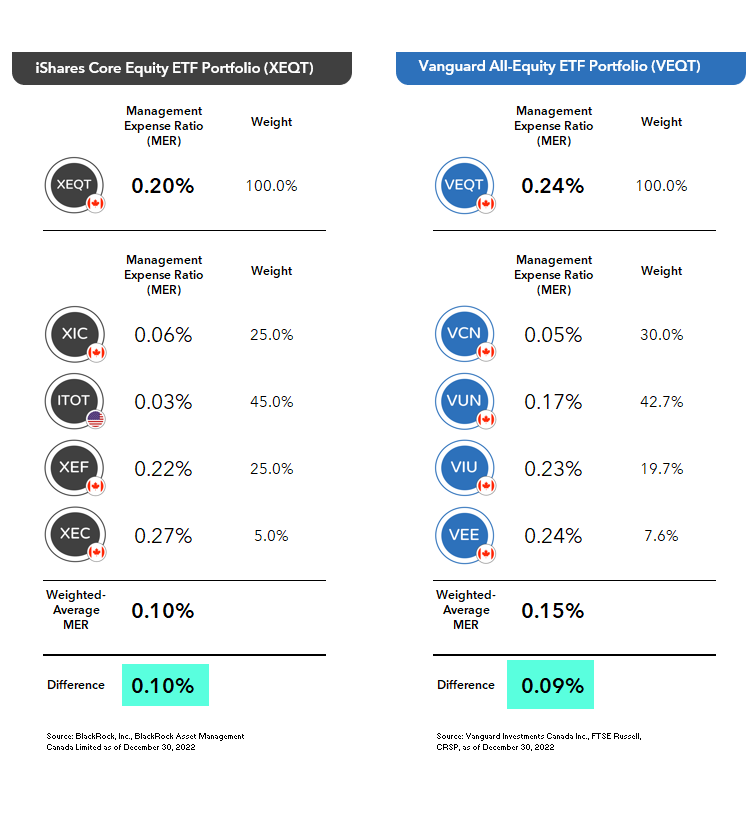
In our last blog/video, we introduced the all-equity ETFs from iShares and Vanguard. These ETFs make it easy to gain and maintain exposure to global stock markets with the click of a mouse, eliminating the hassle of juggling several ETFs in your all-equity portfolio.
Vanguard and iShares don’t offer their services for free though.
The MERs for their all-equity ETFs are slightly higher than the weighted-average MERs of their underlying holdings. Consider this modest surcharge as the price of admission for their professional asset allocation and rebalancing services. In my opinion, that’s a bargain for most investors.
Then again, there are those who might prefer to squeeze every last penny out of their portfolio costs. If that’s you, you may want to try skipping the value-add of an all-equity ETF, and simply purchase the underlying ETFs directly, in similar weights. If you take on the task of rebalancing back to your targets each month when you add new money to your portfolio, you should be able to mimic an all-equity ETF for a lower overall MER.
That’s the goal anyway. But it’s still going to take time, money, or both to keep your asset allocations on track each month. Let’s look at three potential strikes against trying to reinvent an all-equity ETF on your own, as well as one potential play that may serve as a suitable compromise.
Strike One: The potential cost savings are minimal.
For example, let’s say you’ve got $10,000 to invest. Instead of investing it in the Vanguard All-Equity ETF Portfolio, or VEQT, you could divide it up among VEQT’s component funds. The estimated cost savings might let you rent an extra movie each year, but are the savings really worth it? The extra time you’ll need to spend on rebalancing may not leave you much time to even enjoy your movie.
For larger amounts, the fee savings start adding up, but only if you can buy and sell ETF shares at zero commission as you rebalance. If not, you can forget about it.
Strike Two: Managing a portfolio of four ETFs (instead of just one) will be more difficult.
Sticking with our VEQT example, a DIY investor would either need to visit Vanguard’s website monthly to collect the individual ETF weights within VEQT, or use the market cap data from the FTSE and CRSP index fact sheets to determine how to allocate each of the underlying ETFs. They would then need to calculate how many ETF units to buy or sell across various accounts to get their portfolio back on target, and place multiple trades to get the job done. Continue Reading…
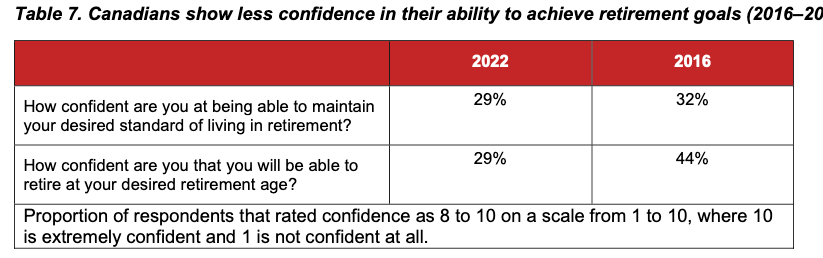
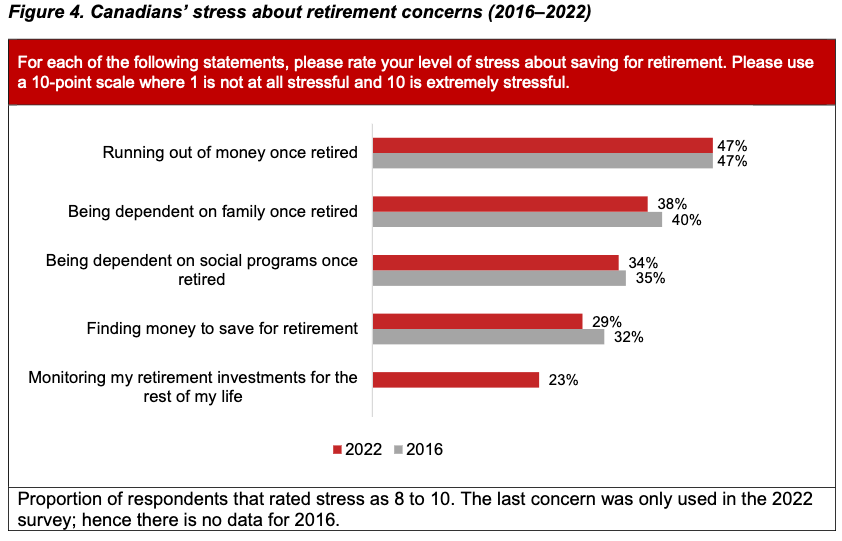
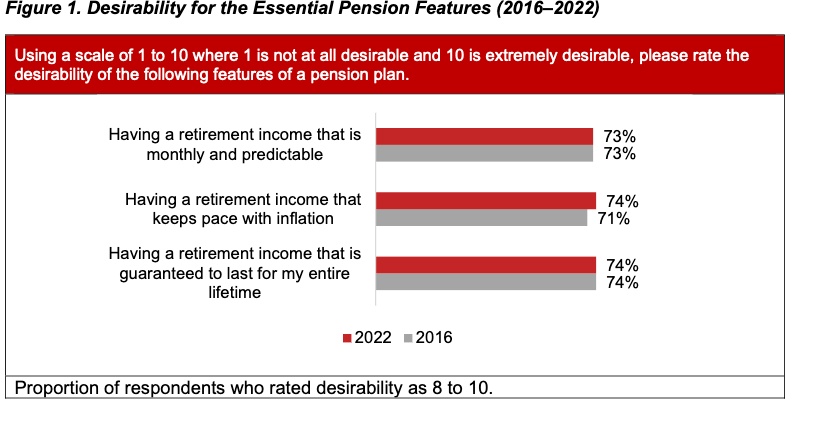
Canadians have lost confidence in their ability to retire on time and debt-free, according to a new report by the Canadian Public Pension Leadership Council (CPPLC). As a result, almost half of those polled by Pollara Strategic Insights are stressed about the prospect of running out of money in Retirement, as the graphic from the report illustrates below:
A press release issued Monday says the report comes from a Canada-wide survey conducted in 2022 similar to an earlier survey by the CPPLC on retirement perceptions prepared in 2016.
An introduction recaps the three major pillars of the Canadian retirement income system: government-sponsored CPP/OAS/GIS; Workplace Retirement Plans and Personal Savings (primarily RRSPs/TFSAs/non-registered savings).
However, a minority of Canadians currently have access to the workplace pension plans of Pillar 2: only 39.7% as of 2021, according to Statistics Canada. Worse, Pillar 3 savings are not making up for that gap: the report cites a Bank of Montreal finding that the average RRSP account balance is $144,613. That is not enough to fund an average yearly spending level of $64,000 (2019 average) over a retirement that may last 20 or 30 years. It also finds that not everyone is using TFSAs: those who do tend to older and married, with higher incomes and education.
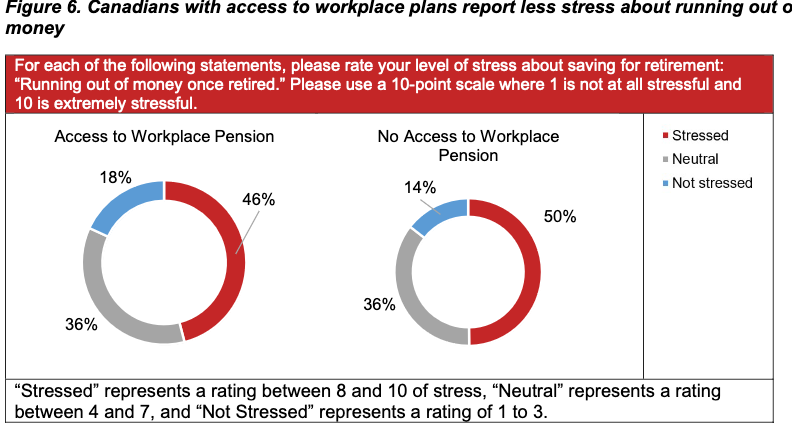
As you can see from the graphic on the right, those with Employer Pensions (especially classic Defined Benefit plans) experience somewhat less stress than those who do not. (Actually, I’m surprised the gap isn’t wider!).
As you might expect, given that they tend to live longer, women are more stressed than men about running out of money: a majority (53%) are stressed about running out of money once retired, compared to 41% of men.
Women also report more uncertainty about managing retirement savings themselves. And they rate the importance of maintaining standard of living higher than men, as shown in the graphic below:
Four key Observations
1.) Canadians consistently show preferences for predictable, inflation-adjusted, and lifetime
guaranteed retirement income
2.) Canadians continue to place importance on maintaining their standard of living in retirement
3.) Fewer Canadians are confident about managing their savings or that they will reach their
objectives and retire when they want
4.) Canadians are less confident they will be debt free in retirement and continue to report low
knowledge of retirement income sources
Three major recommendations
1.) Increase access to collective plans: leverage homegrown expertise to increase participation in
workplace pension plans by encouraging the growth of sector- and broader-based public sector
plans. Continue Reading…
Billy & Akaisha in Mesa, Arizona; courtesy Kiplinger
Earlier this spring, I was interviewed by Billy and Akaisha Kaderli, the globe-trotting early retirees who run the RetireEarlyLifestyle.com website and authors of several books on Early Retirement.
And here is the same interview at RetireEarlyLifestyle.com.
Turnabout is fair play so today, I play interviewer and Billy and Akaisha are on the hot seat to answer.
Jon Chevreau: What do you think of the term FIRE [Financial Independence/Retire Early)? You made it there in your early 30s but can Millennials, Gen X and GenZ expect to replicate your success, given the high cost of housing and everything else?
Billy & Akaisha: FIRE is a great marketing acronym filled with energy and intrigue. There was no such term when we left the working world in 1991, 33 years ago. There really wasn’t even the mental concept of being “financially independent” except for perhaps well-paid athletes, actors and trust fund babies.
We called ourselves Early Retirees, but we never retired from life, just from the conventional idea of working until age 65 or when Social Security kicks in. We had other plans for ourselves like travel, volunteer work, creative projects and continuous learning. We’ve always been productive and we like that feeling of pursuing our passions.
As for whether or not Millennials, Gen X and Gen Z can expect to become financially independent, we would say yes.
It’s a matter of discipline, focus, being aware of one’s financial choices, and most definitely finding a partner who is on the same financial page.
We have explained many times in our books and on our website that the four categories of highest spending in any household are Housing, Transportation, Taxes and Food/Dining/Entertainment. Pare down your personal infrastructure or modify your cash outlay in those categories and you will find money to invest towards your future life of freedom.
So yes, we say it can still be done.
JC: How many countries have you now visited around the world and how long do you tend to stay in any one location? Related question: do you maintain a home base in the United States and how long (and which seasons?) do you stay there each year?
Billy & Akaisha Karderli in Sorrento, Italy, with Mount Vesuvius in background
Billy & Akaisha: For some reason we have never cared to count the number of countries we have visited or lived in. We travel for ourselves, not to tick off boxes or to compete with other travelers.
We have visited all throughout Europe, lived in many Asian and Pacific Rim countries, visited and lived in Canada, most of the United States, all throughout Mexico, Central America and Northern South America, and have sailed throughout the Caribbean Islands.
In the early decades of our vagabonding, we’d be gone years at a time. We made trips back to the U.S. yearly to see family for a few months at a time, but then we’d get our backpacks and world maps out again and hit the road.
We utilized Geo-arbitrage long before there was a name for that hack and found it to be one of the best financial moves we have ever made.
We do still own a manufactured home in a resort in Arizona. But while on this topic, we’d like to say that living in an Active Adult Resort Community in the U.S. has been one of the most affordable and socially satisfying options for housing we have implemented.
That being said, we have many Readers and Friends who prefer to house sit all over the world and that is their gold standard of housing choice to keep costs down.
These are two examples of modifying the category of Housing to positively affect your budget.
JC: I believe you took Social Security early. How much do you think average would-be retirees will be depending on that source of income?
Billy & Akaisha: In our case we planned our retirement as if we would not receive Social Security. We structured our portfolio to produce our needed income on its own. Now that we receive it, between dividends and SS we do not need to touch our portfolio, thus letting it grow. Continue Reading…


 Posted By
  Vanguard Canada has released an interesting study on home country bias around the world, and makes the familiar case that most Canadian investors are woefully overweight Canadian equities and underweight the rest of the world. You can find the full report (PDF), by clicking here.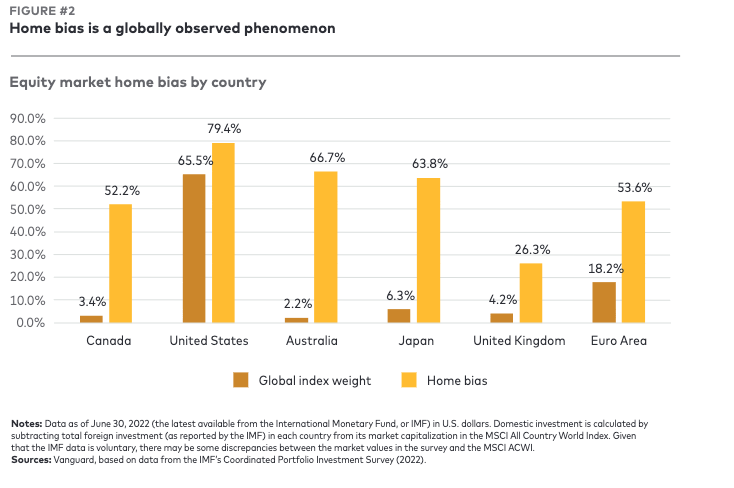
 Posted By