Most of your investing life you and your adviser (if you have one) are focused on wealth accumulation. But, we tend to forget, eventually the whole idea of this long process of delayed gratification is to actually spend this money! That’s decumulation as opposed to wealth accumulation. This stage may also involve downsizing from larger homes to smaller ones or condos, moving to the country or otherwise simplifying your life and jettisoning possessions that may tie you down.
How much is enough? This is the number we all want to know as we strive to determine how much needs to be set aside to fund our aspirations for freedom of life after work. The industry’s tool of choice, to answer this question, is the retirement calculator.
While these calculators provide a rough guideline for those early on in their accumulation years; once the count down for retirement begins (around ten, nine, eight years before retirement lift-off), you need to shift your attention from the rough guestimates of retirement calculators to a more disciplined planning process. Failure to do so robs people of the retirement they dream of and keeps them from achieving the security they deserve.
Reality Oversimplified
I recently re-watched the movie Apollo 11: a film that focuses on the spaceflight that first landed humans on the moon.
While Commander Neil Armstrong and pilots Buzz Aldrin and Michael Collins garnered most of the headlines, as I watched the mission unfold, it occurred to me that the unsung heroes of this mission were really the 100+ engineers back in Cape Canaveral. These were the people tasked with planning and then monitoring every single detail of the flight.
Complex? Unquestionably. Yet, this mission did have a pre-planned duration (8 days), a known destination (the lunar surface), a highly-researched flight plan and the ability to pre-determine fuel consumption: prior to lift-off.
Those approaching or currently living in retirement should be envious of the simplicity of this type of mission. Why? Because baby boomers face a much more daunting mission. A journey of unknown duration (often 11,000+ days), to an (all too often) poorly defined destination, along an uncharted course (Baby Boomers are redefining retirement), while constantly worrying and wondering if they will run out of fuel (money) before their journey’s end.
Unfortunately, the guidance system offered by the financial services industry is based upon the simple math of retirement calculators. Google “Retirement Calculator” – you will find every financial planning institution has an on-line version readily available. Continue Reading…
“I don’t invest in my RRSP anymore because I’ll have to pay tax on the withdrawals.”
This type of thinking around RRSPs has become increasingly common since the TFSA was introduced in 2009.
The anti-RRSP crowd must come from one of two schools of thought:
1.) They believe their tax rate will be higher in the withdrawal phase than in the contribution phase, or;
2.) They forgot about the deduction they received when they made the contribution in the first place.
No other options prior to TFSA
RRSPs are misunderstood today for several reasons. For one thing, older investors had no other options prior to the TFSA, so they might have contributed to their RRSP in their lower-income earning years without realizing this wasn’t the optimal approach.
RRSPs are meant to work as a tax-deferral strategy, meaning you get a tax-deduction on your contributions today and your investments grow tax-free until it’s time to withdraw the funds in retirement, a time when hopefully you’ll be taxed at a lower rate. So contributing to your RRSP makes more sense during your high-income working years rather than when you’re just starting out in an entry-level position.
Taxing withdrawals
A second reason why RRSPs are misunderstood is because of the concept of taxing withdrawals. The TFSA is easy to understand. Contribute $6,000 today, let your investment grow tax-free, and withdraw the money tax-free whenever you so choose.
With RRSPs you have to consider what is going to benefit you most from a tax perspective. Are you in your highest income earning years today? Will you be in a lower tax bracket in retirement? The same? Higher?
The RRSP and TFSA work out to be the same if you’re in the same tax bracket when you withdraw from your RRSP as you were when you made the contributions. An important caveat is that you have to invest the tax refund for RRSPs to work out as designed.
Future federal tax rates
Another reason why investors might think RRSPs are a bum deal? They believe federal tax rates are higher today, or will be higher in the future when it’s time to withdraw from their RRSP.
Is this true? Not so far. I checked historical federal tax rates from 1998-2000 and compared them to the tax rates for 2018 and 2019.
The charts show that tax rates have actually decreased significantly for the middle class over the last two decades.
Someone who made $40,000 in 1998 would have paid $6,639 in federal taxes, or 16.6 per cent. After adjusting the income for inflation, someone who earned $59,759 in 2019 would pay $7,820 in federal taxes, or just 13.1 per cent.
Minimum RRIF withdrawals
It became clear over the last decade that the minimum RRIF withdrawal rules needed an overhaul. No one liked being forced to withdraw a certain percentage of their nest egg every year, especially when that percentage didn’t jive with today’s lower return environment and longer lifespans. Continue Reading…
Like many Canadians with retirement on the short-to-midterm horizon, you may have spent more than one sleepness night worrying that you’re not prepared.
In fact, at least half of Canadians over the age of 50 think they’re not on track with their retirement planning and about the same number of non-retirees don’t have a financial plan.
Experience suggests that people may be afraid that they won’t have enough money to retire, but in reality, they may not even know the true answer. I take the view that not having a formal plan in place doesn’t necessarily equate to not being on track to retire. There are many steps you can take in the critical count-down years to retirement that will reframe your planning and investment approach and alleviate anxiety and stress.
Take inventory of present Financial Situation
I recommend assessing your last six months of credit, debit and cash spending: grouping your expenses into categories. To project for the future it’s important to understand where your money is being spent today. This activity will help to identify where better savings could be achieved. Completing a net-worth statement is also important to determine what you own vs what you owe.
Understanding your pension entitlements is also a key stress reliever. Pension plans will typically offer retirement projections. At 65, CPP has a maximum benefit of $1175.83 monthly and $613.53 for Old Age Security. It’s important to call Service Canada to get an accurate CPP projection to find out what you are eligible to receive. Similarly, OAS is tied to Canadian residency, with 40 years being a requirement for the maximum eligible payout.
Goal Setting and Strategic Planning
After taking inventory, the next step would be determining what income you actually need in order to retire. Completing a pre-and post-retirement budget is an exercise that will help determine the after-tax figure to target. Likely the targeted income would be tiered with a higher spend being projected for the first 10-15 years of retirement ($5000-$10,000 a year for travel) and lower lifestyle costs thereafter, with some planning as a buffer against long-term care costs. Continue Reading…
A million dollars isn’t what it used to be, especially C$ and with no employer pension
By Mark Seed, MyOwnAdvisor
Special to the Financial Independence Hub
They say a million bucks or so ain’t what it used to be … but I still think that’s a pile of money.
Which begs the question: does this couple with C$1.2 million in invested assets have enough to retire on?
Before we get into this latest case study however (thanks to a reader question by the way, I’ve changed the names of the readers for privacy reasons), this is a great time to remind you I’ve done other case studies like this on my site before: there are a few on this Retirement page in particular.
Passionate readers of this site will know I believe personal finance is personal. What works well for some investors or families will not work at all for others.
You need to carve your own financial path.
The 4% rule says you should be able to ‘safely’ withdraw 4% of your original portfolio each year, adjusted for inflation, for at least 30 years and have a reasonably high chance of having money left over.
This means, in more practical terms based on this rule, that a $1.2 M portfolio should be able to last ~ 30 years (or more) by withdrawing $48,000 in year 1 of retirement ($1.2 M x 0.04), then increasing that amount over time with inflation.
That said, while having a core spending plan is all fine and good, it’s also having flexibility designed into your plan that is essential for success. You need to consider your spend on travel, hobbies, home renovations but also the ability to cover emergencies and more during retirement.
Rates of return also matter
The potential sequence of many bad years in the stock market could crush a retirement plan if you’re not careful. Also, while less risky portfolios (i.e., more fixed income portfolios) might fluctuate less in the short term, over the long term this will have a big impact on your returns. This means a more conservative portfolio can actually increase the risk of running out of money …
Karla and Toby case study
To help us figure out if this couple, who has a seemingly healthy $1.2 M in the bank, have “enough money” I’ve once again enlisted the help of Owen Winkelmolen, an advice-only financial planner (FPSC Level 1) and founder of PlanEasy.ca.
Owen let’s get into it!
Sure Mark!
Case study overview
First off, I want to say Karla and Toby are in a very good financial position for retirement with over $1M in financial assets in their 50s. That is excellent.
That said, they face some risk in the future. Let’s look at the information and numbers they sent you:
Karla, was and remains stay at home mom, Age 54.
Toby, marketing manager, makes $110,000 per year now. Age 56. Toby wants to retire early next year in January when he turns 57. You told me they would love to start their winter renting from a Florida condo: sounds great!
They have lived in Canada their entire life. (re: they expect CPP and OAS benefits to come).
They live in Calgary, Alberta and own their home.
They have no debt other than $19,000 Line of Credit (LOC) balance used for a recent vacation and monies borrowed to fund their adult daughter’s wedding earlier this year.
Karla has no workplace pension whatsoever although Toby has a small LIRA from a former employer to draw down.
Portfolio assets:
They have $700,000 in combined assets within their RRSPs; invested in a mix of costly mutual funds.
Toby has $50,000 in his Locked-In Retirement Account (LIRA). Invested in similar mutual funds above.
They have $150,000 (combined) invested within their TFSAs. They hold a mix of Canadian REITs and a few Canadian bank stocks.
They’ve got about $50,000 cash in an interest savings account.
Toby has $250,000 invested in a taxable/non-registered account that includes a mix of cash, U.S. stocks and some Canadian dividend paying stocks.
All told, they have about $1.2 million in investable assets and their home value is estimated at $550,000. They are considering selling their home as they get older and renting, including renting property in Florida each winter.
You also told me they have one car, now paid for, a 2014 Range Rover SUV and no plans to get a new one until at least five years from now.
Mark those are great details to start some analysis with …
Owen’s analysis
Based on what details you shared with me Mark, because a large portion of their desired retirement spending will come from their investment portfolio, this creates a high risk of running out of money if they were to experience a period of poor investment returns in the future. We’ll get into that in a bit. Continue Reading…
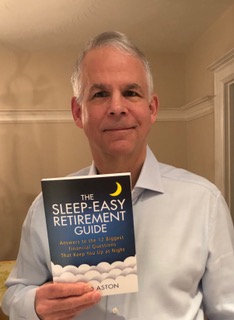
Author David Aston, whose book becomes available today
Today is the formal release date for David Aston’s new book, The Sleep-Easy Retirement Guide. Below is a Q&A I conducted with David to mark the occasion. See also my review of the book at MoneySense that appeared in December, as well as the Hub’s throw to that piece.
Jon Chevreau: What inspired you to write the book after so many years of writing about Retirement?
David Aston: I have covered most of the key issues in planning for retirement in stand-alone articles I have written over the years. But I wanted to update that advice for current circumstances and figures, show how all the issues fit together as an interconnected whole, and provide it in a combined reference guide that people could have on their shelf and readily turn to when questions came up.
Q2: What do you think about the FIRE movement?
DA: The Financial Independence Retire Early (FIRE) movement is certainly laudable. It’s an admirable concept that people should try to achieve Financial Independence as early as possible, which frees them up to do work that is most meaningful to them (rather than being obligated to do work that maximizes income). As I understand it, it also includes the concept that people should adopt a modest lifestyle that consumes money carefully and wisely without wasting it, which in turn helps make Financial Independence more achievable at a relatively young age. But from what I’ve read, many of the FIRE scenarios are oriented to extreme examples of people trying to achieve Financial Independence in their 30s. So it sometimes comes up as a concept for millennials who are looking for Financial Independence as a near-time goal rather than one that is achieved after a long career at work. That’s only possible for a tiny minority of people. In my experience, it is far more common for people in their 30s to go through a very difficult financial crunch period where they are struggling to buy a house, then make humungous mortgage payments, and cover the expensive costs of raising kids. FIRE goals are not realistic and achievable in your 30s for the vast majority of people. However, the quality of thriftiness and emphasis on saving can be emulated by everyone. I personally think FIRE makes a fair amount of sense for the far more common case of people of average means who might aspire to achieving Financial Independence in their early 60s or possibly their late 50s, but that may not sound particularly appealing to millennials.
Q3: What’s your take on Semi-Retirement and/or Phased Retirement?
DA: The whole world of work for older workers is opening up. The once accepted norm that people retired from their career job to live a life of leisure close to age 65 has pretty much gone out the window. There are lots of expanding options for people to do post-career work that is different than their career job. Often it involves reduced hours, but it can also be full-time work that is less stressful or more fulfilling, or some combination of these attributes. There are various forms of part-time work, contract work, self-employment, consulting or temp work. Often it means switching employers or being self-employed, but it can also mean gearing down to reduced hours or a less stressful role with the same employer. And these post-career options are often started in your early 60s, but they can also happen earlier or later. So there is a vast array of options out there and it’s really up to people to pursue the opportunities that appeal to them the most.
I should mention that “phased retirement” is a term that is sometimes applied to formal corporate programs that allow older employees to adopt a reduced-work schedule or otherwise gear down with the same company prior to full-retirement from their career job. If you go back about 10 years or so, there was an expectation that these kind of corporate programs would increasingly catch on and be offered by major corporations. However, it never really caught on as formal corporate programs that are broadly offered to all older employees. What I have seen happen is that you get a lot of these kind of arrangements to offer reduced hours or less stressful/more fulfilling job functions negotiated on an informal, individual basis. They aren’t offered to everybody in the company. Whether or not an employee can achieve something like that or not depends on the nature of their job, what their boss is looking for, as well as their individual wants and needs. Continue Reading…


 Posted By
  By Doug Dahmer
 Posted By



 Posted By