 Posted By
Good Friday


By Danielle Neziol, BMO ETFs
(Sponsor Content)
Canadians are facing a lot of sticker shock lately. My grocery bill was how much? My mortgage payment is going to increase by what per cent? Don’t even ask me what it costs to fill up my car these days. With more money going to living expenses, it has become harder to save than ever. One simple way to get ahead is to be more aware of what we are spending — especially in times like these — and to review our monthly expenses to see where there are opportunities to make cuts.
Our investment portfolios should be viewed no differently. If you are an investor who holds a mutual fund or an exchange traded fund (ETF) there are fees attached to your investments. It would be prudent to review the cost structure of the funds you hold to ensure that the fees make sense relative to the fund’s investment mandate. It would also be wise to review the cost of the funds you hold to see if that fee is competitive relative to similar products in the market. Fees detract from total portfolio returns, so anything an investor can do to manage these costs can help keep more money in their pockets.
Management Fees and MERs
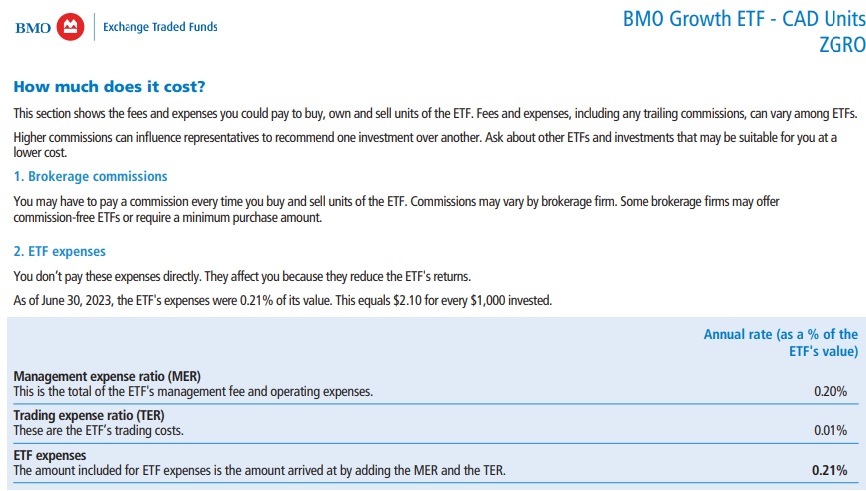
Every investment fund has a management fee. This is the cost a fund manager charges to manage the portfolio operationally (buy and sell securities, rebalance, etc). The Management Expense Ratio (MER) is the bottom-line cost to the investor. It includes any taxes charged to the fund, as well as any added fees (such as leverage). An investor can look up the management fee and MER within the Fund Facts and ETF Facts of their funds. These are regulatory documents that can be found for every fund issued in Canada. Some asset managers advertise very low management fees but have higher, less advertised, MERs, so investors should always do their due diligence on the total fund cost to fully understand the bottom-line payment that they are making every year.
The MER is subtracted from daily returns. Therefore, it has a direct impact on the total return of the fund. And as investors we know that overtime, our total returns help build our overall wealth. Therefore, the lower the fee on the investment, the more money there will be for the investor at the end of their investment period.
Comparing Fees
Once investors are aware of the fees they are paying for their investment products, they have the ability to “shop around” to see if there are any products that may be a better fit in their portfolios or which offer lower fees. When comparing fees it’s important to understand what you’re getting for in return for what you’re paying for. Broad market index funds generally have the lowest fees in the market. For example the BMO S&P 500 Index ETF (ZSP) has an MER of 0.09%. Index funds tend to have the lowest fees because operationally they are easier to manage. A Portfolio Manager will go out and buy the stocks within a particular index, and rebalance when needed.1 Continue Reading…

By Kevin Fettig
A recent report by Ontario’s Municipal Property Assessment Corporation (MPAC) highlights the scarcity of homes under $500,000 in Ontario.
In 2013, 74% of residential properties had a value below this threshold. Today, just 19% of homes are valued below $500,000. While this situation varies from province to province, it highlights the significant challenges faced by first-time home buyers who find the first rung of the property ladder is nearly unreachable.
Most urban centers would benefit by encouraging lower cost paths to home ownership. One avenue for this is building properties on leased land. In certain areas of Vancouver, we already see this practice, often on First Nations or university-owned lands. Leased land provides two primary paths to homeownership: one involves placing mobile or manufactured housing on the leased property, while the other entails constructing permanent homes on the leased land.
More than 50 years ago, manufactured housing made up as much as 6% of Canadian housing completions. Today, it represents less than 1%. In the U.S., supporting the availability of manufactured housing is a key component of the administration’s effort to ease the burden of housing costs. Most of these initiatives focus on improving mortgage financing for these homes through housing finance agencies Fannie Mae and Freddie Mac. Currently, Americans must rely on personal property financing (chattel lending) rather than conventional mortgages.
CMHC launched Chattel Loan program in 1988
In Canada, we’ve had a mortgage insurance product for these loan types for some time. The Chattel Loan Insurance Program (CLIP) was first launched by CMHC in 1988 as a 5-year pilot program. However, CMHC has never actively promoted the program, leading to a lack of awareness among lenders. Moreover, consumer preference for traditional stick-built housing and resistance from local communities to mobile home park developments have further hindered the adoption of the program.
Although the eligible amortization period can extend up to 25 years, some provinces have not allowed longer-term leases, making it challenging to finance structures on leased land, whether stick-built or manufactured. Even with an insured mortgage product, securing financing for manufactured homes can be difficult. Financial institutions often lack understanding of these structures, and the constraints on amortization period restrict the type of homebuyer. Consequently, the market has primarily targeted retirees seeking to downsize from larger family homes to smaller units. However, with appropriate financing options, these properties could also appeal to first-time buyers.
Building permanent homes on leased land is a second avenue to reducing home-ownership costs. Leased land communities are typically located close to small urban centres. The design ranges from townhouses to single family dwellings, and from traditionally built to manufactured. There are some larger institutional groups in this sector, including Parkbridge, a leading Canadian developer and operator of 106 residential and recreational communities across the country. CAPREIT, a Canadian real estate investment trust, also manages leased land communities but is not a developer. Continue Reading…

By Dan Coconate
Special to Financial Independence Hub
Retirement is a significant life event that requires thorough financial preparedness. If you’re striving to ensure that your golden years are your best, this guide will take you through the essential steps of securing your financial future. Read on to learn how to prepare for retirement financially.
Understanding Retirement Planning
Retirement planning is more than just a single event; it’s a dynamic process that requires fluidity and adjustment. You must make significant financial decisions with respect to when you intend to retire, how you will live post-retirement, and what you hope to leave behind. The key to successful retirement planning is to start early, understand the landscape of retirement, and make informed investments and savings decisions.
Calculating Retirement Needs
It’s important to calculate just how much you will need in retirement to live comfortably and handle unexpected expenses. This involves a careful consideration of your current income, your essential and discretionary expenses, and the inflation’s impact. One of the most challenging aspects is predicting how these factors will evolve over the years.
Saving and Investment Strategies
Saving for retirement is a marathon, not a sprint, and the most effective way to prepare is through a combination of savings and investments. Retirement accounts like 401(k)s and IRAs offer tax advantages [in the U.S., or Defined Contribution plans and RRSPs in Canada.] Diversification is a crucial strategy to manage risk and increase the likelihood of a healthy return on investment.
Debt Management
Debt is a heavy financial weight, especially in retirement. One of the healthiest steps toward financial freedom during retirement is to clear as much debt as possible. Entering retirement with less or no debt is like starting a new chapter of your life with a clean slate. It’s essential to ask questions with your registered investment advisor about how to clear debt and structure your finances for these goals.
Income Sources in Retirement
Multiple streams of income make the difference between just getting by and living comfortably in retirement. Social security and pensions are a part of this picture, but a personal investment portfolio and other assets can significantly enhance your income. Maximizing these resources to get the most out of them is a testament to solid financial planning and execution. Continue Reading…

Recently a friend asked, “Pat, I see that several prominent Canadian investor advisors recently wrote articles that said it’s a bad time to buy bonds right now. Do you agree?”
He was surprised when I told him I haven’t bought any bonds for myself since the 1990s. I haven’t bought any for our Portfolio Management clients in the last couple of decades, except on client request.
In the 1990s, I used to buy “strip bonds” for myself and my clients, as RRSP investments. This was the Golden Age of bond investing. Back then, high-quality bonds yielded almost as much, pre-tax, as the historical returns on stocks. In addition, they were more stable than stocks and provided fixed income that simplified financial planning.
Bonds have tax disadvantages, of course. But you can neutralize those disadvantages by holding your bonds in RRSPs and other registered plans.
The big difference back then was that bond yields and interest rates were much higher than usual. That’s because we were still coming out of (or “cleaning up after,” you might say) the inflationary bulge of the 1970s and 1980s.
In the 1980s, government policies pushed up interest rates and took other measures to hobble inflation, and it worked. But interest rates stayed high for a long time after the government policies broke the back of inflation: kind of like finishing the antibiotic prescription after the infection goes away.
Long-time readers know my general view on the stocks-versus-bonds dilemma. When interest rates are as low as they have been in recent decades, high-quality stocks on the whole are vastly superior to bonds. However, you have to understand the differences between the two. For one thing, stocks are more volatile than bonds. But volatility and safety are two different things.
Volatility refers to sharp price fluctuations, often due to short-term uncertainty and the randomness of short-term market movements. Safety refers to the risk of permanent loss.
You might say that what you get from bonds is the opposite of what you get from the stock market.
Inflation near-automatically reduces the purchasing power of bonds. Inflation can also hurt the returns you make in the stock market, of course. However, companies you invest in can take steps to cut the costs of inflation. They can pass on cost increases to their customers. They can introduce new processes and equipment to improve productivity and cut their costs. Continue Reading…
 Posted By