General

Money, health, and family top worries in COVID-influenced RRSP season

By Scarlett Swain

Special to the Financial Independence Hub

As Canadians turn their attention to their investments during this COVID-influenced RRSP season, an annual online study conducted for Questrade by Leger (www.leger360.com) last month unveiled some compelling findings regarding trends and changes Canadians are likely to make when investing.

As part of our ongoing commitment to improving the financial security of Canadians, we set out to learn about what issues are currently top of mind, how they might impact investing, and what we can do to help investors on their journey to financial security. To no surprise, most respondents chose money, health, and family as their top three worries. We also saw some interesting behavioural trends to note.

Despite the pandemic, our research showed that Canadians continue to be very committed to making contributions to their retirement savings, while evidence suggests investors are placing importance on ensuring their investments go farther.

Most will contribute as much or more this year

A majority (69%) of respondents with an existing RRSP plan to contribute the same amount as last year (or more) to their RRSP this year, showing an unwavering commitment to their retirement. The number is even higher amongst those with a TFSA, with 85% planning to contribute more or the same amount to their TFSA. Half (50%) said given the impact and uncertainty during this pandemic, they are more likely to invest for the long term or for retirement, while 44% are actively seeking lower fee options this year, and 39% are investing more this year to get better returns. Continue Reading…

Retiring at 50: How achievable is it?

By Emily Roberts

For the Financial Independence Hub

Most of us dream about and count down the days until our retirement, picturing ourselves at the beach, enjoying a cocktail while laughing about the days we spent slogging away at the office. These thoughts can be what get some of us through the workday, and even if you love your job and could never picture doing anything else, retirement is still the end goal for all of us so that we can enjoy our later years in peace and tranquillity.

Yet some of us go one step further and think about early retirement. While this may seem like an unachievable dream for many, it can in fact become a reality if executed properly. Retiring at 50 isn’t impossible, but it isn’t easy, either. Typically, people will retire between 65 and 67. This can seem like an age if you dislike your job or simply wish to slow down.

If you are wondering how you could retire early but also the benefits of retiring all together, read the following guide. Not only will it explain the advantages of retirement, but it will also list of the best ways to increase your chances of an early retirement as well as the signs that you may not be ready to retire just yet.

Good reasons to retire

There are many good reasons to retire. For starters, you may be unable to complete your typical day-to-day duties at work as you age. This is especially true for those who work in a physically demanding role such as construction or mining. Your body will be unable to keep up with this labour-intensive work and you are more prone to injuries.

However, retirement is a time for you to slow down and enjoy life. Rather than worrying about getting up and making it to the office in time, you can live your life at your own leisurely pace. While this may seem odd at first, the time you usually spend at work is now yours to do with it as you wish. If you’ve always wanted to focus on your art, then retirement can be the perfect time for you to focus on this hobby and passion of yours. Furthermore, if you have a family, retirement can provide you with the free time to focus on reconnecting with your family (and friends!) and make long-lasting memories with them. This is especially valuable for those who have grandchildren.

Other benefits of retiring include being able to look after your mental and physical well-being. Having a career and being so focused on your job can cause you to forget about what is important: your health. We neglect healthy, balanced meals with those that are quick and typically full of saturated fats. We also lose track of time or are simply too tired to head to the gym even though working out consistently is essential. What’s more, some of us simply need to focus on our mental health more than others and heading to work and working specific hours can be harmful to our mental well-being.

Why Early Retirement can be beneficial

There are numerous benefits associated with retirement; however, there are even more linked to early retirement. For instance, when you retire early, you are able to focus on yourself and the hobbies you have longed to invest time in but was never able to before. With the free time and extra drive you have to spend on your hobbies, you could even consider turning your hobbies into a means of making extra money. For example, if you love to paint or draw, then you could always sell your artwork either online and through a website such as Etsy, or you can make a day of it and sell your work at a local market or yard sale. While you will want to have the mindset of this being a hobby that could potentially bring in some income, this can be a great way to bring you purpose while you’re retired. Continue Reading…

The ideal Stock

By Ian Duncan MacDonald

Special to the Financial Independence

The “good” dividends of financially strong companies provide a reliable income and increase the odds for an ever-rising share price.

There are 14,982 corporations in North America with common shares for purchase. For a strong, diversified portfolio you need only find 20 corporations whose shares come closest to matching the following “ideal criteria.”

(1) A stock price greater than $100
(2) A stock price that was greater than $100 four years ago
(3) A stock price that is now 99.50% greater than it was 4 years ago
(4) A stock with a book value greater than $100
(5) A current stock price greater than 49.5% of the book value
(6) Five or more analysts rating the stock a “buy”
(7) Five or more analysts rating the stock a “strong buy”
(8) A dividend yield percent between 7.50% and 10.49%.
(9) An operating margin greater than 79.50%
(10) An average daily volume of shares traded greater than 2,000,000
(11) A stock’s price-to-earnings ratio between 0.1x to 5.49x

In 20 years of reviewing thousands of stocks I have never found a stock that met all eleven criteria. Therefore, since the ideal stock does not exist it means you must sort through those 14,982 stocks to find those 20 that come closest to matching the 11 criteria.

To help identify the best dividend stocks, I score stocks using the above 11 criteria (my background was in commercial risk systems with Dun & Bradstreet, Equifax, etc). When the 11 scores are added they have the potential to reach a total of 100. After scoring thousands of stocks the highest score I have ever calculated is 78; the lowest score is 8. I avoid buying stocks scoring under 50.

Why dividends are important in Value investing

The best portfolio candidates emerge when you sort, by descending score, all 628 U.S. common stocks traded on the NYSE and the NASDAQ paying a dividend of 6 % or greater and all 199 Canadian common stocks paying a dividend of 3.5% or greater on the TSX. A scoring system objectively, mathematically applies a derived number to a stock. This number identifies those dividend stocks that will provide the most reliable, generous dividend income with the potential for substantial future share price gain. Continue Reading…

Invest in Innovation, a driver of Wealth Creation

By Matthew J. Moberg, CPA

Franklin Equity Group (Sponsor Content)

Innovation is where wealth creation occurs. Innovation is a powerful growth engine across the global economy, and it is accelerating, in part because of the COVID-19 pandemic.

Yet innovative companies are often misunderstood and, as a result, their stocks are often mispriced. For example, Amazon.com Inc. is a prominent company that is covered widely (and held by Franklin Innovation Fund), and its stock has long been considered very expensive. Even though it is consistently viewed as expensive, Amazon’s stock has been among the best performers for investors for years, indicating to us a general misunderstanding of valuation by the market, which may seem counterintuitive for a company so well known.

Innovative companies are commonly mispriced as market participants often underestimate the duration of growth these companies can provide. Rather than seeing profits competed away in short order, many of these companies grow and generate excess profits for seven, 10 and 15 years, some even longer. Their pace of growth may also be underestimated, which affects valuations as well.

The Franklin Innovation strategy invests in growth, but the portfolio team thinks like value investors as they look for companies they believe are misunderstood and undervalued – which can lead to outperformance. Our new Franklin Innovation Fund and Franklin Innovation Active ETF (TSX: FINO) are driven by  a time-tested philosophy that innovation can be found everywhere, and that innovation ultimately drives the creation of wealth over the long term.

Key platforms of innovation

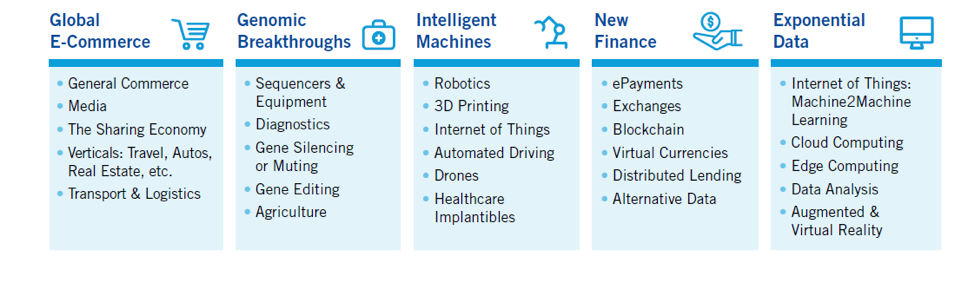
Our Franklin innovation strategy has been investing in innovation for more than 50 years, and over that time we have seen myriad technological and other advances. Our team is constantly reading and researching about what the future might hold and how these advances might develop.  As we look at our strategy today, we have identified five major platforms where innovation is creating investment opportunities across sectors, industries, markets and geographies:

Key Innovation Platforms
Global E-commerce

One of the major trends of the COVID-19 economy has been consumers shifting to e-commerce, accelerating a migration away from brick-and-mortar retailers that was already established. Estimates show that global sales in e-commerce stood at 14% in the summer of 2019;1 by May of 2020, this number had risen to somewhere between 22% and 25%.2 We also see significant opportunities in industries such as fashion, automobiles, travel, ride sharing and restaurant delivery. Other firms to consider are digital payment companies and software developers that will enable brick-and-mortar companies to have an online presence.

Genomic Breakthroughs

The amazing progress in the field of genetics is probably less well known. The cost of gene sequencing — or mapping DNA for diagnostic and curative purposes — has fallen significantly in recent years, which opens the door for further development of diagnostics and therapeutics. We are particularly interested in companies that are focused on diagnostics, gene editing and gene silencing, but opportunities with genetics may extend into agriculture and even artificial intelligence.

Intelligent Machines

Once considered the domain of science fiction, artificial intelligence and machine learning now permeate every layer of product development. The future of production will include products designed specifically for the needs of the individual customer, where efficiencies created in the design and manufacturing process, employing massive amounts of data, will enable that level customization.

New Finance

We believe access to capital is one of the fundamental differences between developed and developing countries. There are three vectors that drive access to capital: what constitutes money, efficient pricing, and methods of exchange. Bitcoin is the latest addition to what constitutes money, while data is increasingly being used to price risk, allowing for a more efficient allocation of capital. Methods of exchange are also evolving through mobile payments and digital wallets.

Exponential Data

Data underpins virtually all our investment themes. Continue Reading…

RRSP holdings on the rise even as investor knowledge about them falls

A seemingly contradictory finding about RRSP trends was uncovered by BMO Financial Group’s latest  (its 11th) annual RRSP survey, released Wednesday. While the average RRSP balance rose to $112,295 — up 3.3% over $111,929 in 2019 and 41% more than $79,492 in 2015 — at the same time Canadians’ knowledge of the benefits and features of RRSPs has fallen since 2015. And women are 18% less likely to know how much they’ll need to retire.

This comes after a pandemic year in which 12% did not contribute at all, resulting in a a 15.5% decrease in overall contribution amounts since 2019; even so contribution amounts for this year are 15.8% higher than the survey found in 2018.

The BMO RRSP Survey was conducted by Pollara Strategic Insights via an online survey of 1,500 adult Canadians  between Nov. 17th and 23rd, 2020.

Robert Armstrong

In a press release, BMO Global Asset Management Director Robert Armstrong said investors need to consider long-term factors like increasing cost of living and longer average life expectancies when planning for retirement: “With these challenges in mind, it’s encouraging to see a national increase in RRSP holding amounts.”

What’s discouraging is that while most regard RRSPs as effective retirement planning vehicles, knowledge about them has steadily declined over the last five years:

  • 71% know how to contribute to an RRSP, an 8% decrease from 2015
  • 61% know the RRSP contribution limit, but the percentage who know this has fallen 12% since 2015. (The RRSP contribution limit for 2020 is $27,230, or 18% of investors’ annual income: whichever is less. Any unused contribution room from previous years is also carried forward.)
  • Only half are aware of what investments are eligible to be held in RRSPs, a 10% decrease from 2015 and only 44%  are aware that RRSPs can hold ETFs, while 79% know that RRSPs can hold mutual fund. (Holdings can include: mutual funds, cash, GICs, stocks, bonds and ETFs.)

Because of the inherent complexities of RRSPs, Armstrong suggests professional advice is valuable to help investors meet their long-term financial goals.

Gender gap

 The study also found a gender gap in retirement planning and RRSP knowledge:

  • Among those surveyed, women are 9%  less likely to know how to contribute to an RRSP and 10%  less likely to know the difference between RRSPs and TFSAs compared to men
  • Only 62% of women know the RRSP contribution deadline (the deadline for this year is March 1, 2021) and 55% know how much they can contribute to the account, compared to 70% and 67% of men, respectively
  • Only 41% of women know which investments can be held within an RRSP
  • Women are 18% less confident than men in their retirement plans, and 18% less likely to know how much money they will need for retirement
  • Women were more likely than men not to be contributing to their RRSPs this year because of pandemic-related reasons (15% versus 9%)
  • Women are less likely to have withdrawn funds from their RRSPs before the age of 71, with 25% having done so compared to 31% of men

BMO has several programs aimed at helping women build their investing confidence:

  • BMOforWomen.com is regularly updated with content to help inspire financial confidence
  • The podcast Bold(h)er podcast features inspiring stories of women making bold moves in their careers and businesses
  • BMO investment professionals provided access to online training to promote and engage women investors and business owners in tailored, goals-based conversations

For personalized advice on meeting financial goals in general, see www.bmo.com/myplan. For RRSP information in particular, visit www.bmo.com/rrsp/.