General

Why I haven’t paid off my mortgage … yet

Followers of this blog know that I tend to focus on saving and investing rather than trying to pay off my mortgage faster. Indeed, our household assets are projected to exceed $1 million this year but we’ve still got a $200,000 mortgage to contend with.

So why don’t I make it a priority to pay off my mortgage? It’s not strictly about dollars and cents. Here are three reasons:

1.) Higher Priorities

Setting priorities is part of any good financial plan, and those priorities change as you move through different stages of life.

For many years we put all our effort into paying off student loan and consumer debt. Then we became laser-focused on saving for a large house down-payment. Priorities shifted again towards maxing out my unused RRSP contribution room. And now, finally, we’re catching up on years of unused TFSA contribution room.

My wife and I are on the same page with our financial priorities. Right now, we’re focused on these four areas:

  • TFSA – contribute $1,000/month
  • RRSP – max out our available contribution room
  • RESP – max out contributions for our two kids
  • Travel – Visit Scotland/Ireland this summer. Vancouver in October. Maui in February.

Paying off the mortgage slides in at priority number five, which leads to the second reason.

2.) Finite Resources

In a perfect world we would all max out our RRSPs, TFSAs, RESPs, and start investing in a taxable account: all while doubling up on our mortgage payments and still having money left over for dining, travel, and sending the kids to hockey school.

Reality check. We don’t have infinite resources, so we need to make choices and trade-offs.

I mentioned above that we neglected our TFSAs for many years. That’s because we decided to get a new car and pay it off over four years. Our TFSA contributions turned into monthly car payments.

Now that the car is paid off, we can go back to funding our TFSAs and hopefully catch up on all that unused room before we need a new car again.

Speaking of cars, ours are now 12 and six years old. This “sacrifice” – if you can call not getting a new car every 4-5 years a sacrifice – allows us to increase our savings rate and fund more of our financial priorities each year.

Unfortunately, there isn’t another $800/month money leak in our budget to close that will allow us to fund a fifth financial priority (extra mortgage payments). Not yet, anyway.

And remember, it’s not simply about earning more money. I’m already combatting stagnant wage growth and creating my own raise by freelancing, selling used items online, and earning credit card rewards. That extra income allows us to do everything we’re doing now, plus keep pace with inflation and feed a growing family.

3.) Mortgage debt and asset allocation

We tend to think of mortgages and investments in isolation, but if an investor has any debt at all – including a mortgage – then he or she is effectively borrowing to invest.

You could say that I have a leveraged investment loan of $200,000. Another way to think about the mortgage is that I am short fixed income. Continue Reading…

5 pro tips staying on budget when using Credit Cards abroad

By Maria Weyman, creditcardGenius

Special to the Financial Independence Hub

When organizing a trip, it makes sense to plan ahead for some extra spending to make the most of the experience.

Even the most frugal penny pinchers will want some extra cash to throw around while on vacation for maximum relaxation and culture absorption.

But, if you’re using your trusty credit card to earn some rewards on those purchases along the way, there may be something you’ve overlooked – foreign transaction fees – the peskiest of all credit-card fees coming in hot to totally ruin your budget.

How foreign exchange fees work

Foreign transaction fees will show up on your credit-card statement when you make a purchase with your Canadian credit card in a currency that isn’t Canadian dollars, either when travelling abroad or shopping online. You’re charged this fee in order to convert your funds to the required currency.

There are often 2 parts to this fee:

  • what gets charged by the credit card issuer (Visa, Mastercard, American Express), and
  • what gets charged by the issuing bank (BMO, TD, etc.)

So, not only are you losing out on the currency exchange (depending on the currency), but you’re also charged an additional fee on top of that.

The average cost of foreign exchange fees

In Canada, most foreign exchange fees are 2.5% of your total purchase, but can range from 2% all the way up to 3.5% : yikes.

Let’s crunch some numbers with some examples.

Say you’re road tripping to the U.S. and use your Canadian credit card to buy a $5 USD latte from Starbucks.

At the time of writing, 1 USD is equal to 1.34 CAD.

( $5 * 1.34 ) * 2.5%

$6.70 * 2.5% = $0.17

Ok, not unreasonable. But, the more you spend, the more it adds up…

Say you travel to Ireland and use your credit card to pay for hotel stays, dining, shopping, and sight-seeing for a week, totalling $5,000 in purchases.

At the time of writing, 1 Euro is equal to 1.51 CAD.

( $5,000 * 1.51 ) * 2.5%

$7,550 * 2.5% = $188.75

$188.75 is not as easily overlooked as $0.17 more for a coffee …

And though it may not seem like much, $200 is still a significant amount of money to figuratively throw in the trash bin if you’re travelling on a budget.

How to save money and avoid FX fees

With that being said, is there any way to escape the dreaded 2.5%?

Here are our top tips on saving money next time you’re adventuring overseas or shopping in a foreign currency: Continue Reading…

Think you’re not speculating in Cannabis? Check your Index Tracker

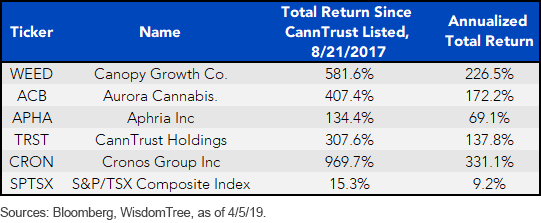
Figure 1: Cannabis Stock returns

By Jeffrey Weniger, WisdomTree Investments

Special to the Financial Independence Hub

Live by market capitalization-weighting, die by market-capitalization weighting.

If you own a broad-based Canadian beta tracker, chances are you own upwards of five marijuana stocks.

Canopy Growth, the largest player in TSX-listed cannabis companies, is up 78-fold since July 2010. Aurora Cannabis, the other major player, has “only” been a 24-bagger since 2007. But if you really want to cherry pick, from that company’s bottom when it was a penny stock in 2013, it is up 49,180%. Sure, no speculation there.

You might be accidentally playing this mania without even knowing it. The S&P/TSX Capped Composite Index also has Aphria, CannTrust and Cronos Group sprinkled in. Granted, we’re only talking about 1.5% of total capital in the industry, but this group is so volatile that it punches well above its weight. What if the dot-com-ness of figure 1 gets flipped on its head?

J.P. Morgan analyzed 13,000 companies that were members of the Russell 3000 Index from 1980 to 2014 and found that 40% experienced a “catastrophic” loss. That means a decline of 70% or more in the price of a stock from its peak, after which there was little recovery such that the eventual loss from the peak was 60% or more.

What are your prime candidates for catastrophic loss? The Big Five banks? The rails? How about some companies that came out of nowhere, in a brand-new industry, owned by your not-around-during-dot-com next-door neighbour?

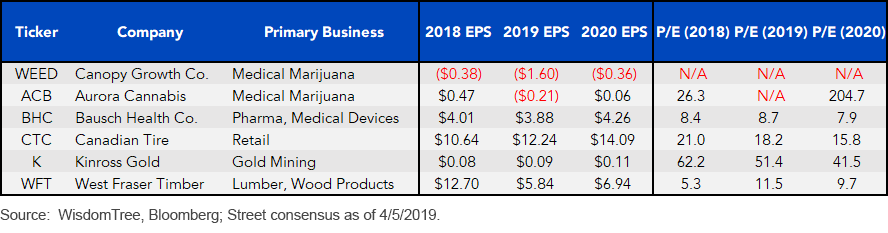
Think about catastrophic loss as you consider the outlook for the two biggies, Canopy and Aurora, in figure 2. I added the only other large Canadian health care firm (Bausch, the former Valeant), along with a few completely unrelated companies for some context.

Figure 2: Earnings per Share & P/E


The cannabis bulls will tell you that earnings in the coming years is not the proper valuation measure. But who among us knows what the marijuana world will look like down the road? I’m hard-pressed to see how Molson Coors, PepsiCo, Merck, British American Tobacco, or any of a dozen other giants will not try to get their hands on the pile of money that is supposedly sitting on the table. Continue Reading…

Retirement #2 priority but four in ten Americans don’t see it happening

Retirement is a close second to home ownership, according to a LendEDU survey of American saving priorities

While having enough money saved for Retirement is narrowly behind buying a home, more than a third of Americans don’t expect they’ll ever be able to retire, according to a survey released Tuesday from LendEDU.com.

Retirement saving was cited by 19% of 1,000 respondents, versus 20% prioritizing “buying my own house or apartment.” Paying off credit-card debt was cited by 14% and building an emergency fund by 10%.

While there was only a minor lack of confidence about paying off credit cards and building an emergency fund, 17% don’t believe they’ll ever become homeowners and but almost four in ten Americas (39%) don’t believe they’ll ever be able retire.

Of those doubting their ability to retire, 52% were over age 54, 30% were between 45 and 54, and 15% were 35 to 44.

As for emergency savings, 33% said a major bill resulting from an injury would destroy their savings and therefore their long-term financial goals; another 14% cited some form of debt that could quickly get out of hand. However, 28% felt “relatively secure” and did not believe their financial goals could be derailed.

Secondary priorities

After home ownership and retirement, the most cited financial priorities were some form of getting out of debt: 14% cited paying off credit-card debt, 7% paying off student-loan debt, and 4% cited paying off other forms of debt apart from credit cards or student loans. 6% answered “Building my credit score,” 5% wanted enough saved to move out of their parents’ homes and rent a home or apartment, 4% said “Buying a car,” and 3% wanted to start a business.

1% wanted to invest in real estate, another 1% wanted to buy a second home and yet another 1% wanted to buy a second or third car. 3% want to “create a retirement account” and 2% want to “invest in the market outside my retirement account.”

Money a bigger priority than Love?

Of the 37% who were not currently in a long-term relationship, 72% were more focused on their financial targets, versus a minority 23% who prioritized finding a romantic partner. (The rest preferred not to say). The survey sees this as a “glass half full” finding: “It is good that Americans are quite serious when it comes to realizing their personal finance goals. But, on the glass empty side, sometimes one’s finances can’t buy happiness, or in this case love, and it is always important to understand what is truly important in life.” Continue Reading…

If you must speculate in penny stocks, find those with these common characteristics

Penny stocks do sometimes pay off, but there are many pitfalls to avoid. As you’ve heard us say often, a lot of penny stocks are little more than very well executed marketing campaigns.

Take a look at the penny stocks in your portfolio. If you’re a penny stock investor you likely have a number of them. The top 10 penny stocks in your portfolio should follow these guidelines:

Tips for analyzing your top 10 penny stocks

  • Look for strong management: Look for an experienced management team with a proven ability to develop and finance a mine, product or service.
  • Look for a strong balance sheet: High-quality penny stocks should have strong balance sheets with low debt. It’s even better if they have a major financing partner.
  • Look for well-financed companies: To profit in penny stocks, you should look for well-financed companies with no immediate need to sell shares at low prices, since that would dilute existing investors’ interests.
  • Look past the hype: Avoid stocks that are trading at unsustainably high prices as a result of broker hype or investor mania.
  • Look for stocks trading on a well-regulated exchange: We think you should avoid stocks trading “over-the-counter”, where such things as regulatory reporting are lax. Stick to penny stocks trading on regulated exchanges like the Toronto and New York stock exchanges.
  • Look for a results-focused company: Automatically rule out investing in companies that promote themselves too aggressively, or do so misleadingly. Success is more likely if the managers focus on developing a saleable product or service, rather than hyping their story.
  • Look for reasonable share prices: Compare the market caps (the total dollar value of all of a company’s outstanding shares) of the stocks with the estimated value of their assets or future earnings streams. Only a few penny stocks will successfully launch a product with enough success to justify the current share price and avoid collapse.

Your top 10 penny stocks will not be marketing ploys

Many penny stocks are little more than very well executed marketing campaigns. Your top 10 penny stocks won’t fall into this category. Many penny stock promoters will do anything in their power to get their penny stock noticed. These extensive marketing campaigns include emails, TV interviews, podcasts, newsletters and paid sponsorships.

There are also some so-called news sites that will sell sponsorships to penny stock promoters. These are great opportunities for penny stock promoters but bad for investors looking for an unbiased opinion on a stock. Continue Reading…