General

The Investing Year in Review: 2018 was not Financial Armageddon

By Dale Roberts

Special to the Financial Independence Hub

cramerpic
Mad Money with Jim Cramer – Wikipedia

Everybody relax. Chill out, or you can Chillax. Is that a word that is still in use?

For all of the noise and hysteria, 2018 was not all that bad a year for Canadian and U.S. investors. But if you listened to the financial press and were unfortunate enough to watch too much BNN or perhaps the more frenetic and desperate U.S’ investment shows that look more like a Football halftime show, you might think the world had ended for  Investorkind.

Seriously, turn this stuff OFF. Unless you’re able to watch and laugh, then carry on. As I like to write, all of this financial and investment fluffery is for entertainment purposes only

2018 was not that bad: all normal and expected market behaviour

When I looked at my accounts at the end of 2018, I saw that my personal RSP account was down just slightly at about 3%. My wife’s personal RSP and spousal RSP accounts were both positive to the tune of about 2-3%.

Hardly Armageddon.

Here’s one of my wife’s accounts. It’s a one-year chart so it shows the slow start to 2019. The purple line is my wife’s account (that I manage), the dotted blue line is the Canadian stock market – the TSX composite.

joan's account

That does not look like panic time. More like snooze time with not much going on.

The account uses the basic building blocks also largely followed by the Canadian Robo Advisors,and mostly by those who create a well-balanced ETF portfolio. You can find some basic models on my ETF Model Portfolio page.

AssetAllocationSnip

For my wife’s accounts, and for all of our accounts, I use Canadian stocks, U.S. stocks and Canadian bonds. I mostly do not use International stocks. Core indexers might say that is a ‘mistake’, you might be best served to stick to the script. I will certainly be back with articles on International Diversification for Canadian investors.

Not including international stocks added a slight boost to our portfolios in 2018.

International Developed Markets (iShares XEF) was down 6.6%.

US Total Markets (iShares XUU) delivered a positive 2.9%in 2018 thanks to the strong US Dollar. Canadian investors see that currency boost.

The Canadian Market (iShares XIU) was down 7.7%.

The Canadian Bond Market (iShares XBB) was up 1.3%.

Put it all together in a Balanced Portfolio 

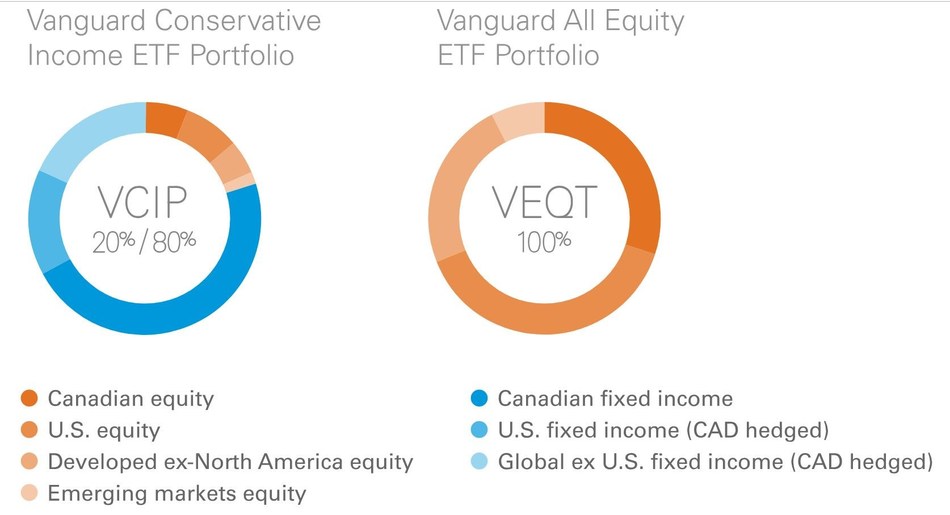
We can see that two of the assets were in positive territory, two of the assets were in negative territory. Typically your asset mix will largely determine your returns. A good benchmark is the new Vanguard all-in, one-ticket portfolio solutions. For more on those wonderful funds please have a read of Jonathan Chevreau’s  Continue Reading…

Safer investments for Retirees: How to retire with less stress


Retirement planning is becoming more difficult for Canadians because they’re living longer and need larger retirement nest eggs. This often manifests itself in “pre-retirement financial stress syndrome.” That’s the malady that strikes when it dawns on you that you may not have enough money saved to be able to earn the retirement income stream you were banking on.

To alleviate this worry, we recommend Successful Investors base their retirement planning on a sound financial plan. Here are the four key variables that your plan should address to ensure you have sufficient retirement income:

  1. How much you expect to save prior to retirement;
  2. The return you expect on your savings;
  3. How much of that return you’ll have left after taxes;
  4. How much retirement income you’ll need once you’ve left the workforce.

Note, though, that if you’re heading into retirement and are short of money, you should move your investing in the direction of safer, more conservative investments. That’s a far better option than taking one last gamble.

Moving into “too safe” investments for retirees can sharply cut your long-term returns

This applies as well to “risk-reducing strategies,” of which there are many. One of the most common is the urge to “go into cash” (also known as “taking money off the table”) when you foresee a market downturn. Like all risk-reducing strategies, this one can seemingly work from time to time, by getting you out of the market before a drop. But it’s even more effective at ensuring that you are out of the market when prices are shooting upward.

In the stock market, downturns do come along from time to time. But they are far less common than fears of downturns, which are virtually non-stop.

Safer investments for retirees: How to use RRSPs and RRIFs to add to your long-term investing success

RRSPs (Registered Retirement Savings Plans) are a great way for Successful Investors to cut their tax bills and maximize returns of their retirement investing.

RRSPs are a form of tax-deferred savings plan. RRSP contributions are tax deductible, and the investments grow tax-free. (Note that you can currently contribute up to 18% of your earned income from the previous year. March 1 is the last day you can contribute to an RRSP and deduct your contribution from your previous year’s income.)

When you later begin withdrawing the funds from your RRSP, they are taxed as ordinary income.

If you want to pay less tax on dividends, interest and capital gains while you’re still working, investing in an RRSP is the way to go.

Converting your RRSP to a RRIF is clearly one of the best of three alternatives at age 71. That’s because RRIFs offer more flexibility and tax savings than annuities (see the pros and cons of annuities at TSI Network) or a lump-sum withdrawal (which in most cases is a poor retirement investing option, since you’ll be taxed on the entire amount in that year as ordinary income).

Like an RRSP, a RRIF can hold a range of investments. You don’t need to sell your RRSP holdings when you convert—you just transfer them to your RRIF.

Safer investments for retirees should assume conservative yield estimates to account for unforeseen setbacks

As for the return you expect from investing for retirement, it’s best to aim low. If you invest in bonds, assume you will earn the current yield; don’t assume there will be increases in the value of the bonds.

Over long periods, the total return on a well-diversified portfolio of high-quality stocks runs to as much as 10%, or around 7.5% after inflation. Aim lower in your retirement planning — 5% a year, say— to allow for unforeseeable problems and setbacks.

Above all, it’s important to remember that while finances are important, the happiest retirees are those who stay busy. You can do that with travel, golf or sailing. But volunteering, or working part-time at something you enjoy, can work just as well.

One thing we encourage all Successful Investors to do is perform a detailed study of how you spend your money now. Then, you analyze your findings to see what personal expenses you can cut or eliminate. This too can have fringe benefits, especially if it helps you break unhealthy habits. You may be surprised at how much you’re spending and how much more you could be saving for retirement.

Do you believe in safer investments? What do you consider a type of safe investment?

What kind of investments do you have in place as part of your retirement plan?

Pat McKeough has been one of Canada’s most respected investment advisors for over three decades. He is the founder and senior editor of TSI Network and the founder of Successful Investor Wealth Management. He is also the author of several acclaimed investment books. This article was last published on Sept. 18,  2018 and is republished on the Hub with permission.  

Stop giving Markets your attention

When I got an activity tracker several years ago I was horrified to learn just how sedentary my lifestyle had become. I’d drive to work, park my butt at a desk for eight hours, drive home, park my butt on the couch for a few more hours, and go to bed. It was mindless laziness.

I fit right in with the average North American, who walks an average of 3,000 to 4,000 steps per day.

Steps to improve my steps

My activity tracker suggested a goal of 10,000 steps per day. I was motivated by the step counter and helpful nudges to get myself moving. I started parking in a free lot about 1 kilometre away from work, adding an extra 3,000 steps to my day (and saving $50 per month in parking fees!).

My new walking routine got me up to an average of 7,000 steps per day, but still not close to my goal. Then, following my wife’s lead, I got into running three to four times per week. The extra activity helped me reach my goal – not every day, but on average throughout the week. Funny enough, I still find motivation from my activity tracker as it nudges me to reach and surpass my daily move goals.

The hyper-attention and daily nudges helped me get my butt in gear and become a healthier person.

Curbing my Screen Time

Similarly, Apple sends iPhone users a new weekly report called Screen Time that shows how much time you spend on your phone. You’ll see which apps you use most often, how many times per day you pick up your phone, how many notifications you receive per day and from which application.

The report can be an eye opener if you’re into mindless scrolling through social networking sites like Facebook, Twitter, and Instagram. Twitter is the biggest attention sucker for me. Hey, it’s where I get my news!

I also get a lot of notifications and can conclude from the report that I receive about 30-40 emails per day from work. Not cool. Because of those notifications I tend to pick up my phone 65-70 times per day to either check my email, respond to a text, or check Twitter.

The week the Screen Time report first came out I spent six hours per day on my phone. I’ve got that down to less than four hours per day and try to design rules around curbing my screen time. That means turning off unnecessary notifications and keeping my phone in another room when I go to bed.

Again, these nudges had a positive effect on drawing my attention to a negative behaviour and making a conscious effort to curb it.

Negative Stock Market Attention

Back when I was a stock-picker I obsessively checked my portfolio, and read every market headline. I scoured the internet for news about my individual stock holdings and searched for analyst opinions (only the ones that confirmed my own opinion, of course).

But just like in the previous two examples, all this attention and information made me want to act. My oil stocks were getting killed and I wanted to get out. Sobeys made a mess of its Safeway acquisition and I wanted to get out. The general market would fall by 5-10 per cent and I felt like I needed to do something – like contribute more money than I had planned, or hold off on adding new money until things “settled down.”

Stock market plunge

Nudges worked against me. I’d get email alerts when Fortis or Great West Life missed their earnings targets. What should I do with this information?

The Globe and Mail app would send helpful push notifications like, “markets plunge on European/China/Russia fears,” or,“Dow posts worst day ever.” A smart investor is supposed to act on this, right? Shift their portfolio to safer assets? Buy gold?!?

Don’t just do something, stand there!

I switched to indexing four years ago with a simple two-ETF portfolio of global and domestic stocks. Now that I own thousands of companies I no longer pay attention to the fortunes of one or two. I find myself paying less attention to market headlines in general.

I make my monthly contributions automatic and only check my portfolio when the cash balance is large enough to make a trade. I figured instead of tinkering with my portfolio daily and reacting to news I’d be better off taking a two-decade nap and letting compounding do its thing.

I make my monthly contributions automatic and only check my portfolio when the cash balance is large enough to make a trade. I figured instead of tinkering with my portfolio daily and reacting to news I’d be better off taking a two-decade nap and letting compounding do its thing.

RelatedHow and when to rebalance your portfolio

Your long-term investing plan has no time for daily market noise. Yes, we may be entering a bear market. Or it’s just a run-of-the-mill market correction. Nobody knows for sure.

We do know that yesterday [late December] the Dow and S&P 500 had historic gains. If you happened to act on your fears and exit the market, thinking it was on its way to a 40-50 per cent meltdown, you missed out on that important rally. In fact, many of the largest one-day gains occur during down markets.

Final thoughts

Technology can help bring attention to a negative behaviour and turn it into a positive outcome. But those nudges and alerts can also work against you.

When it comes to investing often the best course of action is to do nothing and stick to your plan. Daily gyrations smooth out over a period of several months, and over several years the trajectory of the stock market tends to point up and to the right.

Many so-called experts question the value of robo-advisors during a downturn such as this, saying that investors would be better off with a human advisor. But from what I’ve heard during tumultuous times, the robos send helpful nudges via text and email explaining what is happening and why fluctuations in the market are part of a normal investing experience.

For investors that can be calming reassurance in the face of negative headlines screaming for your attention.

In addition to running the Boomer & Echo website, Robb Engen is a fee-only financial planner. This article originally ran on on Dec. 27, 2018 and is republished here with his permission.

Your first resolution: add $6,000 to your TFSA

Welcome to 2019! Now that it’s January you can contribute $6,000 to your Tax-free Savings Account (TFSA), a program that’s now been around a full decade. That means couples can between them contribute $12,000.

The previous annual maximum was $5,500, but because of Ottawa’s promised inflation “bump” it has now officially been adjusted to $6,000. Recall that it was originally $5,000 when the program was introduced back in January 2009. Hard to believe it’s been ten full years now!

As the chart below illustrates, the cumulative limit (shown on the far right column) is now $63,500, which means a couple can between them invest $127,000. The first inflation adjustment was in 2014, when the limit reached $5,500. Under the Harper Tories it actually was almost doubled to $10,000 for calendar 2015 but one of the first things the Trudeau Liberal administration did was to reverse it back to $5,500 in 2016. It’s been $5,500 for three years until the new $6,000 limit that’s now in place.

2009$5,000$5,000
2010$5,000$10,000
2011$5,000$15,000
2012$5,000$20,000
2013$5,500$25,500
2014$5,500$31,000
2015$10,000$41,000
2016$5,500$46,500
2017$5,500$52,000
2018$5,500$57,500
2019$6,000$63,500

In the early years of the program, it might have been tempting to dismiss the original $5,000 as being an “insignificant” amount but obviously $63,500 is a hefty amount and anyone who has been contributing the maximum from the get-go should with tax-free growth have considerably more than that by now: I often hear from readers who have more than $100,000 in them, although December’s brutal stock market action is likely to have set them back a bit.

Maximize the time value of money

Why contribute the new $6,000 right now? I view this as a “time value of money” exercise and you may as well maximize the compounding effect of tax-free growth, assuming you are focusing on equities. Except for profoundly conservative investors, I’d recommend that Millennials and Generation X members use the TFSA primarily for Growth (equities or stocks, or equity ETFs). Baby boomers at or near Retirement could use Balanced Funds or ETFs (like VBAL from Vanguard, which is 60% stocks to 40% bonds, spread around thousands of securities around the world.) That’s likely the one we’ll use ourselves this week: we put the money into our discount brokerages on January 1st, but will actually invest it before the week is out, once markets are open.

Keep in mind that you can keep adding to your TFSA well into old age: I know a lady who is more than 100 years old who continues to do just that! That’s a lot of potential growth, which is why a balanced product may make sense. Of course, those who value interest income and wish to eschew stock-market risk can also use bond ETFs or GICs in their TFSAs: these days even 2-year GICs can be found that pay 3% or more.

Happy new year!

Here’s what home buyers can expect in 2019

By Penelope Graham, Zoocasa

Special to the Financial Independence Hub

2018 has certainly been a tumultuous year for Canadian real estate: tougher mortgage rules, rising interest rates, and sky-high rent prices have squeezed buyers and tenants in markets across the country. Will next year be one of stabilization sales and prices, or will 2019 usher in more uncertainty for those aspiring to be homeowners?

Let’s take a look at four scenarios that are likely to materialize in the new year.

1.) Count on slower sales

New build and resale activity for condos and houses for salehave slowed across Canada this year, and have impacted various markets for a variety of reasons; in Ontario, buyers continue to grapple with the effects of the Fair Housing Plan, a package of policies introduced last March, while Vancouver is dealing with price fatigue and new taxes that target investor and foreign buyers. Smaller western markets, such as Calgary, are slogging through a supply imbalance, which puts downward pressure on prices.

However, all housing markets have been reeling from the effects of the federal mortgage stress test, which was put into effect on January 1 (a year ago). Combined with rising interest rates, it has taken the steam out of real estate activity and reduced buyers’ purchasing power as they must prove they can qualify for a mortgage roughly 2% higher than the rate they’ll actually get from their bank.

According to recent analysis from the Canadian Real Estate Association, it won’t be a cheerier picture in 2019: sales are actually expected to hit a nine-year low, softening 0.5% from 2018, which has already absorbed an 11.2% decline at 548,200 homes sold.

“In 2019, home sales activity and prices are expected to be held in check by recent policy changes from different levels of government, in addition to additional interest rate increases,” CREA states in its November release.

2.) A temporary hold on rate hikes

Good news for borrowers, but not so much for the economy – despite strong expectation that there would be multiple Bank of Canada (BoC) rate hikes this year and next, recent economic events have effectively derailed the central bank’s upward tear, meaning variable-rate mortgage holders and new applicants will get a temporary reprieve on their cost of borrowing.

The BoC, which controls inflation and the cost of lender borrowing by increasing or decreasing its trend-setting Overnight Lending Rate, opted to leave it untouched in its December announcement, despite hiking in October to 1.75%, as a new U.S. – China trade skirmish and domestic oil price plunge have raised doubts on economic stability. 

It has been said throughout the year, in response to early strong inflation growth, that the BoC intended to eventually raise rates to a “neutral” range, between 2.5 – 3.5% by 2019. It is unclear at this time if it still plans to do so over the coming year.

3.) Rents to keep on rising

Sorry, tenants – there isn’t any sign of relief in store for you. 

The price of rent, especially in Canada’s largest urban centres, has been a central theme in 2018; rental MLS listings in Torontofor one-bedroom units rose 9.5% this year to an average of $2,163, according to the Toronto Real Estate Board. A CMHC rental report also reveals that, across the nation, rents have increased 3.5%, with the largest hikes in Vancouver (+55%), and Toronto (+5.2%). Rental vacancies also shrunk in most major markets; Toronto and Vancouver both have roughly 1% of rental stock available, while the Quebec market saw its rate plunge from 3.4% to 2.3% in the span of a year.

And they’re expected to keep on rising by an average of 6% next year, according to the National Rent Report released by Bullpen Research and Consulting, partnered with Rentals.ca, as employment, migration, and desirability factors continue to fuel demand for units.

4.) How can buyers prepare for 2019?

For those sitting on the fence regarding their home purchase, the time to act is now; connect with a mortgage professional to lock in a pre-approved rate before the BoC resumes its hiking mandate. Be prepared to encounter fewer listings in the new year, as many sellers may not feel the climate is the right one to list their home. However, with the pace of price growth expected to soften in many markets, it could be an advantageous time to get onto the property ladder at a lower price point than before. It’s a great idea to work closely with an agent when the market is slightly down, to determine if it’s the best time for you to make a move.

Penelope Graham is the Managing Editor of Zoocasa.com, a leading real estate resource that uses full brokerage service and online tools to empower Canadians to buy or sell their home faster, easier, and more successfully.