General

5 financial fitness tips to help becoming #RetireReady

By Jenny Diplock

Special to the Financial Independence Hub

As any personal trainer will tell you, a new fitness routine starts with a personalized plan and a target goal. And to improve performance, you need to train: especially in the off-season. Taking a similar approach to your retirement contribution goals can help you feel confident you’re #RetireReady.

In fact, according to a recent survey from TD, 79 per cent of working Canadians agree that reviewing their retirement contribution goals outside of RSP season is a good idea.

But even with these good intentions, the data shows just 40 per cent of working Canadians contribute regularly to their registered Retirement Savings Plans (RSPs) through pre-authorized contributions, 20 per cent don’t contribute to retirement savings at all, and nearly a third of working Canadians feel stressed out during the February RSP season.

When it comes to saving for retirement, contributing to your RSP once a year is like running a marathon without the right training. Because you’re not in the habit of saving, trying to come up with one large contribution amount just before the annual RSP deadline can be harder than contributing smaller and more manageable amounts throughout the year, potentially putting additional pressure on the rest of your finances.

To help improve your retirement readiness year-round: Continue Reading…

How to make money online for your business marketing

By Kristen Pearson

(Sponsored Content) 

When you think of something like business marketing, it’s important to consider that it’s not just limited to making people attracted to certain aspects of your business. Given the scope and kinds of business marketing you can pull off, you are actually more than capable of utilizing your business appeal and tap into your potential audience to make means to earn more money for your business outside your products and services. When you read the article below, consider trying to apply these methods to your overall business strategy, and you might find out some new way of creating passive income for your various needs.

It’s important to understand, however, that while there are a lot of ways you can make passive income — in both through your personal endeavors and through marketing itself — you shouldn’t forget to maintain these income streams’ performance. In fact, some of these passive income ideas can actually boost your marketing efforts as well, making it quite the stone that hits the proverbial two birds. This can be very helpful if you’re stuck in a bind and want to use your resources efficiently, as the methods can not just get you potential sales and boost your marketing, but even earn you additional income.

Tips on making money online

With the above in mind, it may be important to consider as early as now that business marketing does hold a lot of potential to attract people to your business. However, did you know you can make passive income out of it? That’s right, try to review the journalreview.org passive income methods below and see if you can actually apply this to your business:

Make your blog suitable for outreach 

Blogger outreach is one of the most relied-upon methods of gaining traction with your audience, though it can be challenging using this to earn passive income as blogging is really more of an investment. When you make a blog, don’t just focus on your rankings and your keywords, but rather to write content relevant enough for your audience across a long period of time. This not only encourages other bloggers to source you, but you can build yourself a reputation of publishing relevant content in your blog. Give it time, and other blogs will want to guest post in your blog – and that’s when you can start charging them on piggybacking on your rankings. And if this is a competitor or someone in a niche, you’re likely going to get samples and other benefits to review as well.

Maximize content releases by making them on sale

Blogging is free: most of the time, anyway. However, if you want to provide more technical and more precise knowledge to your audiences, you always have an option to make them exclusive content. Provide your more relevant information through ebooks and other releases that your fans will want to buy from you, all the while proving to them you provide relevant content through your blog. You’d be surprised how well ebooks and other exclusive content can sale if you get them out there enough.

Encourage fans and audiences to take up an online course

If you know you and the members of your team are experienced enough in your field, you can actually offer a course to help others jumpstart a career in your niche. You can gather your meeting data and your notes in order to create lectures subscribers and loyal customers can avail for a certain fee. This not only puts you in a position to spread learning, but being able to actually teach what you know puts you in a position of relevance. What better way to establish authority than to do things that make you appear like one? Continue Reading…

This is Easy Street for Canadian investors

By Dale Roberts

Special to the Financial Independence Hub

Investing is simple. We are all familiar with the KISS acronym. Simplicity is the key to successful investing. I have been reading and studying investing and investment strategies for decades and came to the conclusion that for the most part “nobody knows nothing.”

Great. All that research and tens of thousands of hours of study and I came back to the fact that I don’t need to know much at all. What a complete waste of time? No not at all. The thousands of hours of study showed me why I, we, don’t need to know much. We do not need to be experts when it comes to investing. As I like to write: It ain’t rocket surgery. Here’s how you find Easy Street.

What is an investment portfolio? In its basic form we can think of a portfolio as having two components: great companies for greater growth potential and bonds to manage the risk. Those bonds work like shock absorbers on the portfolio to reduce the risk or volatility. The more bonds in the portfolio, the lower the risk level of the portfolio.

A typical portfolio will hold great blue-chip companies (stocks) such as Apple, Google, Microsoft, Facebook, Johnson & Johnson, Berkshire Hathaway (Warren Buffett’s company), Coca-Cola and on and on. On the Canadian side we’ll hold Tim Hortons, the big Canadian banks, the telco companies such as Bell, Rogers and Telus, plus railroad companies such as CN and CP Rail and major energy players such as Suncor and Enbridge and on and on.

The rich are business owners

We know that the richest people on earth are usually business owners. We’re going to join them. We’re going to own a piece of those businesses. When enough of those companies do well, you do well. And certainly not every business is going to do well: that’s why you own a bunch of ’em. And that’s why you’ll own great companies in Canada, US and around the globe. And we don’t have to know how to analyze those companies, we can simply go and buy the ‘entire’ stock market. Here’s What is Index Investing and why it’s simply a superior form of investing. It’s so easy we call it Couch Potato Investing.

And back to risk or volatility. Certainly stock markets mostly go up over time, but they do correct or go down with regularity; it’s a normal and expected part of investing. For the potential of those 9-10% annual returns from stocks we need to accept some risk. Keep in mind that stocks can go down by 50% in major stock market corrections. That’s not everyone’s cup of tea to watch their investment portfolio get cut in half. That’s why many or most investors will need some bonds in the portfolio. Bonds are fixed-income investments and are typically less risky than stocks. A bond pays you a fixed payment on a regular basis and bonds can also go up in value when stocks go down – think teeter totter.

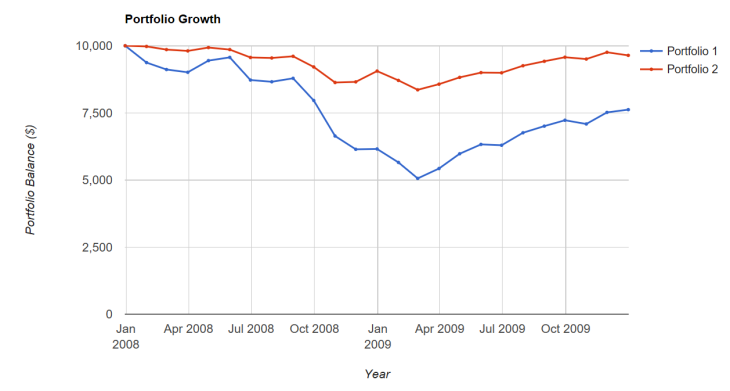
A portfolio with a very generous amount of bonds would have only decreased by about 10%-15% in the last major market correction. For the period of 2008 to end of 2009, here’s a comparison of the US stock market (S&P 500) as Portfolio 1, and a Balanced Portfolio as Portfolio 2.

We see that the all-stock portfolio declined by 50% while the Balanced Portfolio with a 70% bond component declined by just over 15%. By the end of 2009 that conservative Balanced Portfolio is almost back in positive territory while the all-stock portfolio still has more of that hill to climb.

Percentage in Bonds a critical decision

The most important decision that will be made, or the most important question answered will be “What percentage of bonds do you need?” What is your risk tolerance level? What roller coaster do you want to ride? You get to decide. Continue Reading…

Getting the best bang for your buck with everyday purchases

By Sia Hasan

Special to the Financial Independence Hub

You work hard for your money, so it makes sense that you would want to stretch your dollar as far as possible. If you are like many other hard working adults, you may splurge here and there on a cup of coffee or a matinee movie. However, most of your take-home pay may go toward everyday or typical purchases. These may include food, gas, clothes and more.

It may seem challenging to stretch your dollar in these essential areas, but rest assured that there are several strategies you can employ to get the most bang for your buck. Before you make another purchase on regular or everyday items, consider how these tips can benefit you.

Choose your payment method carefully

The primary payment methods for standard purchases are cash or credit cards. Cash may be in the form of hard currency, checks or a debit card. Many people believe that paying with cash or a cash alternative is a smart option because it helps you avoid taking on expensive debt. It is true that debt can cost you money.

However, if you use credit cards responsibly, a credit card may be a better payment option. Consider that you can make all your regular purchases with a credit card, and you can pay the full balance off each month. Therefore, no interest is accrued, and there is not a cost for using the credit card. You may enjoy the benefit of bolstering your credit score with responsible use of your credit card. Keep in mind that higher credit scores may qualify you for a lower rate on a mortgage, a car loan, insurance rates and more. Therefore, this payment method can yield tremendous savings over time.

Take advantage of Credit Card Rewards

When you make purchases with credit cards regularly, you may also enjoy the additional benefit of earning rewards points. You can begin by searching for a good credit card for average credit and comparing rewards programs or opting into the rewards program on an existing account. Pay attention to the fine print as you compare programs. Some credit card rewards programs, for example, limit the points that you can earn within a specified period of time. Other programs require you to use the points within a certain period of time. These rewards may essentially give you cash back on your purchases, or the points may be redeemed for other items with financial value.

Shop around

Even when you take these steps to stretch your dollar, there may be other ways to save as well. Shopping around is easier to do than ever because of the Internet. Continue Reading…

The Future is not quite now: A calm perspective on gloomy predictions

Here are a couple of conversations I’ve been involved in recently. Does any of it sound familiar?

Conversation with a retired engineer. He asked, “What do you think about this driver-less cars business? Has anybody even considered how many people this will throw out of work? We have to do something about this! Otherwise, joblessness will go so high that it will cause a depression.”

Conversation with a middle-aged family doctor/real-estate investor. He said, with complete confidence, “I’m cutting back on my medical career and moving into real-estate development. Long before I want to retire, I expect my job to disappear due to competition from AI (artificial intelligence).”

When listening to predictions, especially gloomy ones like these, keep in mind that nobody can consistently predict the future. Also remember that the most widely accepted gloomy predictions are especially prone to fail. That’s because people, as individuals, react to and prepare for predictions of doom. They work on the problem before its predicted arrival time. Sometimes they offset it entirely.

Y2K was the ultimate example

The ultimate example came on the first day of this century, with the non-arrival of the so-called “millennial bug,” or Y2K for short.

In the late 1990s, computer consultants warned that at the stroke of midnight on December 31, 1999, computers around the world would freeze up because of a problem with their data-storage limits. Computers used to use just two digits to designate a year. So they wouldn’t be able to tell what came after 1999; ‘00’ could mean 1900 or 2000. The problem had a simple fix, however. By the last day of 1999, most computer owners had attended to it. Damage from the predicted crisis was negligible.

Today’s predictions — gloomy and hopeful — revolve around the expectation that computer speeds will continue to rise, and computer costs to drop, at much the same rate as they have for the past half century.

This trend has led to exponential growth in the processing power of computer chips, coupled with an exponential drop in their cost. This leads to casual-conversation predictions like the two I mention above: artificial intelligence will soon lead to legions of unemployed taxi, truck and bus drivers; and legions of unemployed family doctors will follow soon after.

The logical flaw here is that exploding computer power at shrinking cost is a technological advance. But there are social, legal and practical limits to how quickly business can translate these technological gains into real-world progress (or problems, depending on how you look at it).

Computer makers don’t need government permission to raise the speed of their chips. In contrast, makers of driverless cars face all sorts of problems, long before they make any money.

The shift to driverless vehicles will happen gradually, over a period of decades. After all, driving in traffic involves far more surprises than a champion Go player faces on the playing board. Drivers have to deal with changing weather, full sunlight and deep shadow, unpredictable human drivers with varying skills, unpredictable pedestrian web surfers, potholes, snow-covered street markings and so on.

The shift from human to AI doctors will occur at an even slower pace — in line with how long it takes to earn a driver’s license on the one hand, and a medical license on the other. AI will replace family doctors some time after it replaces the voice and chat help lines that people use when they have a problem with a computer, a cell phone or a utility bill.

Assume technological process leads to economic progress

People have a long record of guessing wrong about the impact of new technology, and on how long it will take for the new technology to become part of daily life. You’ll guess right much more often if you just assume that technological progress eventually leads to economic progress. Continue Reading…