General

Why simplicity beats complexity

Special to the Financial Independence Hub

Complexity. It’s hard to avoid.  Tune into the news, and something’s always breaking.  Even in your own life, how many “other” tasks get in the way of the good stuff?

I’m not suggesting you should only do what is immediately gratifying.  There’s considerable enjoyment to be found in taking on tough challenges.  But today I want to focus on why simplicity beats complexity, especially when it comes to your personal finances.

Simplifying your investments

When it comes to writing about investments why reinvent the wheel?  I agree with every point “A Wealth of Common Sense” blogger Ben Carlson makes in this excellent piece, “Why Simple Beats Complex.”  Instead of writing an overly repetitive post, I recommend you give this a read.  Basically, we are prone to using our oversized brains to over-complicate things, especially investments.  Simple advice:  Don’t do that.

Simplifying your finances

While I don’t want to split hairs, there is a subtle, but incredibly important difference between financial goals, financial plans and financial planning.  Knowing the difference helps simplify all three. Continue Reading…

Toronto vs Chicago housing: An Arbitrage for being under-weight Canadian bank stocks

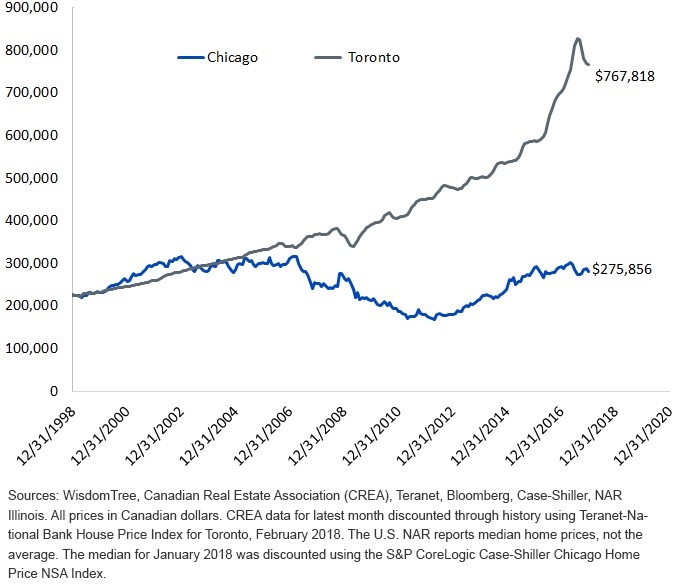
Figure 1: Chicago and Toronto Home Prices
By Jeff Weniger, CFA, WisdomTree

Of the major North American cities that feel most like Toronto, Chicago is clearly the closest fit. It’s Toronto’s sister. Chicago is the third most-populous city in the U.S., behind New York and Los Angeles. According to the U.S. Census Bureau, Chicago proper has a population of 2.7 million, almost exactly the same amount as Toronto.1 Both cities have several million more living in the immediate suburbs. Chicago’s money resides mostly on one side of the city, with most of its poverty found on the city’s south and west sides. Wealthy suburbs span almost to Wisconsin in the city’s “North Shore” suburbs, which consist of some of the wealthiest zip codes in the U.S.

Like Toronto, Chicago is a money centre. It is widely considered to be in that tier of financial hubs that includes Boston and San Francisco, behind the center of it all in New York. Its construction is dense; people take trains and buses to commute into the downtown core. Critically, as far as desirability of property goes, Chicago’s weather is miserable, just like Toronto’s. The two cities are also characterized by left-leaning politics, so there isn’t much of a difference on that front either.

When we engage Torontonians about the U.S. and Chicagoans about Canada, time and again the answer comes back: the city that is most like Toronto is Chicago.

Except in one way.

Chicago homes are one third or half of similar homes in Toronto

There is a major arbitrage just sitting there for anyone who liquidates Toronto property, hops on a 75-minute flight and purchases a mirror-image property for one-third or half the price in Chicago. Yes, Chicago is riddled with violence, but not in the neighbourhoods where someone would spend C$767,818, the average Toronto home price in February.2 In those neighbourhoods, the biggest risk is having a $500 stroller run over your toe.

Just what could C$767,818 get in Chicago?

According to the National Association of Realtors’ (NAR) Illinois chapter:

In the nine-county Chicago Primary Metropolitan Statistical Area (PMSA), home sales (single-family and condominiums) in January 2018 totaled 5,777 homes sold, down 8.0 percent from January 2017 sales of 6,277 homes. The median price in January 2018 was $224,000 in the Chicago PMSA, an increase of 7.2 percent from $209,000 in January 2017.

Converting US$224,000 to Canadian dollars at the January exchange rate of $1.231, that is C$275,856 for the median house in Chicago. Granted, U.S. housing data tends to be measured by the median, whereas the Canadian norm is to take the average, but there is still not much of a comparison; the gap is yawning, and this all started happening only in recent years. Continue Reading…


Debt avalanche vs. debt snowball: When math trumps behaviour

John and Erica Mullen are in their mid-thirties and have two young children at home. Together they earn well over $100,000 per year, but a combination of poor choices and unlucky circumstances have left them buried in debt.

Their substantial income affords them the luxury of not having to turn their life upside down by selling their home and vehicles; however, they will need to make some tough sacrifices in order to dig themselves out of this hole.

Creditor Balance Rate Payment Interest-only
Store credit card $6,800.00 26.00% $200.00 $147.34
Consolidation loan $23,000.00 8.00% $430.00 $153.34
Line of credit #1 $20,000.00 6.34% $105.67 $105.67
Tax bill $1,700.00 5.00% $200.00 $7.09
Car loan #1 $36,000.00 3.90% $460.00 $117.00
Line of credit #2 $16,000.00 3.00% $40.00 $40.00
Car loan #2 $23,000.00 0.90% $317.00 $17.25
$126,500.00 $1,752.67

After a close look at their budget, the Mullens decide they can afford to put $2,000 per month toward their non-mortgage debt. They want to know how best to allocate the extra cash so they can be debt-free faster and pay the least amount of interest.

Two popular debt repayment strategies are the debt snowball and the debt avalanche. Let’s look at each method and apply it to the Mullen’s situation:

Debt Snowball

Dave Ramsey, American author of The Total Money Makeover, suggests an unusual strategy for getting out of debt by using something called the debt snowball method.

With the debt snowball, you’re throwing math out the window, focusing instead on the psychological advantage that comes from making progress with quick, successive wins.

Related: Should you pay off your partner’s debt?

Start by arranging your debts from lowest balance to highest. It feels better to rid yourself of your smallest debt, and the idea is that the snowball effect builds enough momentum so that you’ll be more inclined to stick with the strategy on your way toward debt freedom.

This chart shows how the Mullens would use a debt snowball approach to tackle their debt. Remember, they’re throwing an extra $2,000 per month over-and-above their minimum payments:

Creditors in Original Total Interest Months to Month Paid
Chosen Order Balance Paid Pay Off Off
Tax bill $1,700.00 $7.08 1 May-15
Store credit card $6,800.00 $405.61 4 Aug-15
Line of credit #2 $16,000.00 $301.35 11 Mar-16
Line of credit #1 $20,000.00 $1,572.90 19 Nov-16
Consolidation loan $23,000.00 $2,929.50 25 May-17
Car loan #2 $23,000.00 $390.39 30 Oct-17
Car loan #1 $36,000.00 $3,270.27 37 May-18
 Total Interest Paid: $8,877.10

You can see how the strategy works: the tax loan is killed off in the first month and from there the Mullens can focus on the department store credit card, which will be paid off three months later. Altogether it’ll take 37 months to pay off all their non-mortgage debt and the total interest paid over that time is $8,877.10.

Debt Avalanche

Continue Reading…

Become a Mistress of Money this Mother’s Day

By Heather Compton

Special to the Financial Independence Hub

There is a Mother’s Day gift I wish I had the power to give to all the women I love and even to women I’ve never met. I would give them the gift of a title and all the qualifications and knowledge to go with it – “mistress of financial affairs”. Now I must admit the English language gives the term “master” a much more powerful and commanding sound of authority than “mistress” but I want my gift infused with feminine, not masculine power.

What did you learn about money from your Mother? I’m so grateful to my Mom, a fiscally prudent depression era Scot. She lived to her late 90s and raised four daughters to take an active interest in managing their own financial lives. Mom was always a believer a woman should have money to call her own and she regularly squirreled away a few dollars from the household allowance provided by my Father. Yes, he was a man of his times.

The White Knight

In my years as a financial advisor I saw women too often abdicate responsibility for their financial life. They told themselves creative stories such as “I just don’t have a mind for that stuff and my husband, boyfriend, or father just does a better job”. Some singletons believed there was a white knight out there, just around the corner, who would arrive to change or improve their financial situation. Many were understandably exhausted with all the other work and household responsibilities they carried or they felt that if they managed the day to day bill paying they could leave the big-picture financial decisions to their partner. Please don’t do it – off-load laundry or cooking or toilet bowls – never money management. A “right relationship” with money is too important – and it’s never to late to acquire it

Pick a label

We women hold many titles or labels throughout our lifetime – this month, of course, the first to come to mind is mother but we may also be a daughter, sister, wife, friend, teacher, student, employee – the list goes on and on. Continue Reading…

Generation X feeling the Retirement squeeze

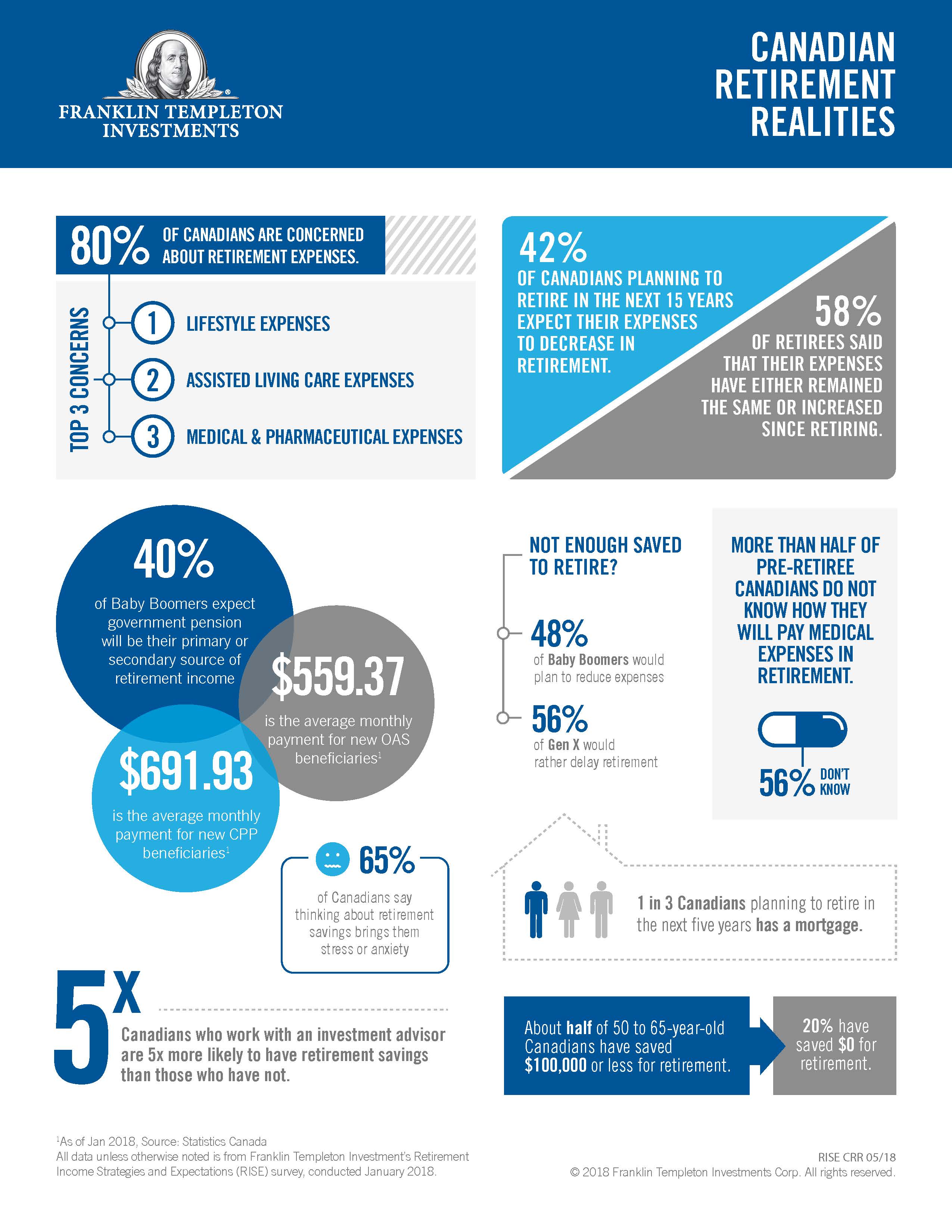
Generation X, and to a lesser extent the Millennials, are already starting to feel the retirement squeeze, according to a Franklin Templeton-sponsored survey released Thursday.

Details are in my column in Friday’s Financial Post, which you can retrieve by clicking on the highlighted headline here: Generation X is ‘stretched beyond their financial limits’ and struggling to save for Retirement. 

The challenges should be familiar to members of any generation (four are mentioned in the survey): it’s never easy saving money when you’re starting out in life with low wages and high expenses. But Franklin Templeton cautions against the  rationalization embraced by younger investors that they simply can  choose to keep on working if they haven’t accumulated enough assets to generate adequate income in retirement.

That may not always be an option, since ill health or corporate downsizing (to mention just two) may prevent this. You can find full details about the fifth annual edition of Franklin Templeton Investments Canada’s 2018 Retirement Income Strategies and Expectations (RISE) survey here.

Stressed GenX resigned to retiring later than hoped

More than half of Gen Xers (aged 37 to 52) are resigned to retiring later than they would want (56% in Canada, 59% in the US). While the online survey included Canadians and Americans across four generations, “this year we felt in particular that Gen X and the stress of preparing for Retirement was the predominant thing coming out of the research,” said Matthew Williams, a Franklin Templeton senior vice president, in an interview.

Continue Reading…