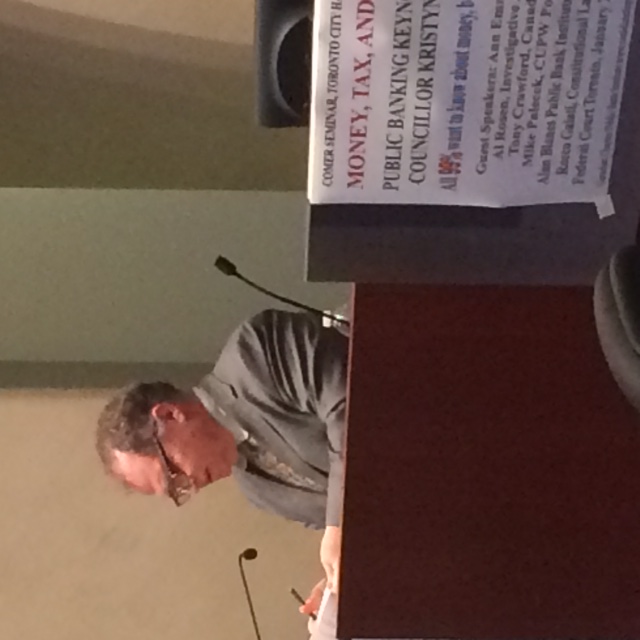
Yesterday (Jan. 26), COMER (Committee on Monetary and Economic Reform) and constitutional lawyer Rocco Galati won another round of appeals in its ongoing (since late 2011) court case against the Bank of Canada.
Galati, a prominent constitutional lawyer, discussed Monday’s result shown here at Hub Videos. In it, he said he does not believe Canada is a democracy any longer and that the media is controlled by the government.
Inflation may seem like a tame or even non-existent threat. We are actually witnessing deflation in the price of oil and other commodities as I write this. Even so, it’s highly unlikely that inflation is dead. The U.S. economy continues to recover from the financial crisis and times of economic recovery are often a trigger for higher inflation.
An annual inflation rate of 2 per cent or 3 per cent over a period of years can seriously erode the purchasing power of your retirement nest egg. At 2.5 per cent inflation, US$1 today will be worth approximately 78 cents in 10 years, 61 cents in 20 years, and 48 cents in 30 years. This could have a major impact on those entering retirement and those already in retirement.
Managing inflation in retirement is crucial; here are some thoughts you need to consider. Continue Reading…
After the loonie plummeted 2 cents to 81 cents US after yesterday’s surprise interest-rate cut, it seems an apt time to address a common misunderstanding about how the falling Canadian dollar affects US equity ETFs denominated in either country’s currency.
Dan — who is both a consulting editor with MoneySense Magazine as well as an investment adviser with PWL Capital — had been chatting with me about the upcoming MoneySense ETF All-Stars feature in general and about the much-misunderstood topic of currency hedging in particular.
Personally, I believe international securities exposure provides diversification both for stocks or bonds but also currencies. I agree with Certified Financial Planner Fred Kirby (see Getting Help section) that the first 20% or 30% of foreign currency exposure doesn’t need to be hedged back into your home country (loonie if you’re Canadian, greenback if you’re American). Of course, American investors who bought US stocks then are laughing. Similarly, if a Canadian invested much of their RRSP directly into US stocks or US equity funds denominated in US$ soon after the 2008 financial crisis and didn’t hedge currencies, they’re probably a happy camper today. Continue Reading…
Editor’s Note. First, in the spirit of full disclosure, the guest blog below is by my brother Graham. Second, as the short bio at the end indicates, he is a successful businessman who thinks for himself and isn’t fussed about being perceived as “politically incorrect.” The issue he raises below tends to be ignored by the mass media (he would term them the “corporate media, lamestream media or lackeys of capitalism”).
The Financial Independence Hub is happy to live up to its name and provide a platform to air this intriguing issue. We’d like to think this is the sort of “challenging content” referred to in Tuesday’s blog by Chartered Financial Analyst Andrew Teasdale that’s relevant but seldom found in “ normal channels.” Findependence.TV plans to run the resulting video of the upcoming event after it is held this Saturday.
Graham Chevreau
By Graham Chevreau,
Special to the Financial Independence Hub
A Brief Summary of the National Debt
A couple of months ago I watched a YouTube video created by Bill Abram entitled “The Crime of the Canadian Banking System.” In the video, Bill makes use of a very informative Statistics Canada graph showing Canada’s national debt over the period of 1940 to 1987.
The graph shows that Canada’s national debt was below $20 billion over the period of 1940 to 1974. After 1974, however, the graph headed dramatically upwards and, by 1993, the national debt was $423 billon. Bill Abram pointed out that of the $423 billion; $386 billion was interest on debt!Continue Reading…


 Posted By