Posted By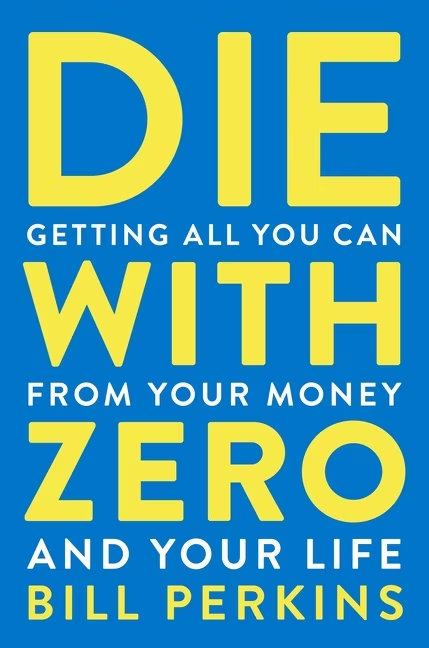
My latest Retired Money column looks at two related books: Die with Zero and Four Thousand Weeks.
You can as always find the full version of the MoneySense column by clicking on the highlighted text: Why these authors want you to spend your money and die with $0 saved.
I start with Die with Zero because it most directly deals with the topic of money as we age. In fact, as most retirees know, one of the biggest fears behind the whole retirement saving concept is running out of money before you run out of life.
But it appears that many of us have become so fixated with saving for retirement, we may end up wasting much of our precious life energy, and being the proverbial richest inhabitant of the cemetery. For you super savers out there, this book may be an eye opener, as is the other book, 4,000 Weeks.
As I note in the column, this genre of personal finance started with Die Broke, by Stephen Pollan and Mark Levine, which I read shortly after it was first published in 1998. That’s where I encountered the amusing quip that “The last check you write should be to your undertaker … and it should bounce.”
The premise is similar in both books: there are trade-offs between time, money and health. Indeed, as you can see from the cover shot above, its subtitle is Getting all you can from your money and your life. As with another influential book, Your Money or Your Life, we exchange our time and life energy for money, which can therefore be viewed as a form of stored life energy. So if you die with lots of money, you’ve in effect “wasted” some of your precious life energy. Similarly, if you encounter mobility issues or other afflictions in your 70s or 80s, you may not be able to travel and engage in many activities that you may have thought you had been “saving up” for.
A treatise on Life’s Brevity and appreciating the moment
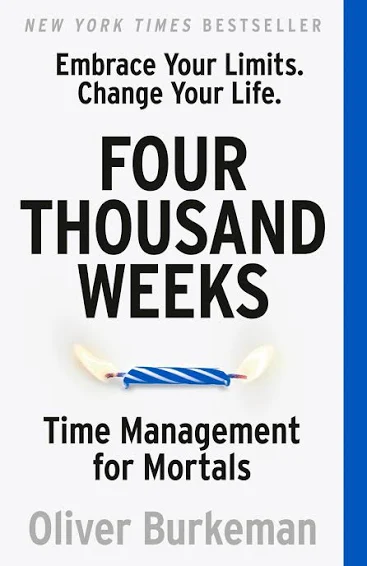
The companion book is Four Thousand Weeks : Time Management for Mortals, by Oliver Burkeman. If you haven’t already guessed, 4,000 weeks is roughly the number of weeks someone will live if they reach age 77 [77 years multiplied by 52 equals 4,004.] Even the oldest person on record, Jeanne Calment, lived only 6,400 weeks, having died at age 122.
I actually enjoyed this book more than Die with Zero. It’s more philosophical and amusing in spots. Some of the more intriguing chapters are “Becoming a better procrastinator” and “Cosmic Insignificance Therapy.” I underlined way too many passages to flag here but here’s a sample from the former chapter: “The core challenge of managing our limited time isn’t about how to get everything done – that’s never going to happen – but how to decide most wisely what not to do … we need to learn to get better at procrastinating.”
 Posted By

 Posted By