Longevity & Aging

No doubt about it: at some point we’re neither semi-retired, findependent or fully retired. We’re out there in a retirement community or retirement home, and maybe for a few years near the end of this incarnation, some time to reflect on it all in a nursing home. Our Longevity & Aging category features our own unique blog posts, as well as blog feeds from Mark Venning’s ChangeRangers.com and other experts.

Why the 4% Rule doesn’t work for FIRE/Early Retirement


By Mark and Joe

Special to the Financial Independence Hub

The 4% rule is a common rule of thumb in many retirement planning circles, including the Financial Independence, Retire Early (FIRE) community in particular.

What does the 4% rule actually mean?

Should the 4% rule be used for any FIRE-seeker?

Does the 4% rule really matter to retirement planning at all?

Read on to find out our take, including what rules of thumb (if any) we’re using at Cashflows & Portfolios for our early retirement dreams.

The 4% rule is really a starting point for a safe withdrawal rate

Unlike 2 + 2 = 4, the 4% rule is not really a universal truth for any retirement plan at all.

It is, however, in our opinion, a great starting point to understand the impacts of asset decumulation, related to inflation, over time.

As you’ll read more about in the sections below, the 4% rule is fraught with many problems. None more so than for an early retiree or FIRE-seeker. In some cases, for the FIRE community, we believe the 4% rule should no longer be used at all.

Are any financial rules really rules?

Backing up, here is the source for the 4% rule.

The article from 1994!

4% rule

Despite the geeky photo, by all accounts, Bill Bengen was one heckuva guy and a smart guy as well!

Potentially no other retirement planning rule of thumb has received more attention over the last 25-30 years than Bengen’s publication about the 4% rule. This publication in 1994 has triggered a new generation of devotees and arm-chair financial planners that are using this quick-math as a way to cement some retirement dreams. We believe that is a mistake for a few reasons.

First, let’s unpack what the 4% rule really means.

What does the 4% rule actually mean?

From the study:

“In Figures 1 (a)-l(d), a series of graphs illustrates the historical performance of portfolios consisting of 50-percent intermediate-term Treasury notes and 50-percent common stocks (an arbitrary asset allocation chosen for purposes of illustration). I have quantified portfolio performance in terms of “portfolio longevity”: how long the portfolio will last before all its investments have been exhausted by
withdrawals. This is an intuitive approach that is easy to explain to my clients, whose primary goal is making it through retirement without exhausting their funds, and whose secondary goal is accumulating wealth for their heirs.”

Unpacking this further, for those that do not want to read the entire study, here is something more succinct from Bengen:

Assuming a minimum requirement of 30 years of portfolio longevity, a first-year withdrawal of 4 percent, followed by inflation-adjusted withdrawals in subsequent years, should be safe.


“Should be safe”.

Again, the theory is one thing. Reality is something different and the financial future is always subject to change. Furthermore, if you’re blindly following this formula without considering whether it’s right for your situation, let alone putting in some guardrail approach to monitor your portfolio value at various checkpoints, you could end up either running out of money prematurely or being left with a huge financial surplus that you could have spent during your retirement. We’ll prove that point in a bit from another leading author.

Should the 4% rule be used for any FIRE-seeker?

Probably not. For many reasons.

Recently, Vanguard published an outstanding article about the need to revise any thinking about the 4% rule for the FIRE movement – a driver for this post.

Although the 4% rule remains a decent rule of thumb we believe most FIRE-seekers should heed the cautions in the Vanguard post. Here are some of our thoughts based on the article’s contents.

  • Caution #1 – FIRE-seekers should not rely on past performance for future returns

We agree. In looking at this Vanguard set of assumptions below, and based on our own personal investing experiences, we believe historical returns should not be used to guarantee any future results.


Source: Vanguard article – Fueling the FIRE movement

While the FP Canada Standards Council doesn’t have a multi-year (10-year) return model in mind, they did highlight in their latest projection assumption guidelines that going forward, investor returns may not be as juicy as in years past.


Source: FP Canada Standards Council.

This means for any historical studies, while interesting, may not be a great predictor of any future outcomes.

  • Caution #2 – The FIRE-seeking time horizon is longer

Bengen noted in his 1994 study:

“Therefore, I counsel my clients to withdraw at no more than a four-percent rate during the early years of retirement, especially if they retire early (age 60 or younger). Assuming they have normal life expectancies, they should live at least 25-30 years. If they wish to leave some wealth to their heirs, their expected “portfolio lives” should be some longer than that. “

Bengen goes on to say:

“If the client expects to live another 30 years, I point out that the chart shows 31 scenario years when he would outlive his assets, and only 20 which would have been adequate for his purposes (as we shall see later, a different asset allocation would improve this, but it would still be uncomfortable, in my opinion).
This means he has less than a 40-percent chance to successfully negotiate retirement–not very good odds.”

To paraphrase, Bengen’s study was relevant to 30 years in retirement. Not 35 years. Not 40 years and certainly not 50 years like some FIRE-seekers may need if they plan to retire at age 40 and live to age 90 (or beyond).

This is simply a huge reminder that your time horizon is a critical factor when it comes to retirement planning.

  • Caution #3 – FIRE-seekers may need to live with more stocks

Bengen’s 1994 study was based on the following:

“Note that my conclusions above were based on the assumption that the client continually rebalanced a portfolio of 50-percent common stocks and 50-percent intermediate-term Treasuries.” Continue Reading…

Lack a DB pension? Pros and Cons of the Purpose Longevity Fund

By Mark and Joe

Special to the Financial Independence Hub

Hello readers of the Financial Independence Hub! We are the founders of CashflowsandPortfolios.com,  a free resource dedicated to helping DIY investors in getting started with their portfolio right up to planning efficient withdrawal strategies during retirement.

We are honoured to have been invited by Jon Chevreau to contribute a piece on a new income product for retirees: the Purpose Investments Longevity Fund.

If you are close to retiring or already a retiree, you’ve likely thought a lot about the following questions:

  1. Did I save enough for retirement?
  2. How will I generate sufficient income for my retirement?
  3. How long will my money last?

If you are lucky enough to have worked for a Government entity for 25-30 years, then you are probably not too worried about funding your retirement.  However, for the rest (most) of us, we need to save and invest on our own over the long-term. If that’s not enough, we then need to figure out ways to decumulate our savings as efficiently as possible.

For DIY investors, there is not much in the form of “forever” payments until death, except of course Canada Pension Plan (CPP) and Old Age Security (OAS). We consider these as one of the three pillars of retirement income for Canadians.

Another common source of “forever” income that acts like a government defined benefit (DB) pension are annuities: which are guaranteed by insurance companies. With annuities, investors are trading their capital for a steady income stream, which is essentially a DB pension.

Why aren’t annuities more popular? For DIY investors, it’s likely because of the fact that you are giving up your capital for a yield (currently around 4-5%) that can be obtained by your own DIY portfolio (see below for an example).

So what if there was a product out there that would provide:

  1. Income for life
  2. A yield higher than annuities
  3. An option to “sell” the product to regain some of your invested capital if needed?

That’s the opportunity and challenge that Purpose Investments has taken on with the creation of their latest mutual fund: The Longevity Pension Fund.

There has been a lot of buzz about the Purpose Investments Longevity Pension Fund and for good reason:  it solves a number of big problems that retirees face.

What is the Longevity Pension Fund and what are the pros and cons of owning such a fund?

Pros and Cons of the Longevity Pension Fund

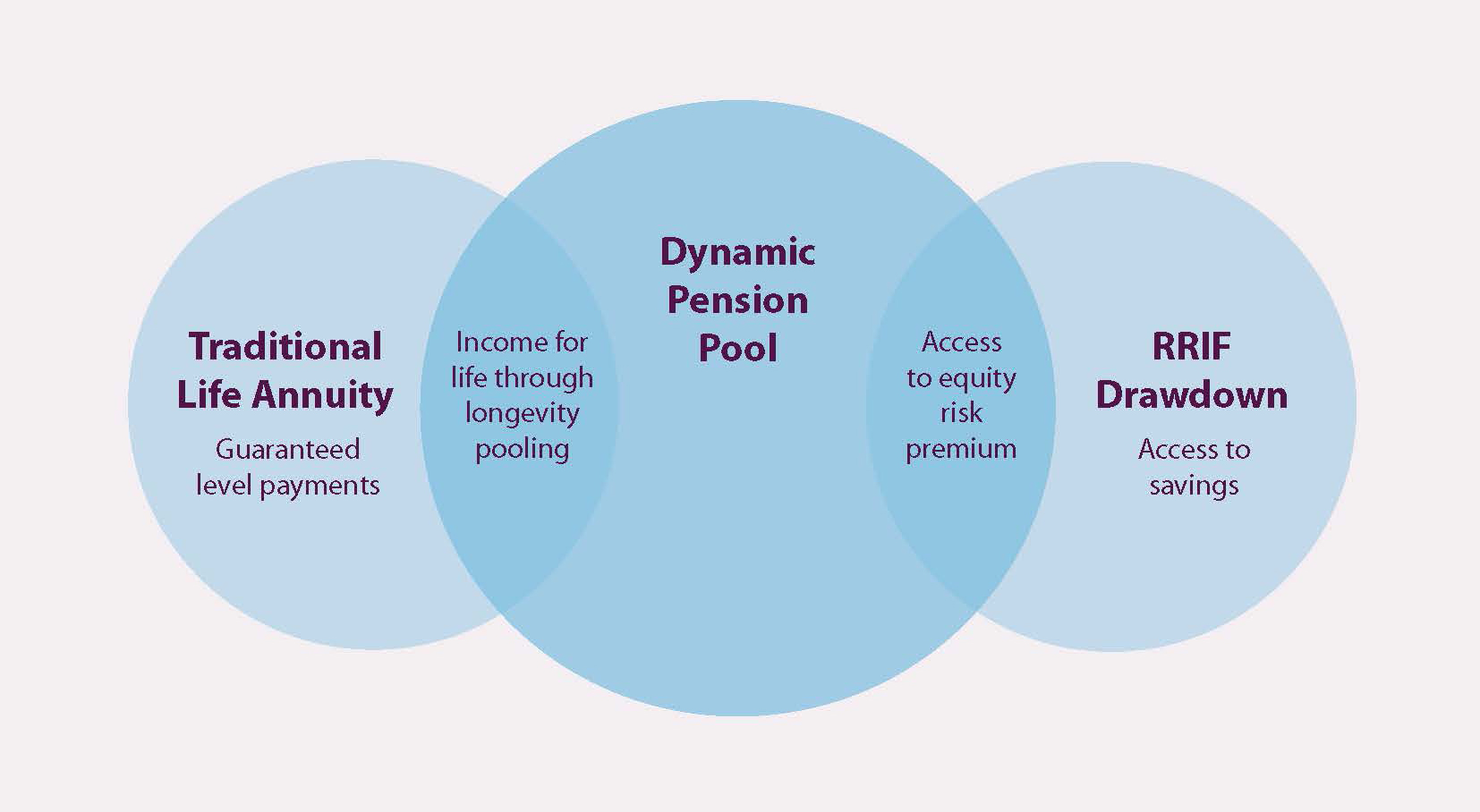
At a high level, the Longevity Pension Fund is a cross between a balanced index mutual fund (47% equities/38% fixed income/15% alternatives), an annuity, and a defined benefit pension. While the fund does offer income for investors, a solid yield, and an option to “sell” the product if needed, these potential benefits must be considered with some drawbacks. As always with financial products, the devil is in the details.

With the basics out of the way, what are the PROS and CONS of the fund?

PRO – Reduces longevity risk (i.e., outliving your money) by offering income for life, but without the guarantees

As mentioned, the Longevity Purpose Fund is a mutual fund that any investor will be able to buy. Once purchased, and the investor is 65 or older, the fund will pay a distribution for life (at least that is the plan). Purpose Investments has stated that the 6.15% yield may sound high, but to maintain that yield they would only need to achieve an annual return of 3.5% net, which is well below historical returns for a common 60/40 stock/bond balanced portfolio.

Combined with mortality credits (investors who die sooner than expected, leaving their money invested in the fund for other investors), Purpose Investments has stated that 6.15% is conservative and can possibly go higher in the future.

PRO – You can get some of your investment back

With annuities and defined benefit pensions, you don’t typically get your contributions back. With this Longevity Fund, if you sell the fund you will get your initial investment minus any income payments. For example, if you have invested $100k into the fund, and have been paid out $10k, then you get back $90k if you sell. At a yield of 6.15%, essentially you can get some capital back up to 16 years of being invested in the fund. After that point, co

nsider yourself invested for life.

PRO – The taxation of the distributions will be tax efficient

While the fund is available for all kinds of accounts — including tax-free savings accounts (TFSAs) and registered retirement income funds (RRIFs) — potentially the best home for this fund could be in a taxable account. That is because monthly income distributions in the first year are expected to be roughly half a return of capital (RoC) with the remainder from capital gains, dividends and interest. This means that in a taxable investment account, the distributions will be tax-efficient (much more so than a defined benefit pension payment).

PRO – No Binding Contract

A key feature of this Longevity Pension Fund is a script from the annuity playbook: mortality credits. Similar to an annuity, you are participating in a pool of credits: those that die. When you die, your estate gets your initial contribution minus the total amount of income payments. The investment gains generated by your investments over the years stay in the fund and are used to top up monthly payments for everyone else.

Unlike an annuity though, you can get out of the fund: it’s not a one-way binding contract.

From Purpose:

“Unlike many traditional annuities or other lifetime income products, the Longevity Pension Fund is not meant to feel like a binding contract. You can change your mind and access the lesser of your unpaid capital** (i.e., your invested capital less the distributions you’ve received) or current NAV. Your beneficiaries are entitled to the same amount if you pass away. Once your cumulative distributions surpass your invested capital, there will no longer be any redeemable value left. Please speak to your advisor or see the prospectus for further details.”

The fund is also designed similar to many pension plan funds or funds of funds:  a balanced mix of stocks, bonds and other investments that should* meet their income obligations to unitholders.

*Target income is just that. This fund does not offer an income guarantee.

CONS – The fund does not pass onto heirs

As mentioned above, the mortality credits are how this fund will sustain its yield into the future, which also means that the fund and its payout do not pass onto your spouse/heirs. For investors with a spouse/heirs, this is one of the largest drawbacks of the Longevity Pension Fund.

CONS – The distributions are not guaranteed

The monthly payments seem juicy right now but the Longevity Pension Fund is not like an annuity whereby income is guaranteed for life; the 6% or more income target is just that: a target. Continue Reading…

My review of The Boomers Retire

My latest MoneySense Retired Money column reviews the new fifth edition of The Boomers Retire by certified financial planners Alexandra Macqueen and David Field. Click on the highlighted headline here to retrieve full article: Fresh takes on the challenges facing baby boomers as they approach retirement.

As I note in the column, the original edition of The Boomers Retire (which I read at the time) was by Lynn Biscott and was published back in 2008.

Macqueen and Field are both CFPs and the book is aimed at both financial advisors as well as their clients, as indicated in the book’s subtitle.

Clearly, retiring boomers constitute a massive potential readership. I myself co-authored The Wealthy Boomer, way back in 1998. At that time, baby boomers may have started to worry about Retirement but most, including myself, would have been squarely in the Wealth accumulation camp.

Wealthy Boomers now well on way to transition to Decumulation

Here in 2021, Decumulation is the emerging financial focus of Baby Boomers, many of whom will already be retired or semi-retired, and considering new decumulation solutions like the Purpose Longevity Fund, which this site has looked at more than once. (here via Dale Roberts and here via another MoneySense Retired Money column.) Continue Reading…

Mexico: US-style Living at one third the Cost

Chacala Beach, Nayarit, Mexico. Photo credit Billy Kaderli.

By Billy and Akaisha Kaderli, RetireEarlyLifestyle.com

Special to the Financial Independence Hub

Mexico, that constantly media-bashed country to the south of the US, might be your better option for retirement.

One million Americans already call Mexico their home and it’s amazingly easy to obtain your residency visa for full-time living, most receiving theirs in a matter of days.

Snowbirds could easily add another million visitors to this number and can stay 6 months on a no-cost visitors visa!

With its proximity to the United States, both US and Mexican airlines offer non-stop flights to and from many destinations in the US. Or, of course, you could drive. So, visiting family or utilizing Medicare is much easier than if you were to live elsewhere overseas.

There are lots of reasons why Mexico is a great choice for retirement, so let’s list some:

Cost of Living

Mexico has everything that the US offers – along with a better lifestyle – at a fraction of the cost.

The Dollar exchange rate makes for attractive affordability.

The cost of a beer is 30 Pesos or about $1.50 at a bar. A lakeside lunch of grilled salmon with wine or margarita as your beverage plus a generous tip runs about $11USD per person.

Commonly used medicines at pharmacies won’t break the bank, and a consultation with a cardiologist or a surgeon is less than $40USD.

More on Medical Care

Many US doctors train in major Mexican hospitals where the “care” is still part of the healthcare industry.

Most doctors here – including specialists – are easily available through phone, WhatsApp or email and most speak English. Highly skilled dentists are abundant with oral surgeons performing teeth implants for a price less than your dental copay back home.

Assisted Living options run the gamut. Pricing for private rooms in a traditional Mexican mansion with gardens, comfort dogs, meals included, internet, laundry service and social activities and a driver to take you to appointments are about $2,000USD per month.

Housing

Here in Chapala, Mexico, all price ranges are available for both rentals and home ownership. For as little as $300 USD a month you can rent a one-bedroom furnished apartment or you can purchase a house in any of the towns which dot the lake for many times that amount.

Maids and gardeners are commonplace, and the price for plumbers, carpenters and electricians run about the same as a Lakeside lunch. Continue Reading…

Retired Money: Has Purpose uncorked the next Retirement income game changer?

Purpose Investments: www.retirewithlongevity.com/

My latest MoneySense Retired Money column has just been published: you can find the full version by clicking on this highlighted text: Is the Longevity Pension Fund a cure for Retirement Income Worries? 

The topic is last Tuesday’s announcement by Purpose Investments of its new Longevity Pension Fund (LPF). In the column retired actuary Malcolm Hamilton describes LPF as “partly variable annuity, part tontine and part Mutual Fund.”

We described tontines in this MoneySense piece three years ago. Milevsky wasn’t available for comment but his colleague Alexandra Macqueen does offer her insights in the column.

The initial publicity splash as far as I know came early last week with this column from the Globe & Mail’s Rob Carrick, and fellow MoneySense columnist Dale Roberts in his Cutthecrapinvesting blog: Canadian retirees get a massive raise thanks to the Purpose Longevity Fund. Dale kindly granted permission for that to be republished soon after on the Hub. There Roberts described the LPF as a game changer, a moniker the Canadian personal finance blogger community last used to describe Vanguard’s Asset Allocation ETFs. Also at the G&M, Ian McGugan filed Money for life: The pros and cons of the Purpose Longevity Pension Fund, which may be restricted to Globe subscribers.

A mix of variable annuity, tontine, mutual fund and ETFs

So what exactly is this mysterious vehicle? While technically a mutual fund, the underlying investments are in a mix of Purpose ETFs, and the overall mix is not unlike some of the more aggressive Asset Allocation ETFs or indeed Vanguard’s subsequent VRIF: Vanguard Retirement Income Portfolio. The latter “targets” (but like Purpose, does not guarantee) a 4% annual return.

The asset mix is a fairly aggressive 47% stocks, 38% fixed income and 15% alternative investments that include gold and a real assets fund, according to the Purpose brochure. The geographic mix is 25% Canada, 60% United States, 9% international and 6% Emerging Markets.

There are two main classes of fund: an Accumulation Class for those under 65 who are  still saving for retirement; and a Decumulation class for those 65 and older. There is a tax-free rollover from Accumulation to Decumulation class.

There are four Decumulation cohorts in three-year spans for those born 1945 to 1947, 1948 to 1950, 1951 to 1953 and 1954 to 1956. Depending on the class of fund (A or F),  management fees are either 1.1% or 0.6%. [Advisors may receive trailer commissions.] There will also be a D series for self-directed investors.

Initial distribution rates for purchases made in 2021 range from 5.65% to 6.15% for the youngest cohort, rising to 6.4 to 6.5% for the second youngest, 6.4% to 6.9% for the second oldest, and 6.9% to 7.4% for the oldest cohort.

Note that in the MoneySense column, Malcolm Hamilton provides the following caution about how to interpret those seemingly tantalizing 6% (or so) returns: “The 6.15% target distribution should not be confused with a 6.15% rate of return … The targeted return is approximately 3.5% net of fees. Consequently approximately 50% of the distribution is expected to be return of capital. People should not imagine that they are earning 6.15%; a 3.5% net return is quite attractive in this environment. Of course, there is no guarantee that you will earn the 3.5%.”

Full details of the LPF can be found in the MoneySense column and at the Purpose website.