Building Wealth

For the first 30 or so years of working, saving and investing, you’ll be first in the mode of getting out of the hole (paying down debt), and then building your net worth (that’s wealth accumulation.). But don’t forget, wealth accumulation isn’t the ultimate goal. Decumulation is! (a separate category here at the Hub).

Wake up excited about your Future with these Financial Planning strategies

LowrieFinancial.com

By Steve Lowrie, CFA

Special to the Financial Independence Hub

When people ask me what I do for a living, I sometimes say financial planning. Or investment advice. Or, “I’m a personal financial advisor.”
But none of these descriptors is spot on. As my website says, what I really do is help people wake up excited about life, not worried about money. A key element to this higher calling is to deploy the secrets of simple investing.

Simple investing sounds like a good idea, right? It’s important whether you’re mid-career and all-business, or you’re approaching retirement, with leisure time on your mind. It applies whether you live in bustling Toronto, my hometown of Barrie, or anywhere else in the world. It’s also a familiar theme on my blog, from Why simplicity beats complexity, to “Simple investing isn’t easy,” to “Simple Investing Strategies to Take Away from 2018.”

Still, the secrets of simple investing never grow old and always bear repeating, lest we forget: Your long-term financial goals should drive your financial planning strategies, which should guide your investment portfolio … not the other way around. Or, even more succinctly:

Investment Success = Goals + Planning + Building & Maintaining

This basic equation explains why trend-hungry traders chasing after the latest SPACs, NFTs, etc. are going about it all wrong.

Today, let’s unpack this wise, but simple investing advice.

Simple Investing Step 1: Setting Goals

For most of us, the ability to wake up excited about life, not worried about money means having satisfying goals ahead, and realistic plans for achieving them. No wonder a significant part of what I do as a personal financial advisor is to walk people through the emotional and financial elements of goal-setting.

To achieve your personal short- and long-term financial goals, first, you must have them. And yet, I often see busy families rushing right past this critical first step.

I see it when I ask a 50-something couple about their retirement goals. As each partner shares their ideas, differences often emerge. One may be imagining action-packed days, filled with family gatherings and community service. The other might be dreaming of downsizing to a peaceful country cottage and enjoying more quiet time. Who knew?

I see it in younger families too, as they wrestle with life’s tradeoffs: kids, careers, friends, personal interests, neighborhood organizations, soccer league … How do you do it all without going crazy, broke, or both?

I’ve also seen how the pandemic has put many families’ once-solid long term financial goals into a tailspin, creating a challenge and opportunity to revisit their assumptions. Now what?

Fortunately, the steps to setting long term financial goals successfully are simple enough:

Define and Describe: First, take the time to record your current goals. Go beyond “I want to be rich and famous,” to large and small, near- and long-term specifics. Chances are, you’ll have more goals than time and money to achieve them all. So, estimate the costs involved, assign priorities, and establish approximate timelines for each:

When we retire in 2028, we would like to buy a family cottage near Georgian Bay. But most of all, we’d like to spend more time with the grandkids.

I would like to finish my master’s degree next year. Either way, I really want to be self-employed with my own business by 2025.

Communicate: Talk about your goals as a couple, to discover common ground as well as where you may differ. Identify where and how you might need to find good compromises.

Maintain: Life changes. You change. Periodically revisit your goals and adjust them as needed.

Simple Investing Step 2: Making Plans

With your short- and long- term financial goals in sight, you’re better positioned to wake up enthused about life’s possibilities. The next step is to reduce the worrying. That’s where planning comes in. Clearly, life doesn’t always go as expected! But we must plan anyway, because …

Your plans become your most dependable touchstones against which to adjust your course as needed.

Robust financial planning should embody your personal goals and financial realities. As a personal financial advisor, my aim is to tend to both, so my clients can:

  • Live comfortably, but within their means, by spending less than they make today
  • Invest what they don’t spend today wisely, to fund tomorrow’s dreams
  • Protect what they’ve achieved so far, by insuring against the great unknowns

Admittedly financial planning can be gnarly. Unless you’re a personal financial advisor too, you probably don’t wake up feeling excited about the chance to balance your budget, invest your reserves, select sensible insurance coverage, and figure out how to draw on your reserves once you retire.

In the spirit of simplicity, let’s revisit the point of these tasks:

Financial planning helps you make the most of your money today AND tomorrow.

In other words, by having personalized, practical plans in place, it becomes much easier to know where you stand today, whether you’re on track for tomorrow, and whether you’re as ready as you can be for whatever might happen along the way.

Which brings me to my final simple investing step:

You don’t just need a financial plan. You need ongoing financial planning.

Simple Investing Step 3: Building and Maintaining

Here’s a simple truth: Whether you manage your own money, or you have a personal financial advisor to assist you, a lot can happen between “now” and “then.”

In Your Life: Relationships, careers, interests, and ambitions evolve. Financial windfalls may propel you forward; emergency spending might set you back. Even if you’ve carefully prepared for a big event like retirement, it may not be quite what you imagined once it arrives.

In the Market: Over time, you can expect to build significant wealth by participating in a market’s long-term growth. But in ever-volatile financial markets, you never know what’s going to happen next, or whether the next few months or years will delight or disappoint.

In the World: You don’t need me to inform you that the world never stops spinning. From Toronto to Beijing, for better and worse, breaking news from near and far can wreak havoc on even the most ironclad plans you’ve made for you and your family. Continue Reading…

Invesco Canada launches two new Thematic Technology ETFs focused on Nasdaq

After the huge success of Cathie Woods and the ARK ETFs in 2020, rival investment managers have been quick to characterize technology funds as “Innovation” or “Disruption” products.

Such was the case on Thursday,  as Invesco Canada Ltd.  announced the launch of two new exchange-traded funds (ETFs) offering Canadian investors exposure to several relevant technology themes. This follows the February announcement from Franklin Templeton of the Franklin Innovation Fund (FINO), which appeared on the Hub under the headline Invest in Innovation, a Driver of Wealth Creation.

Both the words “Innovative” and “Disruptive” appear in the top of the press release for the debut of the Invesco NASDAQ Next Gen 100 Index ETF (QQJR and QQJR.F) and the Invesco NASDAQ 100 Equal Weight Index ETF (QQEQ and QQEQ.F. As the release says, these funds “build on the innovative solutions offered by Invesco and Nasdaq, allowing clients several distinctive entry points to own the disruptive companies listed on The Nasdaq Stock Market.”

Invesco also announced the launch of CAD Units of Invesco NASDAQ 100 Index ETF (QQC).

The Invesco innovation suite was launched in October 2020 and is just now expanding to Canada, with  the following TSX-listed ETFs that started trading on the TSX today (Thursday, May 27). Of the three below, I find the equal weight Nasdaq 100 offering the most interesting:

  • Invesco NASDAQ Next Gen 100 Index ETF (QQJR and QQJR.F)
  • Invesco NASDAQ 100 Equal Weight Index ETF (QQEQ and QQEQ.F).
  • Invesco NASDAQ 100 Index ETF (QQC and QQC.F)
Pat Chiefalo

The innovation play was also highlighted in the following quote attributed to Pat Chiefalo, Head of Canada, Invesco ETFs & Indexed Strategies: “The launch of two new Invesco Nasdaq ETFs reaffirms the commitment of Invesco’s Canadian ETF business to providing our clients with products that access the themes and companies at the forefront of innovation … Now Canadian investors can choose several unique ways to gain exposure to the category-defining companies listed on The Nasdaq Stock Market.”

There are of course several existing rival plays on the top 100 Nasdaq companies apart from Invesco’s famous QQQs. Incidentally, Invesco says it recently changed the name of the Invesco QQQ Index ETF to the Invesco NASDAQ 100 Index ETF, dropping the management fee to 0.20% of NAV to “make it the most cost-effective ETF in Canada tracking the Nasdaq 100 Index.”

By contrast, the new QQJR and QQJR.F are relatively unique: it tracks the Nasdaq Next Generation 100 Index, which includes the “next 100” non-financial companies listed on The Nasdaq Stock Market, outside of the Nasdaq 100 Index, in a mid-cap ETF. Continue Reading…

Equal Weight Indexing during Economic Recovery


By Hussein Rashid, Invesco Canada

Special to the Financial Independence Hub

2020 was a year for the history books: especially from a finance perspective. With COVID-19 ripping throughout the globe, we saw equity markets decline rapidly as several countries closed their borders.

At the same time, however, we saw some companies flourish as people spent more time at home. Companies like Apple, Microsoft, and Google1 shined brightly and became larger than ever before. Central banks globally introduced measures that aided this appreciation by reducing rates to record lows, fueling most growth-oriented stocks upward at a rapid pace.

However, over three months into 2021, we are now seeing signs of recovery towards normalcy, with continued supportive measures by many central banks and governments, along with a growing number of people being vaccinated.

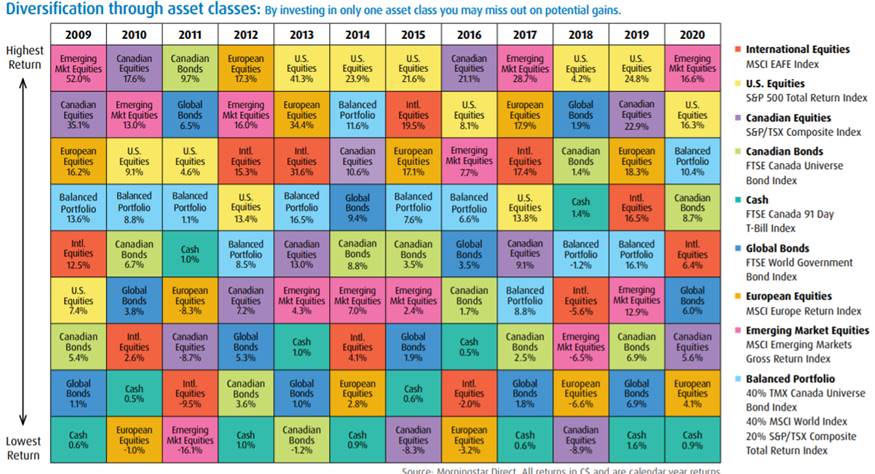
So, what does that look like from a market leadership perspective? As the recovery unfolds and economic activity accelerates, we would expect market leadership to align with that of the left column of the chart above.

We have already seen a steepening yield curve with longer-dated bond rates rising:  this could temper the strong run up in growth-oriented stocks. Near the end of last year, the move from growth stocks to more value-oriented cyclical stocks, and the move from large-cap stocks to small/mid-cap stocks started to occur. Many of these stocks, especially names in the S&P 500®, will tend to benefit more from the economy and society reopening. Continue Reading…

Projected Inflation and investment returns

FP Canada issues guidelines every year to help financial planners make long-term financial projections for their clients that are objective and unbiased. The guidelines include assumptions to use for projected inflation and investment returns, wage growth, and borrowing rates. It also includes “probability of survival” tables that show the life expectancy at various ages.

The 2021 Projection Assumption Guidelines were of particular interest because, well, a lot has happened since the 2020 guidelines were published last spring. How should we project inflation and investment returns as we get to the other side of the pandemic and economies start opening up again?

Will we see sustained higher inflation? Should we expect any returns at all from bonds or cash? Should we lower our expectations for future stock market returns?

Remember, these are long-term projections (10+ years). That’s very different than guessing the direction of the stock market for 2021, or predicting whether we’ll see a short burst of inflation in late 2021, early 2022.

The inflation assumption of 2.0% was made by combining the assumptions from the following sources (each weighted at 25%):

  • the average of the inflation assumptions for 30 years (2019 to 2048) used in the most recent QPP actuarial report
  • the average of the inflation assumptions for 30 years (2019 to 2048) used in the most recent CPP actuarial report
  • results of the 2020 FP Canada/IQPF survey. The reduced average was used where the highest and lowest value were removed
  • current Bank of Canada target inflation rate

The result of this calculation is rounded to the nearest 0.10%

Projections for equity returns were set by combining assumptions from the following sources:

  • the average of the assumptions for 30 years (2019 to 2048) used in the most recent QPP actuarial report
  • the average of the assumptions for 30 years (2019 to 2048) used in the most recent CPP actuarial report
  • results of the 2020 FP Canada/IQPF survey. The reduced average was used where the highest and lowest value were removed
  • historic returns over the 50 years ending the previous December 31st (adjusted for inflation).

Equity return assumptions do not include fees.

Unlikely that bonds can replicate their projections of last 50 years

Projections for short-term investments and Canadian fixed-income returns included the assumptions from QPP and CPP, the results of the 2020 FP Canada/IQPF survey, but the 50-year historical average rate was removed in 2020 as a data source. This makes sense given that interest rates were significantly higher than they are now and so it would be impossible for bonds to replicate the performance of the last 50 years. Continue Reading…

The Bubble blowing contest

Wellington-altus.ca/standupadvisors

By John De Goey, CFP, CIM

Special to the Financial Independence Hub

One element of Bullshift that I cannot help but notice is how the finance business has selective and self-serving definitions and explanations that abound when explaining the business to the public.

We’ve already discussed how a 10% move downward is called a “correction”,  but there is no term for a 10% move upward.  Is that an “incorrection”?  Who decides what is correct or not, anyway?

The related term that I often find a bit amusing is the word “bubble.”  Before reading further, take a moment to reflect on what you believe the word means when used in an economic context.  Have you got it?  Don’t read further until you have a firm definition and / or example of ‘bubble’ in your mind.

According to Wikipedia:

An economic bubble or asset bubble (sometimes also referred to as a speculative bubble, a market bubble, a price bubble, a financial bubble, a speculative mania, or a balloon) is a situation in which asset prices appear to be based on implausible or inconsistent views about the future.

Advisors usually acknowledge bubbles after they burst

In my experience, advisors generally only acknowledge bubbles after they burst.  Here’s a fictional story to illustrate that conditional acknowledgement.  Let’s pretend a pair of 12-year-old boys are in the world championships of bubblegum blowing.  The one with the biggest bubble wins, provided the bubble is generally accepted by judges without bursting first.

Three esteemed economists have been hired as judges in the contest. The boys get their gum, chew it and begin to blow their bubbles.  In short order, the bubbles become remarkably large.  Unbelievably large.  And identical in size …. there’s nothing to choose between them!  The judges can’t decide which of the bubbles is bigger … and yet they get bigger still.  Eventually, one of the identical bubbles bursts and the kid with the unburst bubble holds his position for a couple of seconds for the judges to acknowledge that his remains intact: and then inhales the gum back into his mouth, thinking he has won. Continue Reading…