For the first 30 or so years of working, saving and investing, you’ll be first in the mode of getting out of the hole (paying down debt), and then building your net worth (that’s wealth accumulation.). But don’t forget, wealth accumulation isn’t the ultimate goal. Decumulation is! (a separate category here at the Hub).
Remember piggy banks? I sure do. Piggy banks stuffed with loonies, quarters, dimes, nickels and pennies (remember pennies?) My piggy bank helped me save for so many precious purchases when I was growing up.
During those childhood years, my piggy bank was the equivalent of a low-risk savings vehicle (I’d say ‘no-risk’ but it did shatter if dropped). I knew exactly where my money was and how much I had. The only thing the savings in my piggy bank could not do was grow on their own.
I wasn’t yet an investor; I was a saver. Today I lead a team which helps Canadians to be both, through a solution we’ve just reinvented: the humble GIC (Guaranteed Investment Certificate).
For decades, GICs have been the preferred choice for Canadians looking to invest savings, with the guarantee that their initial investment (principal) would be fully protected.
The market stepped things up by giving some GICs an equity twist – tying GIC returns to the equities markets – for Canadians seeking the security of GICs but looking for opportunities to increase their return potential. As with traditional GICs, an investor’s initial investment is 100% guaranteed. Unlike traditional GICs, equity-linked GICs are connected to stock market performance, linked either to various indexes or a basket of stocks, offering investors potential gains from market returns.
New GIC linked to ESG
Specifically at RBC, this summer we introduced our first GIC based on ESG (Environmental, Social and Governance) factors – the RBC ESG Market-Linked GIC – and our first GIC to track the performance of a customized basket of 20 North American companies – the RBC North American MarketSmart GIC.
Our ESG GIC is a direct response to the growing interest we’ve been seeing among Canadians in looking beyond a company’s balance sheet when making investment choices. If you’re an investor who wants to help make a difference in the world by including ESG considerations in your investment decisions, our ESG GIC is purpose-built for you. It’s linked to a global index of environmentally and socially responsible organizations, all of which must first pass a set of rigorous ESG standards. To be included in the index, each company must demonstrate positive ESG metrics, low carbon impact and strong financial health. Continue Reading…
Financial struggles can significantly contribute to the well-being of business owners. Juggling the books to make sure you keep your head above water can be challenging. None more so than in the wake of the pandemic. Businesses big and small have experienced financial struggles in some way; it has not been easy.
Read on to discover some of our top tips for managing your finances as a small business:
1.) Create Detailed Budgets
It goes without saying that knowing your business profits and outgoings is critical to your ongoing and future success. Without this information, your business will suffer. Create a budget for your company as early as possible. Include any outgoings that you will have to pay.
Comparing the outgoings against the money coming into your business will give you a better idea of your financial health as a company. Assess this information frequently, for your income and outgoings will naturally fluctuate over time.
Keeping up to date with any market changes and internal business factors will significantly impact your ability to manage your finances but are not the only means for doing so.
2.) Educate Yourself
Being at the helm of a business means learning something new every day. Whether you learn something through your own efforts or the means of someone else within your company, educating yourself on business practices on a regular basis will go a long way. Continue Reading…
What should someone know before applying for life insurance?
To help you prepare for life insurance application processes, we asked insurance experts and business leaders this question for their best advice. From researching the required health tests to budgeting monthly costs, there are several tips that may help you when applying for life insurance.
Here are eight things to know before applying for life insurance:
● Know What Test Might be Done
● Clarify Term Life vs. Whole Life
● Determine Your Why
● Gather Your Paperwork Early
● Check Your Health Prior
● Assess Length of Policy
● Budget Monthly Costs
● Figure Out Future Needs
Know What Tests Might be Done
In the past, my life insurance companies would test for marijuana and reject applications for applicants who tested positive for marijuana use. However, since marijuana is legal in several states, but still illegal at the federal level, it is wise to work with an insurance expert to help work you through the process so you can find the right policy at the best rates to meet your needs. — Chris Abrams, Marcan Insurance
Clarify Term Life vs Whole Life Insurance
Learn the difference between term life insurance and whole life insurance so you can select the option that works best for your situation and budget. Term life insurance is an agreement between you and your insurance provider that lasts between 10-30 years. This type of insurance does not usually require a health exam. On the other hand, whole life insurance is truly meant to last your lifetime and carries additional benefits. However, it is also more costly. Understanding how these policies differ can help you make an educated decision about your life insurance. — Brian Greenberg, Insurist
Determine Your Why
The reasons why you are getting life insurance factor into the coverage amount and type of coverage you’ll receive. This can also help motivate you to stay consistent with payments. Most people who have families that rely heavily or solely on them for financial support and stability might opt to get sufficient life insurance coverage in the event of an unexpected death. Depending on the amount and type of life insurance, you provide an income replacement for your family in your absence. –– Rronniba Pemberton, Markitors
Gather Your Paperwork Early
Before applying for life insurance, it’s important to know what kind of personal information you’ll need to give the company. Some companies require detailed medical records while others just require simple information such as your name, date of birth, place of residence, and social security number. Prepare documents accordingly to ensure there won’t be any surprises along the way. — Tim Mitchum, WinPro Pet
Check Your Health Prior
Before applying for life insurance, you should be aware of your health. If you are rejected for life insurance, you could be affected down the road. You could have trouble getting life insurance from another company. Your credit score could even be lowered. The cost of life insurance could be raised out of your reach due to poor health. Learn if you have a preexisting condition. You can be denied life insurance if you have preexisting conditions. Check on the status of your own health condition before asking a life insurance examiner to look at you. — Janice Wald, Mostly Blogging Academy
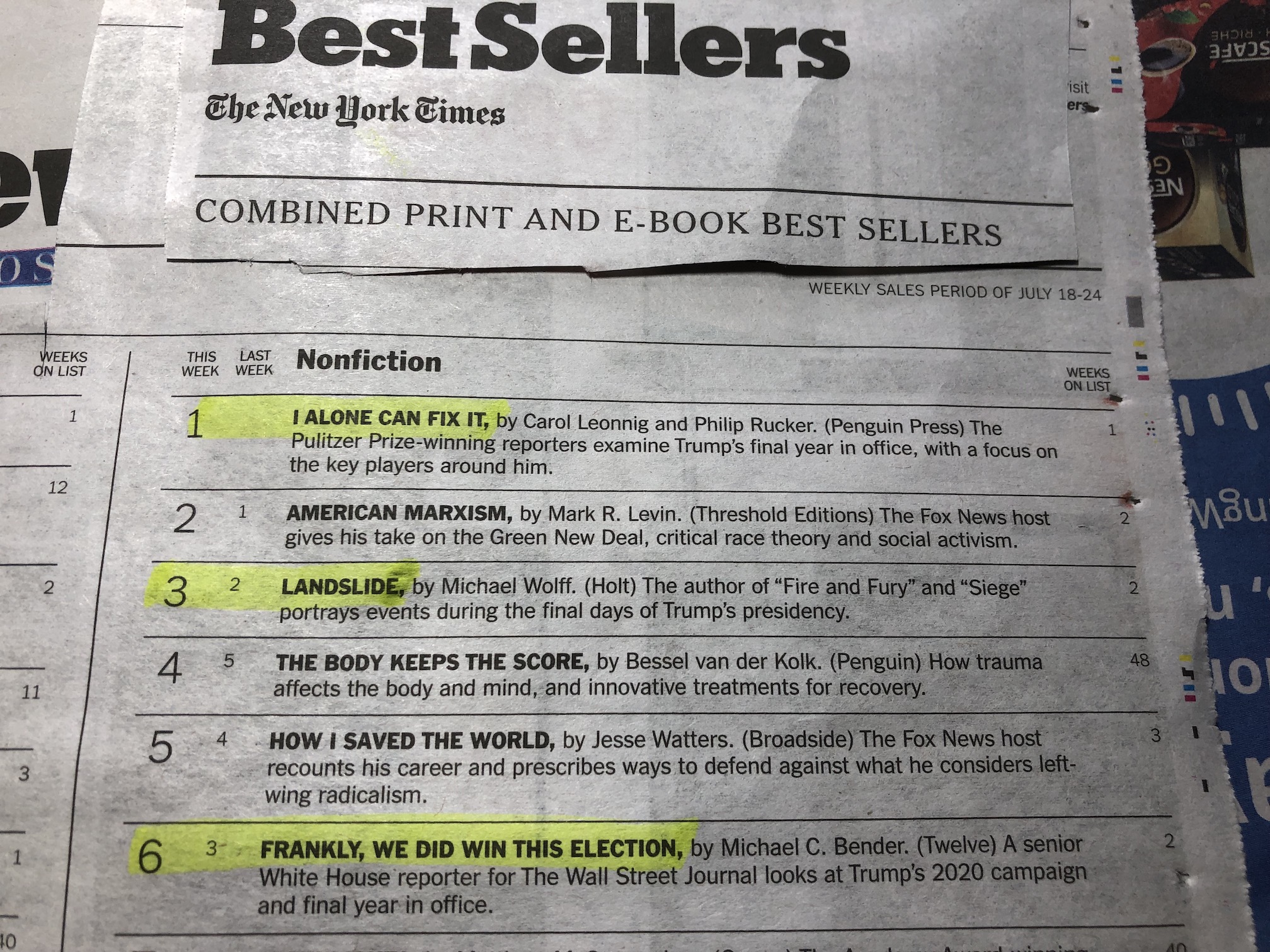
Sadly for democracy, the summer of 2021 has seen yet another flurry of books about former US president Donald Trump. The three main ones are shown in the photo above (taken from the Toronto Sunday Star’s reprint of the New York Times Book Review that appeared on August 15th, referencing late July sales).
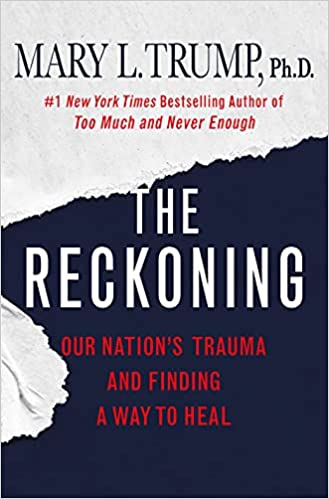
And two more may shortly join them on the list, both by authors who have tackled this terrain at least once before: one by Bob Woodward, Peril, coauthored with Robert Costa, and Mary Trump’s sequel, The Reckoning, which came out this week, more on which below.
While we did publish a version of this blog earlier this summer I have revised it to reflect the fact that the three books already published make up three of the top six bestsellers .
Notice that all three titles originated with words originally from Trump’s mouth. I have now read or listened to all three of I Alone Can Fix It (number 1 on the adjacent list), Landslide (number 3) and Frankly, We Did Win This Election (Number 6). Thank you for the sympathy.
In the case of the three books already out and flagged above, I borrowed ebooks or audio books from the Toronto Public Library’s excellent Libby service and/or a paid service called SCRIBD: a paid service that has a 30-day free trial. Not being a Trump fan, I really don’t relish the idea of actually paying for these books, although you could also argue the authors are performing a public service in reminding American voters of the folly they committed in 2016 and may yet repeat in 2024.
I certainly hope that these five books will be the last batch but fear that we’re not even close. 45 — as I prefer to call him — grabbed an outsized share of the world’s attention during his ill-fated first term and it’s well within the realm of possibility that he will continue to do so in what may prove to be a mere interregnum of the Joe Biden presidency.
If, God forbid, 45 also becomes 47 by winning in 2024 then all told the world would be subjected to more than 12 years of his commanding the media’s attention and that of the publishing world, like it or not. The implications for the global economy and by extension the stock market are not, I think, pretty, should the worst happen.
True, 2024 may seem like a long shot, given 45’s age (75), obesity and poor dietary and exercise habits, not to mention the multiple criminal and civil legal cases unfolding against him. One hopes that eventually all this will catch up with him and that the American electorate will finally wise up to the conman/would-be dictator. You can fool some of the people all of the time but are there really 74 million Americans who are blinded to 45’s obvious faults?
So far, he’s got away with everything
CNN.COM
Apparently so. As Mary Trump wrote in the closing pages of her book on her uncle, Too Much and Never Enough, “So far he’s gotten away with everything.” He’s dodged every bullet fired at him during his checkered career as real estate mogul, reality TV star and twice-impeached US president.
In her followup book, Mary outlines her ideas on how America can cope with the aftermath of her uncle’s chaotic four years.
Again, I read a library e-book and found the 205 pages of The Reckoning to be a fairly quick read. Roughly half the content reprises the first book and its focus on Uncle Donny. The other half, including the opening chapter, covers perhaps more American history than most Canadians will be interested in: especially its native origins and early days of slavery of Black Americans and/or a lot of analysis and recommendations for how America can emerge from the “trauma” that psychologist Mary Trump hypothesizes afflicted her and many other Americans following her uncle’s 2016 electoral victory.
Certainly, she has not dialled down her rhetoric about her uncle. A few sample passages:
She concedes that 74 million people voted for Donald, who she describes as “the least worthy person I can imagine.”
“…. despite, or because of, the four years of incompetence, cruelty, criminality, grifting, unconstitutional behaviour, treachery, treason, and most breathtaking of all, the fact that almost there hundred thousand Americans had died by Election Day as a direct result of Donald’s willfully malicious inaction.”
Or:
“Donald wasn’t just incompetent, laughable, and cruel — though he was all of those — he was actively laying the groundwork, through his rhetoric, his policies, and his perversion of democratic norms and institutions, for autocracy.”
What has this to do with Financial Independence?
What has all this got to do with Financial Independence? At first blush, not a lot. See for example this Hub blog I wrote from 2018: The glut of books about Trump and prospects for Boomers’ retirements. If he actually wins back office from 2025 to 2029, many of his generation will be retired if they’re not already.
The last time we looked at Trump books was last fall, as we steeled ourselves for the possibility of his reelection: apart from the Mary Trump book cited above I reviewed Michael Cohen’s Disloyal and Bob Woodward’s Rage. Again, note that Woodward is about to publish Peril, another book about Trump’s last year in office, coauthored with the Washington Post’s Robert Costa.
Which brings us to the three bestsellers flagged in yellow in the list at the top of this blog. Apart from them, hose interested in the Covid aspect of the Trump presidency might also want to read Nightmare Scenario. I enjoyed it, although anyone paying attention to the news throughout 2020 will be familiar with the story arc: 45’s initial and ongoing denial of Covid, his attempt to keep the stock market from being spooked by it, and on through Operation Warp Speed and Pfizer’s announcement of its successful vaccine scant days after the election, which of course infuriated 45. Mary Trump’s The Reckoning also spends a lot of time on Donald’s negligence with respect to the pandemic
Landslide
This is Michael Wolff’s third book on Trump, which in itself should be cause for pity for this author. The New York Times favourably reviewed this along with I Alone Can Fix It. Continue Reading…
My latest MoneySense Retired Money column revisits the topic of Core & Explore. You can find the whole column by clicking on the highlighted headline here: Rethinking Core & Explore.
If the image on the left looks familiar, it’s because we used it last week to illustrate a republished blog on Explore by Michael J. Wiener, the blogger behind the popular Michael James on Money blog.
Go back to a couple of my Retired Money columns the last year and you’ll see I touch on the topic of speculation for retirees more than once, usually couched in the context of Core & Explore.
“Core” is the prudent long-term strategy inherent in the MoneySense ETF All-Stars: low cost, diversified across geographies and asset class. Fully takes advantage of the “only free lunch:” that of broad diversification.
“Explore” on the other hand, is the polar opposite. The theory is that if you’ve taken care of 80 or 90% of your “Core” or Serious Money, you can go crazy with the other 10 or 20%, by “scratching the itch” of taking flyers on all those crazy things we’ve seen lately, like SPACs, cryptocurrencies etc., nicely surveyed by CFA Steve Lowrie in this recent blog: SPACS, NFTs and another Tech-inspired Silly Season.
Of course, as long as markets keep soaring, it’s hard not to love assets like Bitcoin or Ethereum, which may have tripled or quadrupled in a matter of months. Anyone who bought Tesla a year or two ago, or the ARK ETFs that were roughly 10% in Tesla and many comparable high flyers, was looking like an investing savant by the end of 2020, including Yours Truly. Continue Reading…


 Posted By


 Posted By