For the first 30 or so years of working, saving and investing, you’ll be first in the mode of getting out of the hole (paying down debt), and then building your net worth (that’s wealth accumulation.). But don’t forget, wealth accumulation isn’t the ultimate goal. Decumulation is! (a separate category here at the Hub).
Retirement is for winding down, while Bitcoin is ramping up. It might seem like the two things do not have much in common, but on closer inspection, there is definitely room for some crossover.
Recently, CNN reported that Bitcoin was going mainstream, with one of the reasons being popular innovators like Elon Musk making substantial investments. More people are taking part now, using Bitcoin to its fullest potential. When it comes to retirement, it can certainly enrich that stage of life a great deal.
Here some reasons as to why Bitcoin and retirement could well be a perfect match.
A Sense of Freedom
Retirement is for enjoying a sense of freedom, taking your life in whichever direction that suits you when you are free of obligations. Coincidentally, Bitcoin presides over a similar ethos.
In an article by Forbes titled ‘How Bitcoin Fits In A Retirement Portfolio’, they insightfully note that “If you could invest with hindsight, you’d go back in time, put 100% of your money in crypto and hold tight to the roller coaster […] over a long stretch it has, unlike lottery tickets, delivered a positive return, and most of the time goes its own way, oblivious to the stock market.” No doubt many people of retirement age look back on numerous points in their life and wonder: what if?
As Bitcoin is trending up, a decent investment today can turn into a small fortune after a few years. Remember, Bitcoin was under US$5000 last year and is currently priced at US$55000. If a retiree had bought 1 BTC last year, his investment had increased tenfold. Price swings like this have become quite common, just imagine what the value of Bitcoin could be after a decade. All one had to do is buy Bitcoin and hold it. Continue Reading…
The interest in Blockchain has surged in recent months as Bitcoin goes on a record run. Naturally, the two are inherently linked but one common mistake investors make is to assume one equals the other.
Unfortunately, it is a mistake made by many and one that could not be further from the truth. Blockchain is not Bitcoin, and Bitcoin is not Blockchain.
Without going into great technical detail, Blockchain is the technology that underpins the Bitcoin cryptocurrency. Blockchain powers Bitcoin and while it was initially created for Bitcoin, they are not one and the same.
Decentralization
Blockchain is a decentralized database or a ledger that is distributed across many computers. Hence, why it is referred to as decentralized. Arguably, it is what makes Blockchain’s technology so revolutionary and why the use cases expand far beyond that of cryptocurrencies.
Many believe that Blockchain’s decentralization will revolutionize the way companies do business. For one, it is largely considered to be safe as there is no single point of attack for which to target. Secondly, Bitcoin has made the use case for making digital transactions much easier (and secure). Finally, given its nature blockchain leads to greater transparency, increased accuracy and ultimately, can lead to significant cost reductions.
The potential use cases for Blockchain are too many to list but include things such as executing contracts, maintain records and auditing. Today, organizations worldwide are investigating how they can utilize and adopt Blockchain technology.
How can investors benefit?
Exchange Traded Fund (ETF) investing, is one of the simplest ways of gaining exposure to a broad base of assets. Canadian ETFs cover markets, sectors, industries and in some cases, get down to specific niche industries. Blockchain is one such niche industry and in Canada, there are two solid options for investors.
Harvest’s Blockchain Technologies ETF (TSX:HBLK)
It is worth noting that there have been a few failed attempts at Blockchain ETFs in the past and today, Harvest’s Blockchain Technologies ETF is one of the only one’s left standing. The fund aims to track the performance of the Harvest Blockchain Technologies Index. HBLK (TSX:HBLK) invests in equity securities of issuers exposed, directly or indirectly, to the development and implementation of blockchain and distributed ledger technologies.
he fund is now two years old having first launched in December of 2018. A $10,000 investment in HBLK would be worth $13,699 as of end of November. Worth noting that the fund was underwater until it made a big comeback this past June.
Holdings include a mix of well-established large caps and stand-alone emerging blockchain companies. As of end of November, emerging and large cap companies accounted for 55% and 44% of the fund. It carries a high 0.65% Management Expense Ratio (MER) fee and is eligible for most account types.
As of writing, the company is trading at $15.00 per share, a 9.4% premium to its net asset value (NAV) of $13.70 per share. It is a smaller ETF, with holdings of approximately $10.5 million and as such, is prone to greater volatility.
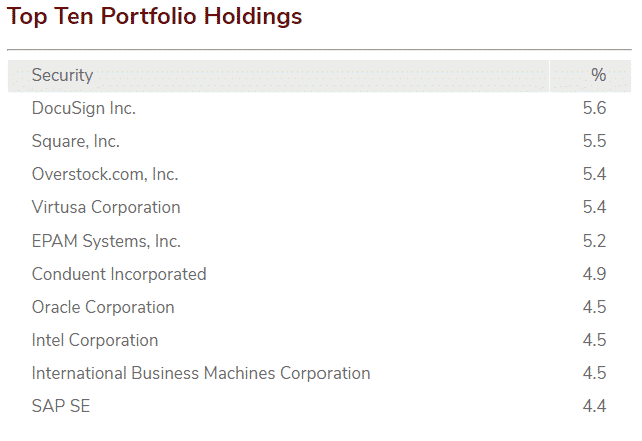
The ETF appears to be well diversified with no holding accounting for more than 6% of the fund. Combined, the Top 10 account for approximately 50% of assets. Among the notable names, there are upstarts and hypergrowth stocks such as DocuSign and Square which are complemented by large players such as Intel and Oracle.
Horizon’s Big Data and Hardware ETF (TSX:HBGD)
Although it is not explicitly stated in its name, Horizon’s Big Data and Hardware ETF (TSX:HBGD) is a blockchain focused fund. The fund seeks to replicate the performance of the Solactive Blockchain Technology & Hardware Index which tracks companies focusing on blockchain innovation and development, and companies providing hardware and hardware-related services used in blockchain applications.
Horizon’s ETF has a reasonable MER of 0.55% and at today’s price of $48.70 trades at a steep 20.15% premium to its NAV of $40.53. The fund was launched in June of 2018 and a $10,000 investment in HBGD at the time of inception would be worth $17,487 as of end of November. Much like HBLK, most of those gains have come over the past six months.
TSX:HBGD Dividend Adjusted Return
Somewhat surprisingly, the fund also pays a modest annual distribution of $0.3701 per share (0.76% yield). Distributions are rare for ETFs that track technology and growth stocks. Horizon’s ETF is made up of approximately 50% mid-to-large cap stocks, while 23% of holdings are microcap stocks. Once again, this is a small fund with only $7.1M in assets and is a higher-risk investment.
This is accentuated by the makeup of the company’s holdings.
The company’s Top 10 holdings are vastly different than that of HBLK. For starters, none of the Top 10 overlap. Although the Top 10 also account for approximately 50% of fund holdings, two companies – Hive Blockchain (TSX:HIVE) and Riot Blockchain (NASDAQ: RIOT) – account for ~30% of holdings. This means that the fund is more reliant on those two companies to drive performance.
Furthermore, half of the top 10 holdings trade on exchanges outside of North America and approximately 31% of total holdings operate in Asia. This makes it the more globally diversified fund of the two.
HBLK vs HBGD
Interestingly, both ETFs offer something different and can be held together without worry of much overlap. Harvest’s fund is likely to be less volatile given its exposure to some of the larger and more traditional tech companies. Continue Reading…
What is your strategy for managing the stress of running a small business?
To help you find new strategies for managing the stress that comes with running your small business, we asked small business owners and entrepreneurs this question for their best advice. From taking time to enjoy nature to setting boundaries, there are several different ways you can manage your stress.
Here are twelve strategies to managing stress while running a small business:
Remember Your Why
Regular Trips Out In Nature
Think About All The Impact You’re Making
Spend Time With Your Pets
Take Longer Breaks When You Need Them
Schedule Self Care
Personal Retreat Sessions
Give Autonomy To Your Team
Mindset Routines
Blocking Time
Setting Boundaries
Use The Pomodoro Technique
Remember your Why
When times get hectic, like they often do, it’s important to have your why statement clearly defined and visible to see at all times. Usually, when I’m feeling stressed, it’s because I am too caught up in the weeds and working “in” the business. By regularly scheduling time to work “on” the business, I start by remembering our why statement which brings my focus back to the big picture. This helps me get pumped and feeling way less stressed. — Jenn Christie, Markitors.com
Regular trips out in Nature
Here at Cruise America, we believe in working hard and playing hard. That is why the majority of our executives take advantage of our RV fleet and take regular trips out in nature. We find that this time out of the office reminds us of why we started this company years ago and the amazing experiences we provide for our customers. That’s what makes every day in the office well worth it! — Randall Smalley, Cruise America
Think about all the Impact you’re making
It is so easy to get caught up in the stress of running a small business and losing sight of why you first launched your company in the first place! Whenever I feel overwhelmed, I just think about all the good my company has done for cities and their communities over the last 37 years and it makes it all worth it. — Blake Murphey, American Pipeline Solutions
Spend time with your Pets
The best part of working remotely is that I get to spend all day with my dog! Whenever I start to feel stressed or overwhelmed, I love taking him on a walk or playing fetch with him on the beach. It is a great way for me to step away from my desk, get a healthy dose of Vitamin D, and of course spend some time with my fur baby. –– Carol Bramson, Side by Side
Take longer Breaks when you need them
Many people stress at work. They do overtime and compensate by accumulating extra holidays and taking spare time off. But by doing so, there’s also the impending fear of stress from having to go back to work. I make the most of every day at work, with myself, and with colleagues. I take longer lunch breaks when I want to—an extra hour to go to the lake or stroll around the city. And if you find yourself dozing off, ask colleagues to get a coffee outside of the office—or if you’re still lucky enough to get some sunshine—go for a gelato run collectively! Nobody ever says no to ice cream. — Hung Nguyen, Smallpdf
Schedule Self Care
Schedule self-care and breaks into your daily schedule. When you map out each week in your digital calendar or physical planner, schedule self-care, family time, and exercise first. These are your non-negotiables. Then schedule everything else work-related around these non-negotiables. Your self-care is unique to you! It may vary from a scheduled meditation time to daily walks, to 30 minutes reading a fiction book. But if you don’t plan for it, work will chip away at life, leaving you little in the way of work-life balance. — Reese Spykerman, Design by Reese
Personal Retreat sessions
Personal retreat sessions are a wonderful strategy to help manage the stress of running a small business. Retreat sessions create plenty of downtime and space for reflection, which is exactly what small business owners need to move naturally towards solutions that can solve stress-inducing issues. Continue Reading…
The traditional balanced portfolio is built for the current economic environment. It is built upon the premise, or guess, that we will remain in a disinflationary environment. It is all that today’s investor has known. In a disinflationary environment US and Canadian stocks and other developed markets perform well. US and Canadian bonds perform well. As you will have noticed, if you have a sensible balanced portfolio or even a portfolio that is heavily weighted to stocks – you’ve done very well. But things could change. The economic conditions could change. For that possibility you might consider a portfolio that is built for any economic condition – the Permanent Portfolio.
The portfolio blind spot
I “got” the portfolio blind spot framing from a Canadian financial planner. The planner stated that for them, inflation was a blind spot. It was not something that the planner understood or knew how to address.
So if many portfolio managers and financial planners don’t consider serious inflation or the possibility for a change in economic conditions (economic regimes) it’s not surprising that the everyday retail investor would not ‘get it’.
And by the way, I am told that advisors and planners are not trained ‘on this.’ They are not trained to protect your wealth in all economic conditions. The word “stagflation” does not show up in their training materials.
And for the record, here are the economic possibilities and what works best in each regime. The chart is courtesy of ReSolve Asset Management.
When you have a blind spot you could get side swiped.
As I detailed in the lost decade for US stocks, there are periods (long periods) when stocks simply don’t work. They deliver no returns, or no real returns (when we factor in inflation) for extended periods – even a decade or more.
For example, US stocks delivered no real returns for a 15 year period from 1968 through 1982. You can thank inflation for that.
Each stock market is different (that is US vs Canada vs other International) but that trend and fact remains. Stocks don’t always work.
All positive US stock gains over the last 130 years have occurred in disinflationary periods.
Not only that, the traditional balanced portfolio can also deliver no real returns for extended periods. The chart is for US stocks and bonds, but the conditions would not change change materially when we substitute or add in other developed market stocks and bonds.
ReSolve Asset Management
Where stock diversification would have helped (marginally) is in the early 2000’s period. Canadian and International developed markets did not suffer to the same degree, as did US stocks in the dotcom crash. It was the US stock market that suffered from greater euphoria and greater over-valuation “issues”. You mean, like today? You might ask.
So how do you build a simple portfolio to protect and prosper through all economic conditions?
The Permanent Portfolio
There are four economic conditions that can exist. The economy can grow or the economy can shrink – economic contraction. We can have inflation and we can have deflation.
And yes we can have periods of stagnation or muted movements for each of the above.
With inflation prices are increasing and so is your cost of living.
With deflation prices are falling and the cost of living is decreasing.
Putting it all together, we can have four quadrants or economic conditions.
Inflation in a period of economic growth.
Inflation in a period of economic contraction.
Deflation in a period of economic growth.
Deflation in a period of economic contraction.
Have another look that chart from ReSolve and you’ll see the economic conditions of the last 120 years and more.
Something is always working
The Permanent Portfolio is designed to hold assets that will perform in each economic environment. Something is always working. Continue Reading…
For better or for worse, cryptocurrencies have gained popularity, at least in part, due to their anonymity. As the industry develops and tries to shake the “crypto-is-for-criminals” reputation from its early days, the anonymity in certain areas fades.
Know Your Client requirements at crypto exchanges have become quite sophisticated. News reports keep appearing about popular crypto exchanges, such as Coinsquare in Canada and Coinbase in the United States, handing information about their account holders to local tax authorities.
The price of Bitcoin has more than tripled in the last four months. As lucky crypto investors consider whether to HODL (Hold On for Dear Life) or sell, they can be certain the taxman is watching. When can information about your crypto investments and earnings become available to the Canada Revenue Agency? Here are a few examples.
1.) If you are audited, the CRA auditor can get access to your crypto exchange account
If you are audited by the CRA for any reason, the auditor may come across a crypto exchange purchase on your bank or credit card statement. If so, expect follow-up questions from the auditor. If the auditor asks about your assets, you must disclose all your assets, including your crypto portfolio. Lying to the CRA is never a good idea and can lead to criminal charges.
The CRA has the power to compel third parties, including currency exchanges, to disclose information related to your crypto account activity through a so-called Requirement for Information (“RFI”). If a crypto exchange receives such RFI, they must either comply with it, dispute it at the Federal Court, or face criminal charges. Most Canadian-based exchanges will promptly release your information to the CRA.
2.) Even if you are not currently audited, the CRA may get access to your crypto exchange account as part of a so-called “unnamed persons” RFI
In some cases, the CRA can ask the Federal Court for an order to compel third parties to disclose information on a group of “unnamed persons” if the group is “ascertainable” and the purpose of the request is to verify the tax compliance of these taxpayers. A recent example of the CRA successfully exercising this power was a Federal Court order compelling Home Depot to disclose information about the accounts of its commercial customers. It appears that the CRA won’t hesitate to use this power when dealing with crypto exchanges.
In September of last year the CRA filed an application in Federal Court seeking an order to compel Coinsquare Ltd., a popular Toronto-based digital asset exchange, to disclose activity of its clients. All its clients. And all the way back to 2013, no less. Coinsquare disputed the application arguing that the group was not “ascertainable” and that the CRA engaged in a “fishing expedition” invading the taxpayers’ privacy.
On March 23, 2021, in its blog post, Coinsquare announced that it reached an agreement with the CRA for an order, whereby only a portion of accounts would be disclosed to the CRA on or before April 6, 2021. Coinsquare would produce to the CRA information on accounts valued at $20,000 CDN or more on December 31 in the years 2014 through 2020, along with 16,500 of the largest client accounts by trading volume during those periods.
3.) Proceeds of Sale of Cryptocurrency can be visible to the CRA
Whether or not you used a popular crypto exchange platform to sell or spend your cryptocurrency, the CRA may question the source of proceeds (traditional currency or assets purchased with cryptocurrency) you received in exchange. If you are audited, your reported taxable income should be consistent with that large deposit in your bank account or that late-model Tesla parked in your driveway. If the CRA finds a discrepancy, the consequences can be very serious.
4.) Crypto investments are only anonymous while your crypto address is not linked to your name. But if the CRA makes the connection, look out
Using the same crypto address for sending and receiving some types of cryptocurrency is like writing under the same pseudonym. If anyone ever connects your real identity to the pseudonym, all you ever published under the pseudonym will then be linked to you. Continue Reading…


 Posted By