For the first 30 or so years of working, saving and investing, you’ll be first in the mode of getting out of the hole (paying down debt), and then building your net worth (that’s wealth accumulation.). But don’t forget, wealth accumulation isn’t the ultimate goal. Decumulation is! (a separate category here at the Hub).
During the 20+ years I’ve been a financial advisor, I’ve noticed how often the market keeps playing the same devilish tricks, each time in a guise that differs just enough to fool us all over again.
Today’s “Stop Doing” post exposes one of these more common tricks of the trade: Investors who are seeking a reliable income stream for retirement should STOP building their investment strategy around dividend-paying stocks (or higher-interest-yielding bonds) in isolation, without considering them in the context of their total wealth management.
Speaking of devilish acts, let’s revisit The Wall Street Journal columnist Jason Zweig’s “The Devil’s Financial Dictionary” (emphasis is ours):
DIVIDEND YIELD, n. A company’s annual DIVIDEND divided by its current share price. “You buy a cow for its milk and a stock for its yield,” says an old Wall Street proverb. But when a company gets into financial trouble and has to cut its dividend to hoard cash for its own survival, the yield will shrink or disappear. Investors who buy a stock only for its yield may suddenly find themselves owning a cow that gives no milk and is too scrawny to butcher for the meat.
Clearly, I am not alone in my skepticism when I see investors investing in a stock because “it pays a good dividend.”
What is a Dividend?
Sweep away all the complexities about corporate profits, and you’re left with this truth: When a public corporation makes a profit, it has two choices on what to do with that cash:
Re-invest it back into the business, or
Return it to shareholders through cash dividends or share repurchase plans.
These concepts aren’t new. Nobel laureate Merton Miller and Franco Modigliani published a paper back in the 1960s, explaining why profits are profits, whether they’re “packaged” as dividends or share value. So, let’s take a look at why chasing dividend-paying stocks may not be all it’s cracked up to be. Continue Reading…
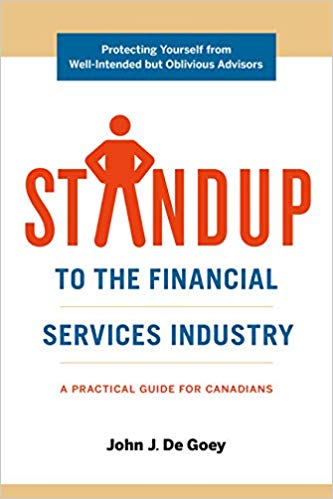
My latest MoneySense Retired Money column is a review of advisor John De Goey’s new book: STANDUP to the Financial Services Industry. Click on the highlighted headline for the full column: Fight for your right to low fees.
Obviously a retrofitted acronym, STANDUP stands for Scientific Testing and Necessary Disintermediation Underpin Professionalism. STANDUP was an undercurrent in the four editions of De Goey’s previous book, The Professional Financial Advisor. There he argued that while most advisors hold themselves out to be professionals like doctors, lawyers or accountants, the primary function of most advisors is “to sell products.” STANDUP Advisors are the good guys and gals: the “self-aware and knowledgeable advisors” his new book aims to help readers find. His personal website is www.STANDUP.today.
Bad advice they believe is good
Right from the get-go, De Goey is pretty harsh on many members of his profession. Much of what advisors believe is “demonstrably wrong” he declares right on page 2 of his introduction: “People who give advice for a living routinely give bad advice while honestly believing that the advice they are giving is, in fact, good. That’s a huge problem.”
He puts much of the blame on the managers of retail advisors, chiefly the senior members of Canadian mutual fund companies. He hauls out the old Upton Sinclair quote to illustrate the gap between doing what’s good for investors and what’s profitable for the financial industry itself: “It is difficult to get a man to understand something when his salary depends upon his not understanding it.” Continue Reading…
Tax Minimization Strategy for High Income Individuals
By Spencer Tilley, CFP, RFP, CFA
Special to the Financial Independence Hub
There is a common theme among high net worth and high-income earners: “How can I save on tax?,” and “What are the most tax efficient ways to save for retirement?”
No question that focusing on tax savings is the most crucial component to some of the most successful individuals in the world.
In Canada, RRSPs, TFSAs and pension plans are commonly utilized retirement vehicles, but what happens when you max out your available room? Unfortunately, as a salaried employee, your additional options for tax-efficient retirement savings are limited, or non-existent.
Retirement Compensation Arrangements (RCAs) are one strategy that not many know but may be available to you as a high-income earner.
What is an RCA?
RCAs are a tool for a high-income earner to save additional funds on a tax-deferred basis, over and above the RRSP/pension limits, for their retirement. It is funded by an employer for the employee’s long-term benefit. It was created to help supplement and overcome the income gap in retirement that occurs because of the relatively low annual prescribed RRSP/pension limits.
Basically, RRSP room has not kept pace with wage growth and there is essentially a cap on the amount that can be saved tax-deferred for retirement. RCAs help make up the difference between what can be saved for retirement and what is needed in retirement, on a tax-deferred basis.
Here’s what you need to know:
Today, top personal tax rates are over 50% in 7 out of 10 provinces, with the other 3 provinces clipping north of 47.5%. With these high personal tax rates combined with the recent changes in the Federal Government Small Business Tax regime, RCAs, along with the Individual Pension Plan (covered here), are making a comeback as a strong player in the retirement game for highly compensated executives and can provide a huge tax benefit for those who may qualify to use it.
How it works:
The employer contributes 100% of the amount, of which 50% is sent to the CRA, held in a non-interest bearing, refundable tax account and 50% is deposited to your RCA Investment account, held with a custodian where it can be invested on a tax-deferred basis. Withdrawals are taxed as regular income. Giving the CRA 50% of your money today may seem like a bad deal, but let’s examine the benefits a little closer:
The Benefits
Employee benefits (assuming top marginal tax rate):
In 7 out of 10 provinces, you would otherwise be paying the CRA 51.3%-53.53%, upfront and permanently. You are already ahead of the game in these provinces
In the other 3 provinces, you would pay 47.5%-49.8% to the CRA, so at most a 2.5% disadvantage. But …
The real advantage lies in your ability to withdraw the funds over time and at your discretion, rather than receive them personally all at once, thus (hopefully) reducing your income in any given year enough to drop you into a lower tax bracket and ultimately pay less tax
Contribution limits are not based on RRSP room and can exceed pension contribution limits by significant amounts
50% is contributed to the RCA investment account and invested for your retirement.
When you withdraw funds in retirement, 50% of your withdrawal is added back to the RCA investment account via a refund from the CRA refundable tax account (the 50% that went to the CRA at the beginning)
Funds are the employee’s in the end, whether the company is around or not
Employer benefits:
100% of the employer contributions are tax-deductible for the business
Key employee retention
The Downside/Risks
An actuary needs to be hired to implement and keep track of everything incurring an annual cost for administration” approximately $1,000/year
50% of the contribution is sent to the CRA in the form of a refundable tax
Money in the CRA account is held in a non-interest bearing account
Investment risk is taken on by you and not your employer (unless the RCA is funding for a defined benefit supplemental pension guaranteed by your employer)
Employment income needs to be high over the last 15 years to qualify
This is only for those who have maximized their pension benefits and cannot achieve 70% of their current income as retirement income with existing retirement plans
A company cannot ‘bonus down’ to keep income lower than the small business limit
Who this is best suited for:
High-income earners: groups of managers or executives, successful business owners, or other highly compensated individuals where income is tied to special employment incentives, such as a professional athlete.
Let’s review a simplified example:
Assume you have earned a $1,000,000 incentive paid above your usual salary of $314,928/year in Alberta, which you have received for the last 10-15 years. If you were to pre-plan with your employer and utilize an RCA, the benefit could be upwards of approximately $200,000 using the RCA strategy vs straight T4 income: that’s like an extra $10,000/year for 20 years of your retirement!
Some technical details:
If this $1,000,000 incentive were paid as T4 income, in Alberta you would pay $480,000 (48%) tax and you would keep $520,000 (52%). Continue Reading…
One of the most exciting events in most people’s lives is becoming a parent. Those who are currently bringing new kids into the world tend to fall into the Millennial generation, which includes people born between 1981 and 1996. These parents need to be prepared for many things they may not be ready for. Having a home security system is a good idea, but there are also many other financial considerations to take into account.
Kids are expensive
The cost of raising a kid is now estimated to be around US$233,000. That’s just until they are 18. Therefore, Millennial parents can expect to pay more than $12,000 per year for their little bundles of joy. Of course, there are ways to avoid some of these costs, like skipping out on day care costs by having one parent stay home until the child goes to school and buying clothes at thrift stores. Additionally, family members like grandparents might be willing to watch kids for a reduced fee, if they charge anything at all. Regardless, there are costs that come with having a child, and new parents should be prepared for them.
It’s important to get your documents together
Many parents fail to adequately prepare for the future. No one wants to die before their kids reach adulthood. However, there is always that possibility. Therefore, taking out a solid life insurance policy is a good idea. Also, setting up a will that indicates where the kids should go in the event that both parents die or become incapacitated will help ensure that the children stay out of the foster system.
College is coming up
Those who have a child this year will likely have between 18 and 19 years to get ready for college expenses. As of 2018, a year at a public four-year school at the in-state tuition rate averaged US$20,770, while a year at a private school costs just under US$47,000. Continue Reading…
If you want to practice law you must graduate from law school. If you want to be a doctor you need a degree in medicine. But what if you want to be a financial advisor who counsels people on how to handle their money and their investments? Until now, pretty well anyone could hang a shingle, but thankfully, those times appear to be changing which is good for the consumer/investor.
The recent 2019 Ontario Budget had a proposal to formally regulate the terms ‘financial adviser’ and ‘financial planner.’
What’s the difference? The adviser helps clients manage their investments, but the planner is a bit different. A financial planner helps you identify and meet your goals. That may be paying for your child’s post-secondary education, paying off your mortgage, or just getting everything in place so you can retire comfortably.
While one needs a professional license to offer advice on the purchase or sale of a stock, insurance policy, or mutual fund, until now pretty well anyone could claim to be a financial planner or wealth management adviser who dishes out general advice for the masses.
Forensic financial planning
But bad or erroneous financial advice from one who isn’t properly qualified can be disastrous for the client/investor, and I have seen it happen all too often. Those of us in the industry call this ‘forensic financial planning’ and the key word there is forensic.
What exactly am I talking about? It might be putting too much weight into something like whole life insurance or high-risk securities. It might be not taking a prudent look at leverage in your investments. Or buying expensive mutual funds that don’t pan out. Continue Reading…


 Posted By
 Posted By