Building Wealth

For the first 30 or so years of working, saving and investing, you’ll be first in the mode of getting out of the hole (paying down debt), and then building your net worth (that’s wealth accumulation.). But don’t forget, wealth accumulation isn’t the ultimate goal. Decumulation is! (a separate category here at the Hub).

How to teach your children good financial habits

Special to the Financial Independence Hub

Teaching your kids sound financial habits when they’re young can help them learn to make wise choices about their money, and ease their reliance on you later.

Alison Tedford blogs about parenting at Sparkly Shoes and Sweat Drops, and at home is a dedicated mom who teaches her eight-year-old son Liam about finances, among other life lessons. We spoke with Alison as well as Jeannette Brox, CFP®, a senior financial consultant with Investors Group in Toronto, who’s affectionately called “The Money Lady” by her clients’ children.

The value of effort versus reward

To help instil a sense of the value of money in Liam, Alison enlists Liam’s help as she works on her blog and manages her social media channels, and ensures that he understands the financial value of each activity. “When he wants something, we tell him it’s the value of a blog post, or a Facebook Live video,” she says. “That way, he understands the value of the item relative to the effort he needs to put into it. Then he can make a judgement call as to whether the money should be spent or not.” When a larger contract comes in for Alison, they discuss how to use the money as a family.

This principle of making money choices can be adapted to your child’s age and situation. For example, a new iPad might be equivalent to 20 “regular” toys. Or, if your child receives an allowance, you can help them understand the length of time it’ll take to save for what they want and what they might need to give up in the meantime. It all adds up to an important money (and life) lesson about short-term compromise to reach long-term goals.

Jeanette Brox, CFP, Investors Group

In Jeanette’s practice, she gets her clients’ kids to start saving monthly at a young age. “It becomes meaningful for them,” she says. “When they get older, they understand the power of money accumulating instead of blowing it on stuff.”

She uses the same “save early and often” approach for children of different ages, although the situations will be different. “A six-year-old is excited when they’re saving to contribute to something they want. When they finally get it, they have pride of ownership.” She’s also helped kids save up for things they may want in their teenage years, such as a car, and advised teenagers who are buying sports equipment to get it off peak season to save money.

Jeanette also encourages kids to save for their own post-secondary education. “Even if parents contribute to an RESP, there may not be enough money to cover all of their university or college expenses.” And she recommends that children cover the cost of their own first year of school. “It makes them more responsible to have made that financial commitment,” she says.

Problem-solving helps form sound financial habits

Alison engages in proactive problem-solving to teach her son responsibility, even in situations unrelated to money. “For instance, it’s a common parenting challenge to have kids come to you with homework that didn’t get done that now has to get done in a short period of time,” she says.

Instead of jumping to do the task for Liam when this happens, Alison points him in the right direction by asking him to troubleshoot how he can help himself and to analyze what got him into the situation in the first place. “We look at contingency planning for the next time, such as setting reminders, tracking deadlines and so on.” Continue Reading…


Why simplicity beats complexity

Special to the Financial Independence Hub

Complexity. It’s hard to avoid.  Tune into the news, and something’s always breaking.  Even in your own life, how many “other” tasks get in the way of the good stuff?

I’m not suggesting you should only do what is immediately gratifying.  There’s considerable enjoyment to be found in taking on tough challenges.  But today I want to focus on why simplicity beats complexity, especially when it comes to your personal finances.

Simplifying your investments

When it comes to writing about investments why reinvent the wheel?  I agree with every point “A Wealth of Common Sense” blogger Ben Carlson makes in this excellent piece, “Why Simple Beats Complex.”  Instead of writing an overly repetitive post, I recommend you give this a read.  Basically, we are prone to using our oversized brains to over-complicate things, especially investments.  Simple advice:  Don’t do that.

Simplifying your finances

While I don’t want to split hairs, there is a subtle, but incredibly important difference between financial goals, financial plans and financial planning.  Knowing the difference helps simplify all three. Continue Reading…

Generation X feeling the Retirement squeeze

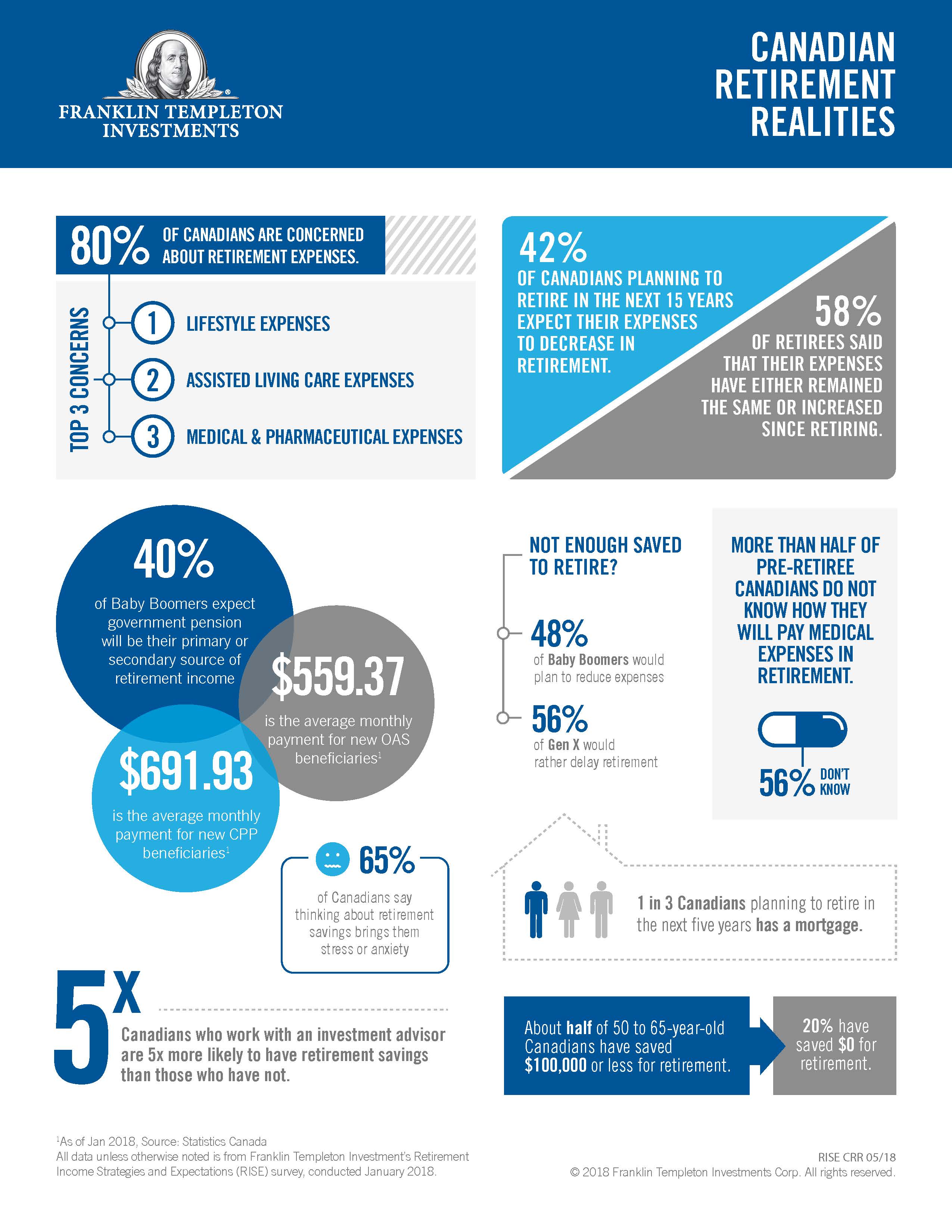
Generation X, and to a lesser extent the Millennials, are already starting to feel the retirement squeeze, according to a Franklin Templeton-sponsored survey released Thursday.

Details are in my column in Friday’s Financial Post, which you can retrieve by clicking on the highlighted headline here: Generation X is ‘stretched beyond their financial limits’ and struggling to save for Retirement. 

The challenges should be familiar to members of any generation (four are mentioned in the survey): it’s never easy saving money when you’re starting out in life with low wages and high expenses. But Franklin Templeton cautions against the  rationalization embraced by younger investors that they simply can  choose to keep on working if they haven’t accumulated enough assets to generate adequate income in retirement.

That may not always be an option, since ill health or corporate downsizing (to mention just two) may prevent this. You can find full details about the fifth annual edition of Franklin Templeton Investments Canada’s 2018 Retirement Income Strategies and Expectations (RISE) survey here.

Stressed GenX resigned to retiring later than hoped

More than half of Gen Xers (aged 37 to 52) are resigned to retiring later than they would want (56% in Canada, 59% in the US). While the online survey included Canadians and Americans across four generations, “this year we felt in particular that Gen X and the stress of preparing for Retirement was the predominant thing coming out of the research,” said Matthew Williams, a Franklin Templeton senior vice president, in an interview.

Continue Reading…

How to win at tax-free investing: RRSPs, TFSAs and Dividend Stocks

Tax-free investing can help you save money over both the long and short term if you invest using these tips.

Tax-free investing and using tax shelters are strategies employed by many successful investors.

Tax shelters are legal investment vehicles that let investors pay less tax. While some are risky and should be avoided, like flow-through limited partnerships, others, like RRSPs and TFSAs, are great ways for Canadian investors to cut their tax bills.

Here are the best ways to defer or lower the amount of tax you have to pay on your investments.

Tax-free investing with Registered Retirement Savings Plans (RRSPs)


RRSPs are a great way for investors to cut their tax bills and make more money from their retirement investing. RRSPs are a form of tax-deferred savings plan. RRSP contributions are tax deductible, and the investments grow tax-free.

You can put money in RRSP tax shelters each year (up to a limit based on your income) and deduct it from your taxable income. You only pay income tax on your investment, and the income it earns, when you make withdrawals from your RRSP.

In a way, investment gains in RRSP tax shelters give you a double profit. Instead of paying up to 50% of your investment gains in taxes right after you make them, you keep 100% of them working for you until you take money out. That will likely be years later in retirement, when most Canadians enter a lower tax bracket.

If you want to pay less tax on investment income while you’re still working, investing in an RRSP is the way to go.

Tax-free investing with tax-free savings accounts (TFSAs)

A tax-free savings account lets you earn investment income — including interest, dividends and capital gains — tax free. But unlike registered retirement savings plans (RRSPs), contributions to tax free savings accounts are not tax deductible. However, withdrawals from a TFSA are not taxed.

TFSAs can generally hold the same investments as an RRSP. This includes cash, ETFs, mutual funds, publicly traded stocks, GICs and bonds.

Here are three tips you can use to make sure you’re getting the most profit—and tax benefits—from your TFSA:

1.) Keep higher-risk investments out of your TFSA: Holding higher-risk stocks in your TFSA is a poor investment strategy. That’s because high-risk stocks come with a greater risk of loss. If you lose money in a TFSA, you lose both the money and the tax-deduction value of the loss.

2.) Let your current income help you decide between your tax free savings account and RRSPs:RRSPs may be the better choice in years of high income, since RRSP contributions are deductible from your taxable income. In years of low or no income—such as when you’re in school, beginning your career or between jobs—TFSAs may be the better choice.

3.) Consider holding exchange-traded funds in your TFSA: It’s difficult to build a diversified portfolio within your TFSA. Instead, look to exchange-traded funds for TFSA investing.

Tax-free investing strategies can include saving on dividend taxes

Continue Reading…

A Canadian compromise on TFSA contribution room  

By John De Goey

Special to the Financial Independence Hub

Canadians are notoriously nice consensus seekers.  The old joke might be that they tend to never cross the road because they consistently prefer to be in the middle.  If that’s the case, I’d like to propose a “Canadian” solution to the ongoing debate about how much should be allowed to contribute to their TFSAs annually.

You may recall that the limit is currently set at $5,500 and is likely to go up to $6,000 in a year or two (TFSA contributions are indexed to cumulative inflation and go up in $500 increments when thresholds are passed). You may also recall that for one brief year, the limit was set at $10,000 in keeping with a political promise made by a party that is no longer in power in Ottawa.  The debate, it seems has mostly revolved around the benefit of incremental tax relief for those who might not need it.

You may recall that I have argued that there is an unfair cap put on RRSP contributions because the 18% limit that applies to most people essentially penalizes the small percentage of Canadian income earners who make more than about $145,000 a year.  Similarly, some people like CIBC’s Jamie Golombek have pointed out that many Canadians are opposed to using RRSPs because they will end up paying tax down the road when making RRIF withdrawals.  The point made by Golombek* and others including yours truly is that people should be thinking about the concept of ‘tax bracket arbitrage’ when contributing to government plans. If you’re in a higher tax bracket now as compared to in retirement, contributing to your RRSP makes more sense.  If you’re in a lower bracket, the TFSA makes more sense.  If you think you’ll be in the same bracket, it makes no difference.

Continue Reading…