Tag Archives: bonds

Getting your Fixed Income Fix with BMO ETFs

This article has been sponsored by BMO Canada. All opinions are my own.

Fixed income doesn’t get enough attention on this blog, mostly because I’m still in my accumulation years and invest in 100% equities across all my accounts. But most investors should hold bonds in their portfolio to reduce volatility and so they can rebalance (selling bonds to buy more stocks) whenever stocks fall.

In this post we’re going to take a deep dive into BMO’s line-up of fixed income ETFs. We’ll see that there isn’t a one-size-fits-all approach to investing in fixed income, and that investors can capture yield using a wide array of products and strategies.

DIY investors should be familiar with BMO’s suite of fixed income ETFs. It’s the largest in Canada with more than $23 billion in assets. At the top of the list is BMO’s Aggregate Bond Index ETF (ZAG) with total assets of $5.86 billion.

Robo-advised clients also have BMO fixed income ETFs in their model portfolios:

  • Nest Wealth clients hold BMO Aggregate Bond Index ETF – (ZAG)
  • Wealthsimple clients hold BMO Long Federal Bond Index ETF – (ZFL)
  • Questwealth clients hold BMO High Yield US Corp Bond Hedged to CAD Index ETF – (ZHY)
  • ModernAdvisor clients hold BMO Emerging Markets Bond Hedged to CAD Index ETF – (ZEF)

BMO Fixed Income ETFs

Investors are nervous about holding bonds today. Interest rates are at historic lows, and when rates eventually rise, we’ll see bond prices fall – especially longer duration bonds. We’re also seeing higher inflation, which causes interest rates to go up (and bond values to go down).

Q: Erika, investors are concerned about low bond returns, particularly from long-term government bonds. How should they think about the fixed income side of their portfolio?

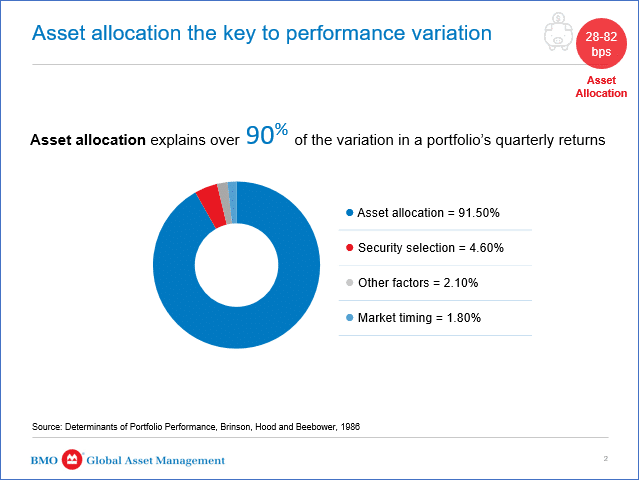
A: Investors should think of fixed income as a ballast in their portfolio. It helps reduce overall volatility (chart below). Correlations between US Treasuries and stocks (represented by the MSCI USA index) have been negative over the last two decades. All that to say, when stocks fall, bonds tend to do well.

BMO figure 1

Retired Money: how to prepare for “Transitory for Longer’ inflation

As oxymorons go, you have to love the phrase “Transitory for Longer,” which comes up in my latest MoneySense Retired Money column. It looks at inflation, which of course is in the news virtually every day this summer, and one reason why stock markets are starting to weaken again (along with renewed Covid fears). You can find the full MoneySense column by clicking on the following headline: How might Inflation impact your Retirement plans?

As with trying to divine short-term moves in stocks or interest rates, I view predicting inflation — whether near-term, medium-term or longer-term — as somewhat futile. So the column preaches much the same as it would about positioning portfolios for stock declines or rises in interest rates: broad diversification of asset classes.

Asset Allocation for all Seasons

The ever useful four asset classes of Harry Browne’s Permanent Portfolio I find may be a good initial mix of assets to prepare for all possibilities: stocks for prosperity, bonds for deflation, cash for depression/recession and gold for inflation. Browne, who died in 2006,  famously allocated 25% to each.

That’s a good place to start, although as I point out in the column, many might add Real Estate/REITs and make it a five-way split each of 20%. Some suggest 10% in gold (both bullion ETFs and gold mining stock ETFs), which might be expanded to include other precious metals like silver, platinum and palladium. Some might add to this a 5% position in cryptocurrencies like Bitcoin and Ethereum, which some view as “digital gold.”

To the extent stock markets and interest rates will forever fluctuate over the course of a retirement, such a diversified approach could help you sleep at night, as some asset classes zig as others zag. Seldom will all these assets soar at once, but hopefully it will be just as rare for all to plunge at once.

Annuities and new “Tontine” approaches

Another approach to this problem is not so much Asset Allocation but what finance professor Moshe Milevsky has dubbed “Product Allocation.” Continue Reading…

Bonds are back but what did they just say?


By Dale Roberts, cutthecrapinvesting

Special to the Financial Independence Hub

Bonds are the adult in the room. And when they speak, we should probably hear them out. This week [late June] bonds went on a tear. What were bonds trying to say? They were listening to the ‘Fed Speak’ in the U.S. that left many confused. Of course, the Federal Reserve and the Federal Reserve Chairman set the overnight rates that affect bond markets and our borrowing costs. It’s an economic lever. Maybe the adults in the room are suggesting that inflation is not a threat? We’ll see deflation in the near future? Or maybe a recession is closer than we think?

Here’s a good barometer for the bond market and economic sentiment – long term U.S. treasuries.

They’ve had a good month (and more) and they had an explosive week. The index ETF was up about 3% over the last two days. Long term treasuries are known as some of the best stock market risk managers. They punch above their weight.

Must read: Bonds are the adult in the room.

Recently I suggested that the stock and bond markets are buying the transitory inflation argument.

And in my most recent MoneySense weekly I had a look at some of the economic data for Canada and the U.S., including that recent Fed Speak and reaction.

Perhaps the bond market is going well beyond saying ‘inflation is transitory’. Let’s have a listen to what a few experts say about this weeks stock and bond activity.

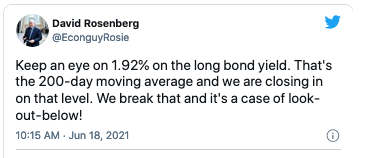
David Rosenberg says look out below.

In a recent Globe and Mail piece Mr. Rosenberg suggested that inflation jitters will turn into deflation fear by year end. (pay wall) Of course bonds like deflation. And that’s one reason why we hold bonds right? Even though almost no one thinks that we could enter a long period of economic contraction and deflation. From Mr. Rosenberg …

“When these temporary disturbances fall out of the data, people are going to be surprised at how low the readings are going to be on these official inflation statistics,” the famed Canadian economist said in an interview Friday.

“I think we’re going to go back to talking about disinflation and deflation [by] the end of the year.”

The boring balanced portfolio is having its way these days. Stocks for growth and bonds for ballast and no-growth scenarios. Readers will know that I am also a fan of covering off inflation as well, you’ll read about that in the new balanced portfolio.

Investing is like a box of chocolates.

To quote Forrest Gump, you just never know what you’re going to get. This past week gave us that big and important reminder. Who would have thought that bond investors would have a such a sweet week? I’m happy to hold long term treasuries and that TLT and the BMO Canadian dollar version in ZTL.

Mike Philbrick at ReSolve Asset Management offered via Twitter …

No one knows the future price of any asset class so diversification is incredibly important as the first line of defense.

And as an example, pick your poison of inflation or deflation or economic shocks of any variety. More from Mike …

Another great example, why making sure investors are always exposed to inflation shocks rather than trying to time it … Money and mindshare piled in recently but all the returns came months before that, when investors were not noticing.

Perhaps there is no real economic growth?

Perhaps the bond markets echo Lance Roberts (no relation), CIO and partner at RIA Advisors, with respect to what is real and sustainable economic growth?

The reason that rates are discounting the current “economic growth” story is that artificial stimulus does not create sustainable organic economic activity.

And on the inflation front from Lance, you can’t create real inflation from artificial growth. From that post …

Yes, we see that word “deflation” again.

Rethinking the 60/40 portfolio?

That has been a hot topic for quite some time given the low yield environment. Many suggest tweaking up your equity exposure to the 70% level or so, if you have the risk tolerance. That was certainly covered in this post on the Horizons one ticket ETFs. Those portfolios employ U.S. Treasuries that help dampen the volatility of increasing equity exposure. Continue Reading…

The Permanent Portfolio

By Dale Roberts

Special to the Financial Independence Hub

The traditional balanced portfolio is built for the current economic environment. It is built upon the premise, or guess, that we will remain in a disinflationary environment. It is all that today’s investor has known. In a disinflationary environment US and Canadian stocks and other developed markets perform well. US and Canadian bonds perform well. As you will have noticed, if you have a sensible balanced portfolio or even a portfolio that is heavily weighted to stocks – you’ve done very well. But things could change. The economic conditions could change. For that possibility you might consider a portfolio that is built for any economic condition – the Permanent Portfolio.

The portfolio blind spot

I “got” the portfolio blind spot framing from a Canadian financial planner. The planner stated that for them, inflation was a blind spot. It was not something that the planner understood or knew how to address.

So if many portfolio managers and financial planners don’t consider serious inflation or the possibility for a change in economic conditions (economic regimes) it’s not surprising that the everyday retail investor would not ‘get it’.

And by the way, I am told that advisors and planners are not trained ‘on this.’ They are not trained to protect your wealth in all economic conditions. The word “stagflation” does not show up in their training materials.

And for the record, here are the economic possibilities and what works best in each regime. The chart is courtesy of ReSolve Asset Management.

When you have a blind spot you could get side swiped.

As I detailed in the lost decade for US stocks, there are periods (long periods) when stocks simply don’t work. They deliver no returns, or no real returns (when we factor in inflation) for extended periods – even a decade or more.

For example, US stocks delivered no real returns for a 15 year period from 1968 through 1982. You can thank inflation for that.

Each stock market is different (that is US vs Canada vs other International) but that trend and fact remains. Stocks don’t always work.

All positive US stock gains over the last 130 years have occurred in disinflationary periods.

Not only that, the traditional balanced portfolio can also deliver no real returns for extended periods. The chart is for US stocks and bonds, but the conditions would not change change materially when we substitute or add in other developed market stocks and bonds.

ReSolve Asset Management

Where stock diversification would have helped (marginally) is in the early 2000’s period. Canadian and International developed markets did not suffer to the same degree, as did US stocks in the dotcom crash. It was the US stock market that suffered from greater euphoria and greater over-valuation “issues”. You mean, like today? You might ask.

So how do you build a simple portfolio to protect and prosper through all economic conditions?

The Permanent Portfolio

There are four economic conditions that can exist. The economy can grow or the economy can shrink – economic contraction. We can have inflation and we can have deflation.

And yes we can have periods of stagnation or muted movements for each of the above.

With inflation prices are increasing and so is your cost of living.

With deflation prices are falling and the cost of living is decreasing.

Putting it all together, we can have four quadrants or economic conditions.

  • Inflation in a period of economic growth.
  • Inflation in a period of economic contraction.
  • Deflation in a period of economic growth.
  • Deflation in a period of economic contraction.

Have another look that chart from ReSolve and you’ll see the economic conditions of the last 120 years and more.

Something is always working

The Permanent Portfolio is designed to hold assets that will perform in each economic environment. Something is always working. Continue Reading…

Investing in times of uncertainty

It’s easy to stick to your long-term investing plan when times are good. Indeed, if your investment portfolio had any U.S. market exposure at all over the past 12 years you’ve likely enjoyed nearly uninterrupted growth.

Of course, there are always bumps in the road. Stocks fell sharply in a short period between February and March 2020, the swiftest decline in history. The world was shutting down in response to the COVID-19 pandemic and investors panicked. But stocks came roaring back and the S&P 500 ended the year with a gain of 18.4%. Things were good again. Until they weren’t.

Investors have been worried about a prolonged stock market crash for years. Those fears are heightened each year that stocks continue to rise. Surely this can’t last forever. Meanwhile, as we come out of the pandemic, there’s anxiety over inflation and rising interest rates, which has put downward pressure on bond prices. Long-term government bonds are down 12% on the year. U.S. treasuries, the ultimate safe haven, are down 3.3%.

In uncertain times we look to economic forecasts and predictions of what’s to come. There’s no shortage of opinions, so it’s easy to find one that fits your narrative. It’s hard not to listen when legendary investors like Jeremy Grantham call this the greatest bubble since 1929.

So, what’s an investor to do when stocks are poised to crash, bonds are in a free-fall, and cash pays next to nothing? Even gold, often pegged as an inflation hedge and portfolio diversifier, is down nearly 10% year-to-date.

Are you properly diversified?

Is your portfolio as diversified as it should be? Does it have a mix of Canadian, U.S., International, and Emerging Market stocks? A mix of short-term and long-term corporate and government bonds?

Are you judging your portfolio as a whole or by its individual parts? It’s never easy to see a specific holding fall in value. It makes you wonder why you hold it at all. Bond holders must be feeling that way right now.

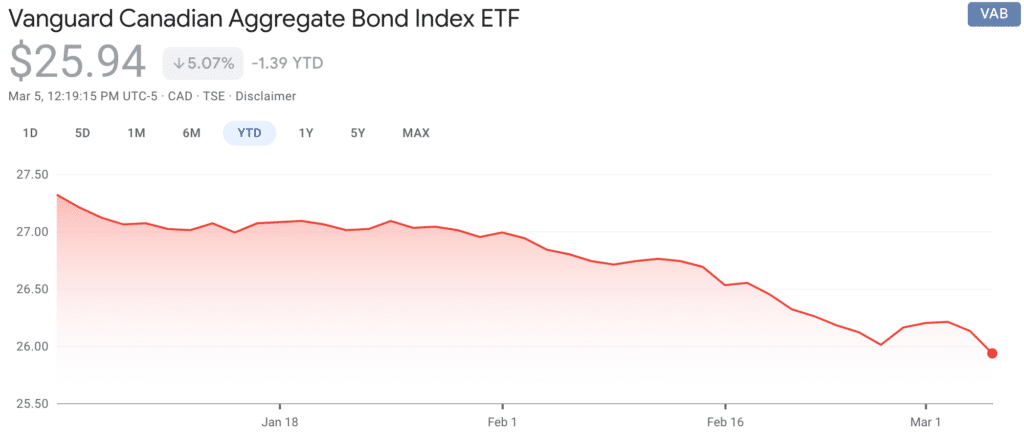
If you hold Vanguard’s Canadian Aggregate Bond Index (VAB), you’re likely not pleased to see this performance:

VAB YTD returns

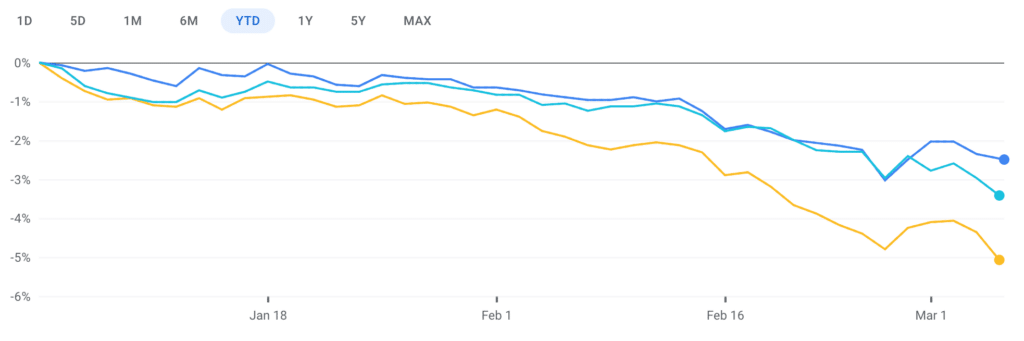
When you add U.S. and Global bonds to the mix, the results are similar but slightly more favourable:

Vanguard US and Global Bonds YTD

Now let’s add Canadian, U.S., International, and Emerging Market stocks to the portfolio using Vanguard’s FTSE Canada All Cap Index (VCN), Vanguard’s U.S. Total Market Index (VUN), Vanguard’s FTSE Developed All Cap ex North America Index (VIU), and Vanguard’s FTSE Emerging Markets All Cap Index (VEE):

Vanguard Canadian, US, International ETFs

When you put all seven of these ETFs together you get Vanguard’s Balanced ETF portfolio (VBAL). Each part following its own unique path, but blended together using a rules-based approach that maintains the original target asset mix through regular rebalancing.

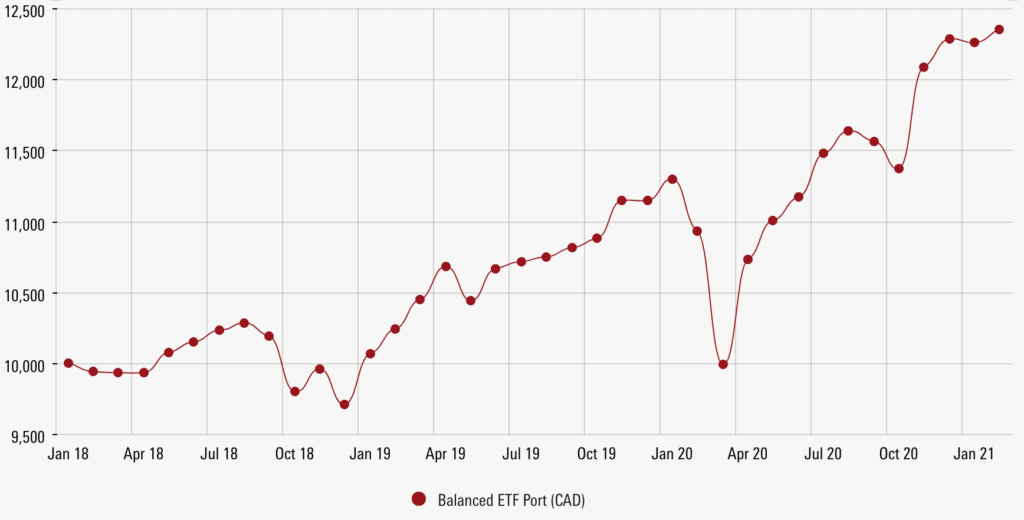
Here’s how that looks over a three year period (since VBAL’s inception):

VBAL since inception

This is what diversification looks like. While some individual parts lag behind, others lead the charge and drive the overall returns. Regular rebalancing helps ensure you always buy low and sell high while managing your risk and return. The result is a compound annual growth rate of 7.3% since 2018.

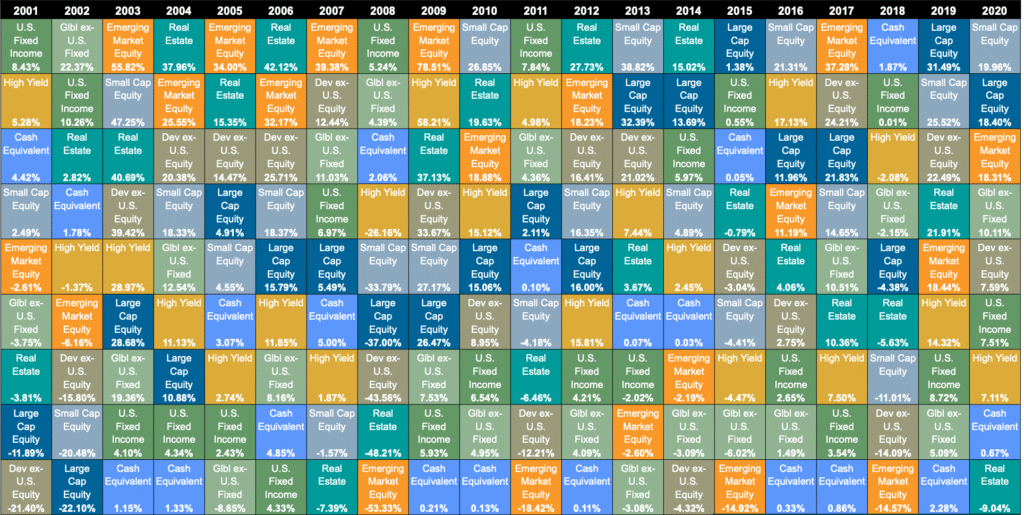
Perhaps the best way to visualize how diversification works is by looking at the periodic table of investment returns over the past 20 years (source: www.callan.com):

Periodic Table of investmeent returns

Last year’s winner is often next year’s loser. Every asset class has had its turn at or near the top, including large cap stocks, small cap stocks, emerging markets, real estate, bonds, and yes, even cash (once).

Do you think you can predict which assets will lead the way in 2021 and beyond? Unlikely. That’s why it’s best to diversify broadly so you can capture market returns without trying to guess where to park your money.

What about pulling out all of your investments and moving to cash? Well, cash was the worst performing asset class in eight of the 20 years. Even in 2008-09 bonds were the better bet.

Have you rebalanced?

I’ve written before about investors getting distracted by shiny objects like cryptocurrency, technology stocks, and high-flying fund managers. Even seasoned investors were moving more of their money into U.S. stocks, technology stocks, and Bitcoin to capitalize on rising markets.

Indeed, why hold bonds at all when every other asset class has been soaring?

The result is a portfolio and asset mix that is likely out of step with your original goals.

Rebalancing is counterintuitive because it forces you to sell what’s going up in value and buy more of what’s going down. It’s tough to wrap your head around selling U.S. stocks to buy more Canadian stocks. Or worse, to buy more bonds.

It’s even more difficult in uncertain times. It’s easy to look back at March 2020 or March 2009 as buying opportunities of a lifetime for stocks. But in the moment it probably felt terrifying to even be holding stocks at all.

Today, nervous investors are worried about holding bonds. What should be the stable portion of their portfolio is suddenly underwater and signs of future upside are nowhere to be found.

Damir Alnsour, a portfolio manager at Wealthsimple, has heard from many of these anxious investors in recent days. They’re asking questions like, will bonds keep going down?

“The answer is that no one really knows if it is likely to continue, but we always look at our portfolios with a long-term lens because we don’t allocate our investments based on short-term market performance. We expect that in the future there will be times where stocks are doing well, and bonds are underperforming but also the opposite. We can’t predict these times, and we don’t think anyone else can either,” said Alnsour.

He encourages his clients to take a 30,000-foot view and remember the reason their portfolio includes bonds. Bonds are a long term source of return that improve the stability of your portfolio because they often react to changes in the economic environment differently than stocks.

“During most of the major stock market downturns historically, bonds have increased in value and helped cushion losses,” said Alnsour.

Just like the three-year chart of VBAL’s returns, a well-balanced and diversified portfolio is expected to rise over time: after all, that’s why we invest in the first place. But it’s normal for the same portfolio to suffer minor short-term losses along the way that can sometimes take weeks or months to recover.

Back to Wealthsimple’s Alnsour:

“Also, keep in mind, we would rebalance the portfolio if bonds were to continue to sell-off. What this means is that should the bond allocation drop below our rebalancing threshold, we would sell some equities to add to bonds and therefore pick up more fixed income at a cheaper price and better yields (just as we would have sold bonds to add to your equity position in March of 2020!).”

Don’t Just Do Something, Stand There!

Your portfolio is like a bar of soap. The more you touch it, the smaller it gets. Yet in times of uncertainty we can’t help but feel like we need to do something to curb losses or increase gains.

The better choice, assuming you have a well-diversified and automatically rebalancing portfolio, is to log out of your investing platform, close your internet browser, and do nothing. Focus on your family, friends, hobbies: anything that will prevent you from logging back on and seeing your investments in the red.

As PWL Capital portfolio manager Benjamin Felix says, “your investment strategy shouldn’t change based on market conditions.”

That’s right. You identified your risk tolerance and time horizon, and chose your original asset mix for a reason. You understood that markets fluctuate, often negatively, for periods of time and that is out of your control. Yet when markets are going through their downswing, you feel compelled to change your approach.

Let’s go back to the term, “uncertainty.” Isn’t the future always uncertain? When are we investing in certain times?

Pundits and market forecasters often paint a bleak future, like Grantham’s 1929-style crash or Dr. Doom Nouriel Roubini calling for hyperinflation. The truth is nobody knows how this will play out.

What if you make a tactical shift to your investment strategy and you’re wrong? There are plenty of investors who moved to cash after the global financial crisis and never found their way back into the stock market. Once you convince yourself of a particular narrative it’s nearly impossible to admit that you were wrong and change course.

Final Thoughts

It’s reality check time for investors. We’ve been in a bull market for 12 years (minus a few blips). Almost everything has worked, which can lead to overconfidence in your investing skills. Meanwhile, many investors have strayed away from their original goals to chase even higher returns from U.S. stocks, technology stocks, and the like.

It’s time to check in on your portfolio and make sure it’s broadly diversified and risk appropriate for your age and stage of life. It’s time to rebalance, if you hold multiple funds, and get back to your original target asset mix. Finally, if you’re already invested in an appropriate asset allocation ETF or robo-advised portfolio, it’s time to do nothing. Don’t change your investing strategy based on market conditions.

Take a long-term view of your investments rather than looking at the daily changes (which can be maddening). That’s how to invest in uncertain times.

In addition to running the Boomer & Echo website, Robb Engen is a fee-only financial planner. This article originally ran on his site on March 5, 2021 and is republished here with his permission.