Tag Archives: cash

The coming recession

By Ian Duncan MacDonald

Special to the Financial Independence Hub

If a financial guru, to sell his newsletters, predicts every month that we will soon have a full-blown recession, sooner or later he (or she) will be right.  A recession is usually a six-month decline in economic activity.  It is measured by a nation’s decline in Gross Domestic Production, coupled with monthly employment statistics. Since it must last six months, you are never quite sure if you are in one or not.  Since the duration of the average recession is 9 months, it will most likely be over before Government departments can agree that we ever in a recession.

Recessions do not last forever.  The longest recession was between August 1929 and March of 1933.  This was the start of “The Great Depression” which, if you asked those who lived through it, believe it did not end until the beginning of the Second World War in 1939. It saw a Gross Domestic Product (GDP) decline of 26.7% compared to an average recession decline of 2.7%. Our last recession, between December 2007 and June 2009, was a contraction of 4.3%.

Normally the gap between recessions is 4 years 2 months.  The current gap is almost eleven years.  Employment is still high. Economic activity is not declining. Previously, the largest gap was between February 1961 and December 1969.

Cashing out in advance is a gamble

In a recession, investors see a large decline in the value of their shares.  Can this decline in capital be avoided by selling your shares and reverting to cash until the recession is over? It can; however, you are never quite sure when you are in a recession and when you are out of it.  Thus, liquidating a portfolio is a pure speculative gamble. Continue Reading…

Rattled by the “Correction?” Diversification keeps your nest egg on the rails

“I know not what the future holds, but I know who holds the future.”
—Homer

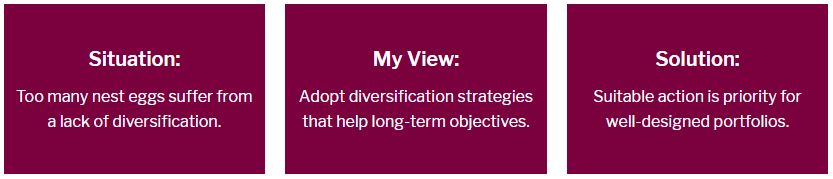
We are all aware that portfolio winners rotate position from time to time. Leaders have a habit of becoming laggards. “Must own” darlings become “forgotten” names. Winners vacate the “winner’s circle.” As the timeless saying preaches, don’t put all your eggs in the same basket. Hopefully, this classic advice is being followed.

“Diversification strategies are essential, time-tested tools for every nest egg.”

The main goal of investment diversification is to contain the damages of market volatility from being inflicted on the nest egg. The importance of this is fundamental and always in fashion. I highlight some key observations on portfolio diversification:

  • Investment portfolios suffer from inadequate diversification.
  • Mutual funds we own often have the same, or similar, stocks.
  • Investors are not aware that they lack diversification.

Diversification strategies are essential, time-tested tools for every nest egg. They improve your chances of achieving better consistency of long-term returns. It’s a focus for every investor to prioritize.

Basic diversification involves spreading your risks across different sectors of the economy. All within the asset allocation targets set by your investment plan of action. Make sure that you are comfortable with the approach so that you don’t have to dwell on regrets. Portfolios I review range from too concentrated to well over diversified.

Overall, diversification is a necessary safeguard. You don’t want problems arising in any asset class to ruin your well-designed portfolio. Especially the one that delivers the family’s retirement cash flow.

Develop sound habits

Diversification increases the odds of you being right more often than wrong. When some selections are suffering, others can step up and help cushion the rest of the portfolio.

Make it your habit to keep your nest egg from slipping off the rails. I summarize my top ways to achieve necessary portfolio diversification:

  • Asset Classes: Choosing different asset classes for the game plan is a sensible and prudent step. Stocks, bonds, cash, commodities and real estate are common picks.
  • Economic Regions: Portfolios may include selections from Canada and other regions around the world. Like the USA, Europe, Far East and emerging countries.
  • Time to Maturity: A portion of the portfolio could have a range of investment maturities. From as short as 30 days to as long as 30 years.
  • Foreign Currencies: Investment selections can be purchased in currencies other than Canadian funds. Such as US dollars, the Euro or hedged to our Loonie.
  • Investment Quality: High investment quality trumps reaching out for questionable yield. Trading quality for higher yields increases the potential to incur large losses.

Portfolios ought to contain a variety of investments that don’t all move in unison. However, seasoned investors know full well that is not always possible.

Broad brush

My table below is far from scientific. Look upon it as a broad brush view of portfolios that own Exchange Traded Funds (ETFs) and/or mutual funds as their primary investments in equities. Each investment selection is referenced as a “basket.” I divide the diversification landscape into three ballparks. Continue Reading…

The most dangerous asset class may surprise you: Cash!

Depositphotos_16811249_s-2015Investors flee to cash during times of trouble.  However, far from being a safe haven, cash is potentially the most dangerous asset class for investors, luring investors into bigger psychological bubbles than even tech stocks and housing have historically.

We recently wrote about why investors might want to consider holding bonds rather than cash, even at current low and negative yields (see Why on earth would you hold a bond with a negative yield?).  A recent article (see Journey of Cash by Alex Gurevich) and further investor questions have inspired us to think a bit more specifically about cash and its merit (or not!) as an asset class in a well diversified portfolio.

Hold cash for known near-term purchases and an emergency fund

Continue Reading…

How realistic is it to live only on cash?

Repak-Headshot
Steve Repak

By Steve Repak, CFP

Special to the Financial Independence Hub

If you are in debt, you have probably heard over and over again that you should quit using credit cards and stick to using cash exclusively for purchases (aka “cash-only” purchases.)

In a previous article I explained that for some people it actually hurts to break a large bill like a $20, so only using cash may help you get your spending under control. I wanted to share some of the risks and benefits of a cash-only lifestyle and also show that you can still get out of debt if you want to use credit cards.

If getting out of debt is your goal, there are three things you must do in order to succeed regardless of whether you use cash or credit:

  1. Spend less money than you take home each week
  2. Build an emergency savings
  3. Develop and follow a get-out-of-debt plan

Cons of using cash

Continue Reading…

Record cash levels in bear market suggests buying opportunity for stocks?

Stock market trend business concept and financial prediction uncertainty symbol as a heard of bulls and bears running towards each other to set the direction of an economic forecast.
Is Cash your no-man’s land between battle of the bulls and bears? Try not to get trampled!

Here’s my latest Financial Post blog, which looks at the record amounts of cash scared Canadian investors are sitting on during this bear market. For full blog, click on the coloured headline here: When Volatility Scares You, is it Time for Investors to Buy or Sell?

The blog accompanies Garry Marr’s piece on the CIBC World Markets report released Tuesday: Ocean of Fear: Canadian investors sitting on record cash pile risk billion in lost returns.

Since markets got off to their worst January in decades, per force the Hub has been running several blogs on the topic of volatility. See also from the past week:

Hedging in the Retirement Risk Zone (which is mentioned in today’s FP blog).

Volatile, Unpredictable and entirely normal.

Behavioural Finance: Coping with Losses.