Tag Archives: Financial Independence

Poll finds most wonder how friends or neighbours can afford lifestyles

It’s one thing keeping up with the Joneses but a poll from Edward Jones finds that 61% of Canadians wonder how their friends or neighbours can even afford their lifestyles. This is especially so among Millennials (aged 18 to 34), 71% of whom felt this way, while 66% of Gen Xers aged 35 to 44 were curious to understand how those around them finance their purchases.

Seems to me this gives new meaning to the phrase The Millionaire Next Door, a popular book on how frugality is a key trait in building wealth. Typically, the kind of millionaires in the book live modestly and their net worth may not be obvious merely observing the size of a given home and/or what’s parked in the driveway. Conversely, it can also be that an apparent “millionaire next door” has no net worth at all but is fuelling their conspicuous consumption merely with debt.

Either way, it appears many of us are influenced by what our associates are spending their money on.

Sadly, the Edward Jones poll found that the pernicious practice of looking at the purchases of others may influence consumers to buy beyond their own budgets: a whopping 93% said they experienced buyer’s remorse after such purchases and admit to regrettable spending habits. Among Millennials, 96% experienced buyer’s remorse but so did 90% of baby boomers.

Among the types of purchases most likely to generate regret were tangible purchases, which were cited as a source of regret in 83% of cases. Clothing or shoes were regretted by 35% polled, jewelry by 28% and electronics by 26%. Millennials regretted spending on clothing/shoes in 47% of cases, while boomers were more likely to regret spending on jewelry (34% of them did).

While Millennials famously are supposed to value experiences over stuff, across the Canadian population, 83% regretted making impulse tangible purchases, versus 71% for experiential purchases.

Build spontaneous spending into your budget

So what lessons does this survey furnish for those seeking ultimate financial independence? “If you know you enjoy spending money spontaneously, build this into your monthly budget,” said Roger Ramchatesingh, Director, Solutions Consulting at Edward Jones in a press release issued on Monday, “When it is unplanned for, it can add up over time and hurt other long-term goals such as retirement or the purchase of a home.” Continue Reading…

Is typical retirement advice good? – Testing popular Retirement rules of thumb

Special to the Financial Independence Hub 

You want to retire soon. How should you set up your retirement income?

You talk with some friends, read about it on the internet, and talk with a financial advisor. Are you actually getting good advice?

When it comes to retirement income, most financial advisors rely on a few rules of thumb handed down from one generation of advisors to the next. The rules appear to be common sense and are usually accepted without question.

Do these rules of thumb actually work?

Before giving clients this advice, I tested them with 150 years’ history of stocks, bonds and inflation. I wanted to see if these rules were reliable for a typical 30-year retirement. (The average retirement age is 62. In 50% of couples that reach their 60s, one of them makes it to age 92.) 

These five rules are the “conventional wisdom” – the advice typically given to seniors:

  1. “4% Rule”: You can safely withdraw 4% of your investments and increase it by inflation for the rest of your life. For example, $40,000 per year from a $1 million portfolio.
  2. “Age Rule”: Your age is the percentage of bonds you should have. For example, at age 70, you should have 70% in bonds and 30% in stocks.
  3. “Sequence of returns”: Invest conservatively because you can’t afford to take a loss. You can run out of money because of the “sequence of returns.” You can’t recover from investment losses early in your retirement.
  4. Don’t touch your principal. Try to live off the interest.
  5. Cash buffer: Keep cash equal to 2 years’ income to draw on when your investments are down.

The results: NONE of these rules of thumb are reliable, based on history.

Let’s look at each to understand this.

1.) “4% Rule”: Can you safely withdraw 4% of your investments plus inflation for the rest of your life?

Based on history, the “4% Rule” was safe for equity-focused investors, but not for most seniors.

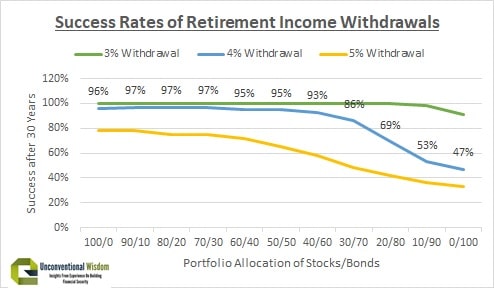
In the results shown in the graphic at the top of this blog, the blue line is the “4% Rule,” showing how often in the last 150 years a 4% withdrawal plus inflation provided a reliable income for 30 years.

The “4% Rule” only works with at least 50% in stocks.

The “4% Rule” worked only if you invest with a minimum of 50% in stocks. Even safer is 70-100% in stocks. It is best to avoid a success rate below 95% or 97%. They mean a 1 in 20 or 1 in 30 chance of running out of money during your retirement.

Most seniors invest more conservatively than this and the 4% Rule failed miserably for them.

A “3% Rule” has been reliable in history, but means you only get $30,000 per year plus inflation from a $1 million portfolio, instead of $40,000 per year.

These results are counter-intuitive. The more you invest in stocks, the safer your retirement income would have been in history.

To understand this, it is important to understand that stocks are risky short-term, but reliable long-term. Bonds are reliable short-term, but risky long-term. Why? Bonds get killed by inflation or rising interest rates. If either happens during your retirement, you can easily run out of money with bonds.

The chart below illustrates this clearly. It shows the standard deviation (measure of risk) of stocks, bonds and cash over various time periods in the last 200 years. Note that stocks are much riskier short-term, but actually lower risk for periods of time longer than 20 years.

Stocks are more reliable after inflation than bonds after 20 years.

Ed’s advice: Replace the “4% Rule” with “2.5% +.2% for every 10% in stocks Rule.”  For example, with 10% in stocks, use a “2.7% Rule.” If you invest 70% or more in stocks, then the “4% Rule is safe.

2.) “Age Rule”: Your age is the percentage of bonds you should have. For example, at age 70, you should have 70% in bonds and 30% in stocks.

Continue Reading…

Why and how Financial Independence is achievable

By Jade Anderson

Special to the Financial Independence Hub

Financial independence can mean different things to different people, but the widespread definition is to be financially secure and on the right track to a safe retirement.

Sometimes people will still need to work in order to maintain their financial independence (aka “Findependence”), but the main idea is that you are free from any debt or outside help from financial institutions. This may seem like something that is unachievable for anyone outside of retirement age, who isn’t well established; however, because of the different types of financial independence, it may not be so difficult after all. Adjusting your spending habits, creating a budget for your self and several other things can lead you towards Findependence, if you know the right things you need to consider.

Reduce unnecessary expenses

Setting up a budget for the long term is extremely important if you’re wanting to become financially independent. If you can cut down on any unnecessary expenses (such as extra food, clothing, and entertainment) in your weekly spending, then you’ll find it will be a lot easier to save. If you are not used to saving money, starting small is important because it will help you establish a pattern of saving properly, and it will be easier for you when you move up to saving more of your average income.

Plan your savings and spending

Planning not only your savings, but also your spending is crucial for ensuring your financial independence. If you have a few debts, and you can make plans to pay off certain amounts by certain dates, you’ll find that the overall debt is easier to pay off, than if you paid it off in a lump sum. Using one of the financial calculators like those on Brighter Finance can help you calculate your budget and repayment periods for your loans, so you can keep track of your money more easily.

Continue Reading…

FP: A look at three retirement income planning software packages

My latest Financial Post column looks at a few retirement income planning software packages that help would-be retirees and semi-retirees plan how to start drawing down from various income sources: Click on the highlighted text to retrieve the full article: How you draw down your retirement savings could save you thousands: this program proves it.

There may be as many as 26 distinct sources of income a retired couple may encounter, estimates Ian Moyer, a 40-year veteran of the financial industry and creator of the Cascades program described in the article.

When he started to plan for his own decumulation adventure, five years ago, he felt there was very little planning software out there that was both comprehensive and easy to use. So, he hired a computer programmer and created his own package, now called Cascades.

While the main focus of the FP article is on Cascades, (available to financial advisors for $1,000 a year; do it yourself investors can negotiate a price directly), the article also references a couple of other programs we have looked at previously here on the Hub: Doug Dahmer’s Retirement Navigator and BetterMoneyChoices.com, the latter currently nearing the end of beta testing.

Dahmer has been writing guest blogs on decumulation here at the Hub almost since this site’s founding in 2014. See for example his most recent one, or the similar articles flagged at the bottom: Top 10 Rules for Successful Retirement Income Planning.

Dahmer says he’s pleased that others are waking up to the need for tax planning in the drawdown years: “Cascades provides a very good, easy-to-use introduction to these concepts.”

Planning for peaks and valleys in spending

Retirement Navigator’s Doug Dahmer

However, Dahmer would like an approach that doesn’t assume yearly spending remains relatively static: his Better Money Choices(available on line for $108 a year) allows for the “peaks and valleys” of spending as retirees pass through their Go-go to their slow-go and finally their “no-go” years.  Most retirees have to plan for sporadic large purchases like renovations or replacement of roofs or furnaces, plus of course vacations with widely varying price tags. Each spending peak represents a tax challenge, while the valleys are where the tax planning opportunities exist. Dahmer likens Better Money Choices to a gym monthly membership and Retirement Navigator to a personal trainer.

Personally, I found going through both firm’s programs a fascinating exercise, very much like putting together a jig saw puzzle. For me, Better Money Choices helps you visualize the final picture you’re trying to assemble, showing how much money you’ll need and when you’ll need it. Cascades provides vivid yearly snapshots of your year-by-year progress in putting the pieces together.

What does it really take to move overseas?

Overseas life is adventuresome

By Akaisha Kaderli

Special to the Financial Independence Hub

In preparing for a retirement overseas, we would wager that most people occupy themselves with the practical concerns of residential visas, banking, owning property, finding a doctor they like, medical care that they can afford and dealing with any language barriers. These are pragmatic matters with realistic solutions, and we say that these areas are almost the easiest part of making this lifestyle change. While the above mentioned topics are important and must be solved, we want to share with you what it really takes to move overseas.

It may surprise you, but what we have seen take people down, destroying their retirement dreams and sometimes even their marriages, are the emotional and psychological challenges one faces in adjusting to their new lifestyle overseas.

How do you prepare for these obstacles ahead of time? We hope the following tips and insight will shed some light on the topic.

Just like home, only cheaper

You could save a bundle moving overseas

Many people trip themselves up with their giddiness over the fantastic cost of living in their new location. They often come into a new country talking themselves into believing that living in their new destination is just like home, only cheaper. We want to tell you that no place overseas is just like home. Customs, foods, weather cycles, housing codes, the treatment of pets, the laws, the language, cobblestone streets and workmanship quality are all different.

We have seen folks love the quaintness of their new town but then fall apart because they can’t find parking near to markets where they shop. Their charming town might not have one-stop-shoping with a parking lot tying several stores together so they find that market day involves stopping in six locations, perhaps fighting traffic in between. Instead of taking their time to enjoy their enchanting town, they find this situation to be annoying and they carry the frustration with them all day.

 Culture and customs

Animals are treated as animals in developing nations and not as family members. Street dogs are common and if your heart is easily broken, then this might pose a problem for you. Continue Reading…