Tag Archives: Financial Independence

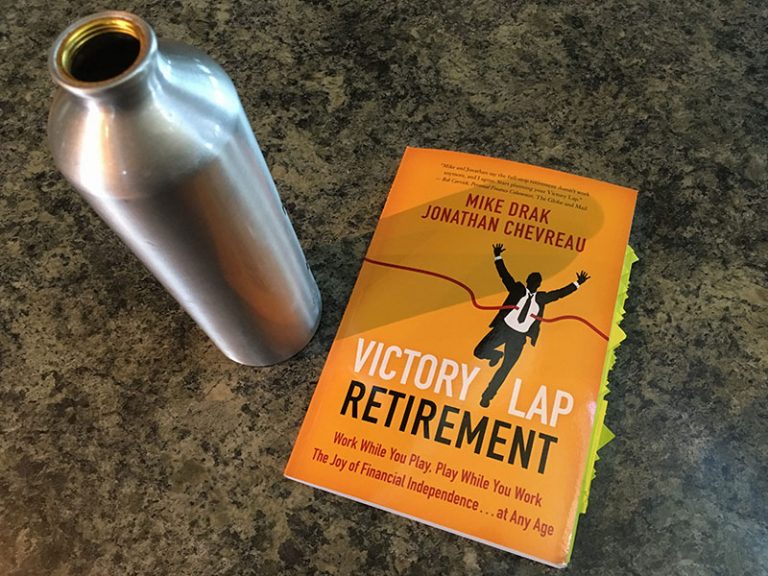
Rockstar Finance’s review of Victory Lap Retirement

By Hélène Massicotte, Rockstar Finance

Mike and Jonathan walk the talk. They both have made sound financial decisions that enabled them to leave their corporate lives (either through retirement or redirection), allowing them to shift their focus toward what they wanted to do next without having to have money be the primary driver.

How can we start stacking the deck in our favor to do the same? By:

  1. Following the “Seven Eternal Truths of Financial Independence”
  2. Focusing on one important formula
  3. Forgetting traditional notions of retirement

#1. The “Seven Eternal Truths of Financial Independence”

When it comes to managing money, most of us want to improve our odds of success. That means ensuring we behave in a way that reduces the financial obligations that work to limit our personal and professional choices. The authors suggest the following behaviors can do a great deal to help us increase our financial flexibility:

  1. Live below your means
  2. Pay yourself first
  3. Get out of debt
  4. Buy a home and pay it off as soon as possible
  5. Be an owner, not a loaner
  6. Never say no to free money from your employer
  7. Take the government up on its few offers of free money

Two of these include interesting twists on the theme beyond what is usually covered in what’s considered mainstream financial advice:

#4. Buy a home and pay it off as soon as possible. This is great advice for those among us who want to own a home, but the authors take it one step further: we should look at our home as part need and part want. Need is the bare minimum of what we need in a home: shelter, basic utilities, safety, minimum square footage, proximity to other needs, etc. Want are the extras beyond what we need: extra space, extra features, better privacy, less noise, better outdoor space, better-than-needed neighborhood, etc.

Looking at housing this way can help us consider the appropriateness of the largest physical asset class we’re likely to ever own. It’s easy to justify buying too much house, thereby turning a good purchase into a bad one, and this “need vs want” can help us keep the inflation in check.

#5. Be an owner, not a loaner. This suggests that, though bonds are lower-risk investment vehicles, they won’t offer the returns that equity can, even when these are risk-adjusted. The authors suggest a diversified portfolio that includes high-quality dividend paying stocks and stress that qualifying dividend-paying stock income also offers some tax advantages over bond-related income for investments that are held in non-tax-sheltered accounts.

#2. The Freedom Formula

Mike and Jonathan managed to increase choice in their lives by focusing on one important formula:

PASSIVE INCOME > NON-DISCRETIONARY EXPENSES = FREEDOM

Continue Reading…

The Price of Security

By akaisha-in-a-longboat-on-the-mekong-riverBilly and Akasha Kaderli, 

RetireEarlyLifestyle.com

Special to the Financial Independence Hub

“Security is mostly a superstition. It does not exist in nature, nor do the children of men as a whole experience it. Avoiding danger is no safer in the long run than outright exposure. Life is either a daring adventure, or nothing.” —  Helen Keller

Recently I have been reading a book called Daring Greatly by Brene Brown. You may have heard of it. The theme of the book is about being vulnerable, taking risks and being willing to expose ourselves to possible failure. It’s an enlightening read.

I bring this up because what I want to share with our readers is that security has a price. Everyone speaks about how risk is dangerous and sometimes unthinkable. It seems that everyone wants unmitigated surety – the 100% guarantee.

But security never makes one courageous nor does it make a person’s heart sing.

We all want our bases covered, and none want to be starving or out in the land of the lost. But there is an energy about taking a risk with the possibility of failure that adds dimension to our lives and creates memories that we share with our children and grandchildren and we can ruminate over when we become old. Having everything laid out, fully unchallenged with no adversary to overcome makes for a dull story.

Personal examples

To make my point, I want to share with you a couple of big risks I took with my life direction over the years.

In 1971 was 19 years old and my then 20-year-old boyfriend wanted to make an extensive summer motorcycle trip across the country from the Midwest through a semi-southern route, up the coast of California to Alaska and back again via northern roads. This sounded like the most exciting thing I could imagine in my life at that time.

Continue Reading…

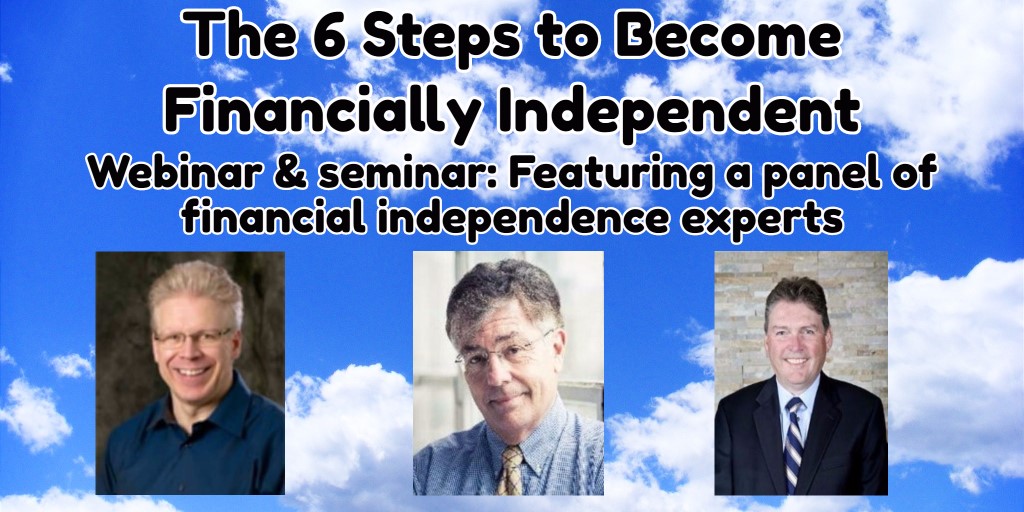
The 6 steps to Financial Independence

L to R: Ed Rempel, Jon Chevreau, Mike Drak

By Ed Rempel, CFP, CMA

Special to the Financial Independence Hub 

What is financial independence? How do you get there?

Financial independence means work is optional. You have enough money to live the way you want without having to earn money.

When you get there, life changes. You have freedom. You can do only what you enjoy or find meaningful.

If you don’t like your job or your boss, just quit. Your life is full of options. You can make the most of your own life.

When you get there, you can have a quiet confidence. You are financially secure.

Your plan should start with understanding your inner motivation and defining specifically the lifestyle you want to have once you are financially independent. It is your opportunity to determine your future.

Becoming financially independent requires planning and effort, but it is worthwhile to live a more fulfilling life. “It’s not about the money. It’s about your life.”

“Real freedom is financial freedom.” When is your Findependence Day?

Achieving financial independence is a very broad topic. Writing nearly 1,000 comprehensive, professional financial plans specifically for real Canadians has given me a deep insight into what really works.

Seminar in Toronto this Wednesday evening

Continue Reading…

In pursuit of Boomer happiness

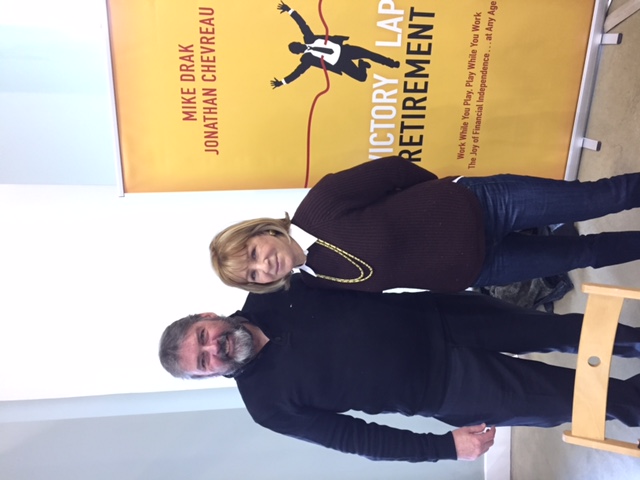
Mike Drak and Heather Reisman

I was at my local Indigo bookstore the other weekend and look at who happened to stop by.

I’m really starting to believe in this karma thing as more and more chance encounters like this are happening to me since writing the book.

Through this chance meeting I had the chance to talk to Heather about Victory Lap Retirement and my concern that we had miscategorized the book by putting it into the personal finance/retirement section. Heather was kind enough to share her thoughts and now I’m convinced that our book should be in the self improvement section.

Not really a retirement book

Victory Lap Retirement is really not a book about retirement; in fact we make a strong case about the benefits of not retiring in the traditional sense. It really is a book about lifestyle design with the goal of helping people create their own low-stress healthy fulfilling lifestyle, one based on their own unique needs and wants. We know that through proper planning and intentional living, we can substantially improve the quality of our remaining years, which is not a bad way to go out when you think about it.

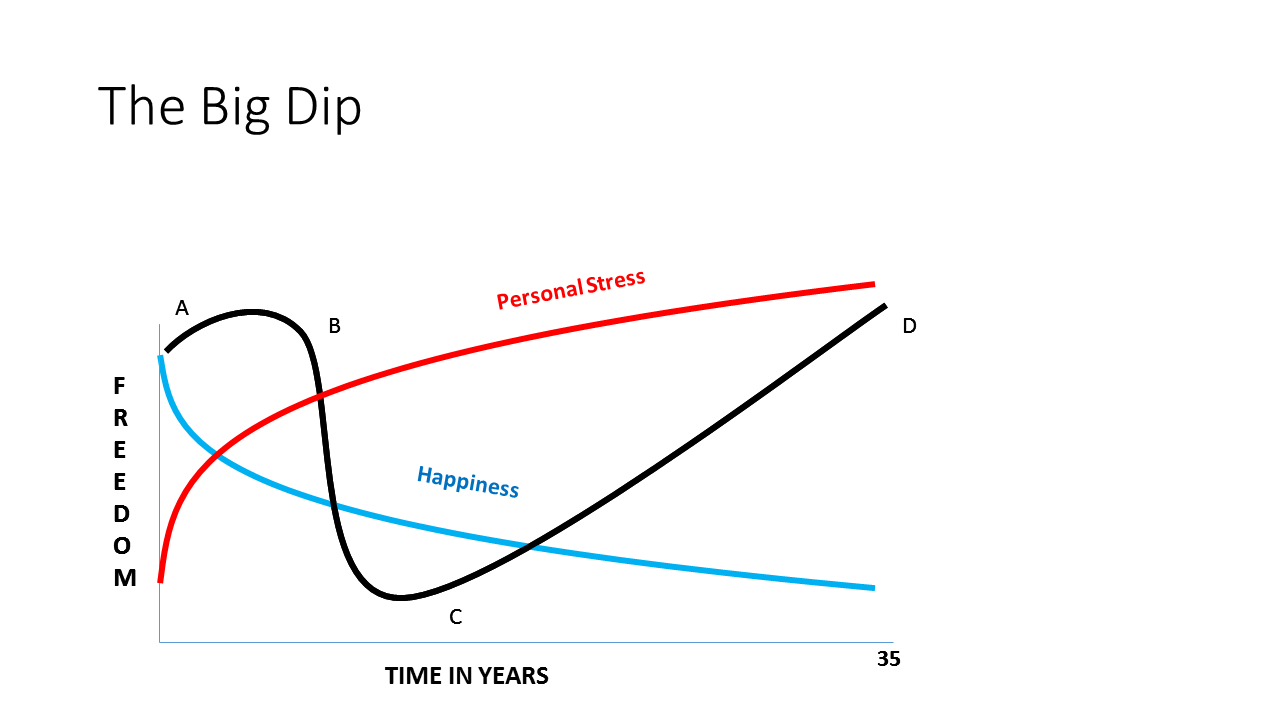
Stress is the main risk in our eyes and prolonged exposure to stress can really mess a person up and in some cases actually kill them. I don’t know if it’s just me but I’m seeing more evidence of this each and every day; examples seems to be everywhere. Is it just me or are you seeing it as well?

We discussed the role of stress in a recent blog post called “The Big Dip.”

Stress inversely correlated with Happiness

Continue Reading…

The “Work Optional” stage: Work because you WANT to, not because you HAVE to

Nice to see the phrase “Work because you want to, not because you have to”  used by NestWealth.com in its just-posted Retirement blog that looks at Victory Lap Retirement.

VLR, as co-author Mike Drak and I call it, has in some recent weeks cracked the Globe & Mail non-fiction bestseller list.

The line “Work because you want to, not because you have to,” was originally coined by me in the prequel to VLR: Findependence Day.

Aman Raina

Meanwhile you can view a “video book report” on Victory Lap Retirement in this clip by Sage Investor’s Aman Raina, who regular Hub readers may recognize as a guest blogger who provides considerable insights into the robo-adviser space. You can also find the video book report here via iTunes.  Aman’s most recent Hub blog was this one reviewing Year 2 of his personal Robo-adviser experience and test.

Continue Reading…