Tag Archives: Financial Independence

Review & Excerpt of Clay Gillespie’s Create the Retirement You Really Want

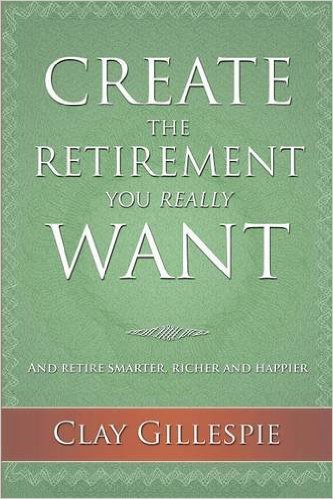
The Financial Post has just published my review of a new book by Vancouver-based financial advisor Clay Gillespie: Create the Retirement You Really Want: And Retire Smarter, Richer and Happier.

You can find the online review by clicking on this highlighted headline: From Dreams to Legacy: New Book Details the 5 Stages of Retirement.

And below is an excerpt from the chapter highlighted in the review. We may also run at least one other excerpt in the coming weeks. Over to you, Clay!

By Clay Gillespie

Special the Financial Independence Hub

Retirement isn’t an event; it’s a process, and it begins years before you actually retire. Working with hundreds of clients over many decades, I’ve come to realize that retirement success is best achieved in five distinct stages. Each stage reflects a different aspect of who you are and where you want to be in retirement, and it all begins with a dream.

       1.) Dreams stage

The Dreams stage of retirement typically begins about five or six years prior to actual retirement. This is the time when people have decided to retire but aren’t yet sure of the date. It’s the time where retirement goals and hopes for the future become defined and a preliminary retirement plan is developed. For couples, especially, retiring now becomes an ongoing topic of discussion, not just something brought up in passing.

2.) Reality stage

The Reality stage usually occurs between 6 and 24 months before retirement and its temporal proximity really starts to hit home. Lifestyle issues come into greater focus, along with fears that one’s retirement nest egg may be inadequate. This is a crucial time from a planning perspective. Old Age Security (OAS) and Canada Pension Plan/Quebec Pension Plan (CPP/QPP) applications need to be made, income streams need to be consolidated, taxes need to be minimized and portfolios need to be optimized for income and growth.

3. Transition stage Continue Reading…

R.I.P. Traditional Retirement

By Brandon Hill

Special to the Financial Independence Hub

Does the notion of grinding it out day in and day out for the next 40 years to experience the freedom of retirement scare you? Wouldn’t you rather strive to enjoy the journey along the way?

The good news is that the traditional concept of retirement is slowly dying.

With the elimination of most employer pension plans and the fact that humans are living longer than ever, we are forced to come up with a different take on how our parents/grandparents view retirement.

Today I’ll show you two different concepts that rethink our traditional retirement model and are gaining popularity amongst the next generation of workers.

Findependence

What’s Findependence? It’s a term coined by Jon Chevreau: author, former editor-in-chief of MoneySense Magazine and founder of the Findependence Hub, an online platform and community for curated content focusing on achieving Financial Independence. “Findependence” is simply a contraction of the phrase “Financial Independence.”

Financial Independence is the point at which you work because you want to, not because you have to. It’s the tipping point where you have the right level of savings and investments working for you to provide the income you need to live your ideal life.

Think about that. It sounds very similar to our definition of retirement and at the same time totally reframes the perception of what retirement should entail. Rather than focusing on when you can stop work forever, you now shift your mindset to creating enough passive income through investing so that you can pursue anything you want.

Continue Reading…

Why rely on hindsight for retirement saving?

By Atul Tiwari

Special to the Financial Independence Hub

New research from a colleague has me thinking about hindsight. The trouble, as the saying goes, is that hindsight is 20/20 — and you can’t benefit from it after the fact.

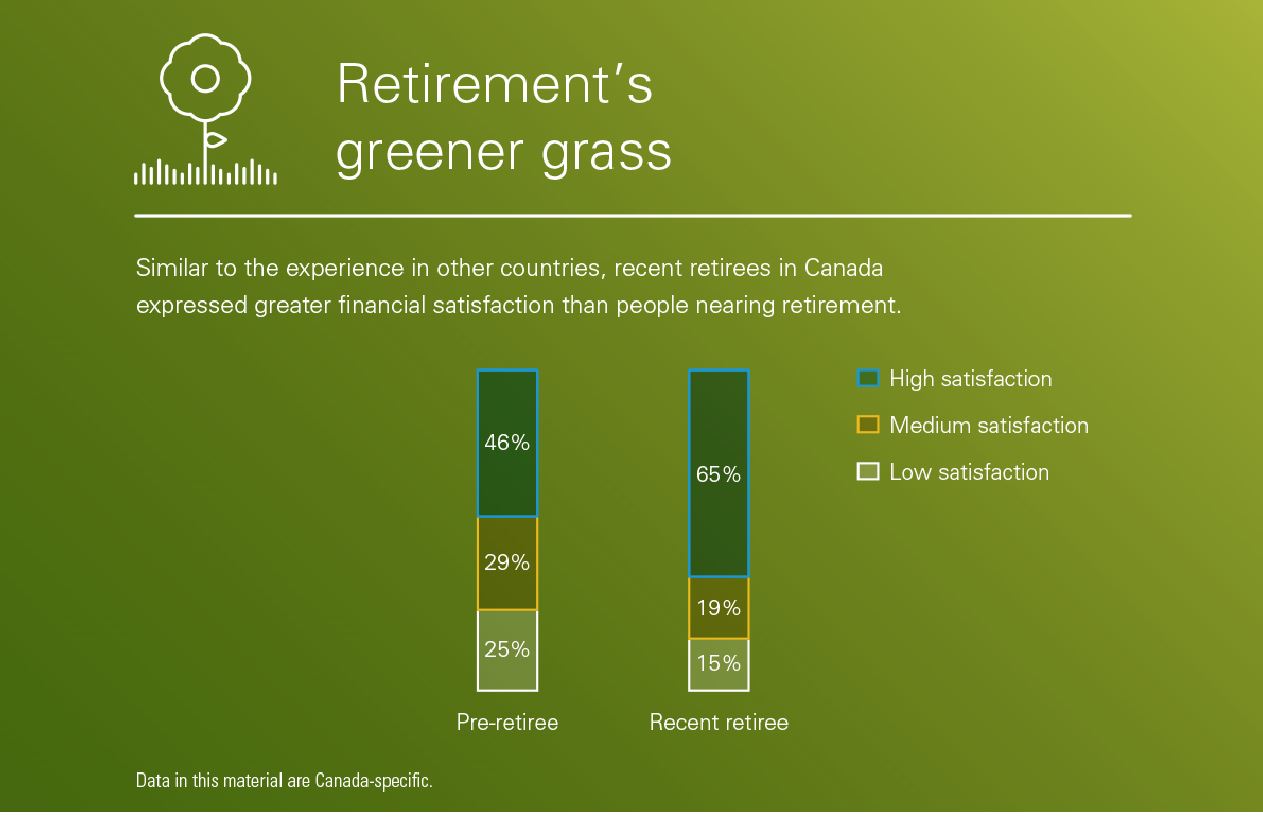
But why not try to benefit from someone else’s hindsight? My colleague Anna Madamba of the Vanguard Center for Investor Research found in a new study that recent retirees were largely satisfied with their financial situations in retirement, but, if they could, would still do some things differently in preparation.

With the benefit of retrospect, 43% of Canadian survey respondents “agreed” or “strongly agreed” that they would have saved more — a higher percentage than garnered by any other answer.

But perhaps it’s too simple to suggest that pre-retirees should just follow the example of others. Many people know at some level that they need to save more. Whether they do often comes down to two things: competing priorities and insight into how much money they’ll have (and need) in retirement.

Obstacles to saving more

Continue Reading…

Q&A: How Dividends can speed Financial Independence

I recently had a chance to discuss a new Canadian advisory on dividend stocks with the people responsible for that newsletter. The advisory comes from TSI Network, founded by Pat McKeough, whose investment approach I have always respected.

The advisory is TSI Dividend Advisor (shown above), and it grew out of a long respect for the power of dividends.

Pat and his investment team have always viewed dividends as a sign of investment quality. By extension, dividend stocks become the most reliable foundation of an investment portfolio built for growing wealth and financial independence.

This confidence in dividends is accompanied by a detailed examination of dividend-paying stocks to identify those with the greatest potential to sustain, and raise, their payouts.

The 8 key points they use to evaluate dividend stocks grew into their Dividend Sustainability Ratings. This proprietary ratings system became the backbone of the new TSI Dividend Advisor.  It was launched late in 2016 to impressive reviews in the media and a flood of subscriptions from Canadian investors.

Here are some of the keys to that success, from the editors’ point of view.

Jon Chevreau:  First of all, Pat, thanks for your time. What role do dividends play in a  successful portfolio? How can they lead to Findependence?

Pat McKeough

Pat McKeough: Top dividend stocks are a key part of a successful portfolio. Top dividend stocks can produce as much as a third of your total return over long periods. These payouts are drawn from earnings cash flow and paid to the shareholders of the company. Typically, these dividends are paid quarterly, although they may be paid annually or monthly as well.

At TSI Network, we think investing in dividend stocks is one of the best investment decisions you can make to achieve Findependence. Dividends serve as a way for companies to share the wealth they accumulate through successfully operating their businesses.

JC: Many stocks have dividends. What makes a top dividend stock?

Jon Chevreau

PM: Top dividend stocks provide steady dividends: a sign of investment quality. Some good companies reinvest profits instead of paying dividends. But fraudulent and failing companies hardly ever pay dividends. So if you only buy stocks that pay dividends, you’ll automatically stay out of almost all the market’s worst stocks. For a true measure of stability, focus on companies that have maintained or raised their dividends during economic and stock market downturns. These firms leave themselves enough room to handle periods of earnings volatility. By continually rewarding investors, and retaining enough cash to finance their businesses, top dividend stocks provide an attractive mix of safety, income and growth. Continue Reading…

The Big Dip in Financial Freedom

There is something very wrong with the work world today. It is far too common to find employees who are tired, over-worked, stressed out, and living in fear of an uncertain future.

As a result, people are eating too much, watching too much television, and complaining too much, often self-medicating with drugs and/or alcohol or taking prescription medication to cope with their stress.

How can it be that in North America, with two of the most prosperous societies in the world, people are taking more medications for anxiety, depression, and sleep disorders than ever before?

Blame it on the big dip.

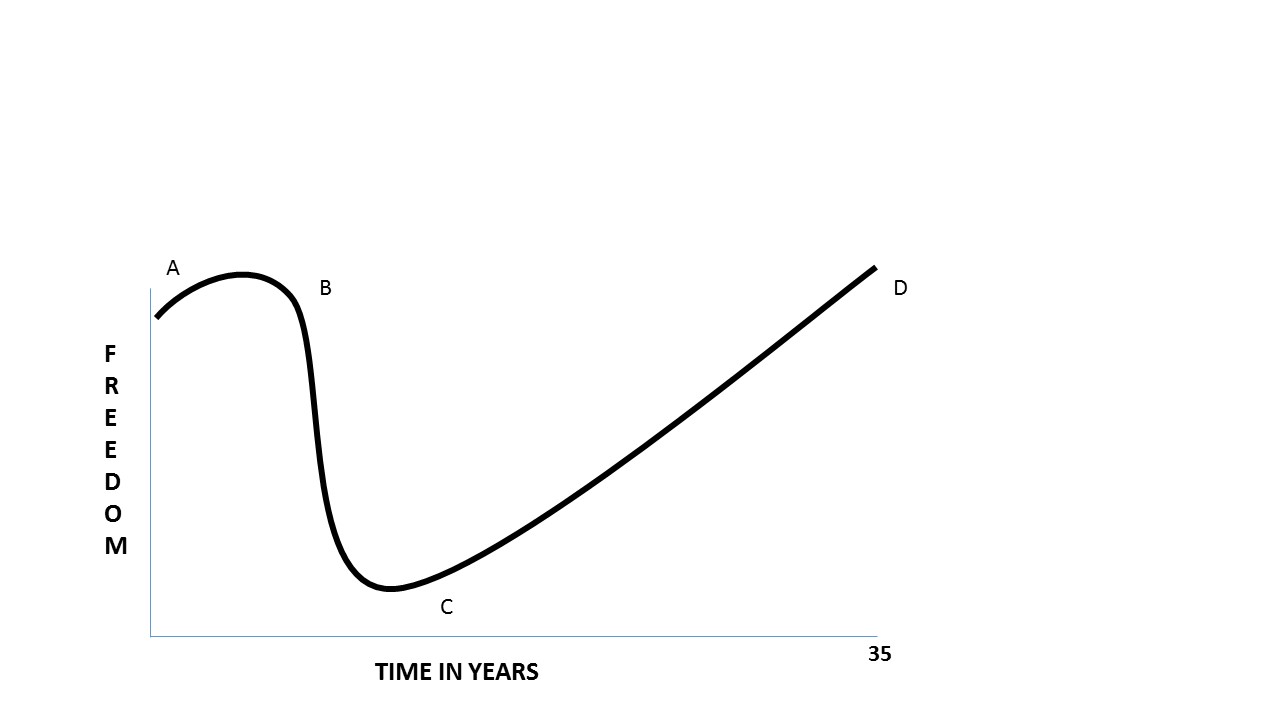
The graph above represents a typical person’s (mine) working lifecycle. I call it the “big dip” as it’s only fair to recognize Seth’s influence on the development of the concept.

You will note two axises, the vertical one representing personal freedom and the horizontal one representing time spent in years. The graph isn’t to scale but it does get the point of the story across. Be warned, it might scare you: it gave me the jitters when I first drew it so you might want to sit down for this one.

Entry point A is when you leave school and start working, maybe in a “corp.,” like I did. It’s a happy time. Life is fun and exciting and you do not have any significant worries. You are finally making some real money for the first time. One could reasonably say a person at this point is financially independent. They carry no personal debt, their parents still provide them with a roof over their head and food on the table. Life is as simple as it could be. Work-Eat-Have Fun-Repeat.

Everyone’s goal at this point is similar. Work hard, get promoted and make more money. This was the path to success as taught to them by their parents and teachers and every kid wants to look successful in the eyes of their parents, right? Continue Reading…