
Tag Archives: Financial Independence

4 key factors and 3 tips to consider when investing for retirement

We recommend that you base your investing for retirement on a sound financial plan. Here are the four key factors that your plan should address to ensure that your retirement investing generates enough income in retirement:

1.) How much you expect to save prior to retirement;

2.) The return you expect on your savings;

3.) How much of that return you’ll have left after taxes;

4.) How much retirement income you’ll need once you’ve left the workforce.

Stick with conservative estimates to account for unforeseen setbacks

As for the return you expect from investing for retirement, it’s best to aim low. If you invest in bonds, assume you will earn the current yield; don’t assume you can make money trading in bonds.

Over long periods, the total return on a well-diversified portfolio of high-quality stocks runs to as much as 10%, or around 7.5% after inflation. Aim lower in your retirement planning —5% a year, say — to allow for unforeseeable problems and setbacks.

Above all, it’s important to remember that while finances are important, the happiest retirees are those who stay busy. You can do that with travel, golf or sailing. But volunteering, or working part-time at something you enjoy, can work just as well.

One thing we encourage all investors to do is perform a detailed study of how you spend your money now. Then, you analyze your findings to see what personal expenses you can cut or eliminate. This too can have fringe benefits, especially if it helps you break unhealthy habits. You may be surprised at how much you’re spending and how much more you could be saving for retirement.

Dollar-cost averaging brings automatic profits

Continue Reading…

TFSA or RRSP? – The right answer for YOU

By Ed Rempel

Special to the Financial Independence Hub

TFSA vs. RRSP is one of the most common questions I am asked. If you want to know for sure which is better for you, then you need a financial plan.

Many articles have been written on this topic that list pros and cons with general opinions.

The truth is that:

1.) Rather than just having an opinion, there is a precise right answer specifically for you. To the extent that you know your present and future marginal tax brackets, you can calculate a precise optimal contribution for RRSP and TFSA for each year, as well as the optimal amounts to withdraw each year after you retire.

2.) The decisive factor is your tax brackets now vs. after you retire. Most people just assume they will be in a lower tax bracket after they retire, because their income will be lower. In many cases, that is not true.

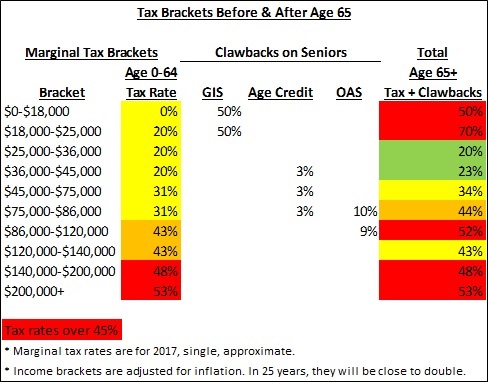
When you include the clawbacks of government income programs that affect everyone over 65, many seniors are in shockingly high tax brackets!

The clawbacks cost you actual money and are the same as a tax. The three main clawbacks are the 50% clawback on GIS for low incomes (under $20,000), 15% clawback on the age credit for middle incomes ($35,000-85,000), and the 15% clawback on OAS for higher incomes ($75,000-120,000).

The chart above shows the actual approximate tax brackets before and after age 65. Check out the tax brackets over 45% in red:

Understand the differences

You can own the same investments in your TFSA as your RRSP. The main difference is that RRSP contributions and withdrawals have tax consequences, while TFSA contributions and withdrawals don’t.

Therefore, the answer to TFSA vs. RRSP is primarily based on your marginal tax bracket today compared to when you withdraw after you retire: Continue Reading…

Helping Boomers create their own Victory Lap Retirement

Victory Lap Retirement is currently #7 on the Globe & Mail’s Canadian non-fiction bestsellers list

I’ve been working hard on my year-end review and goal setting, which I will share with you in next week’s blog. I’m excited by what we have accomplished over the past year, but recognize that there is still a lot to do in the years ahead.

My co-writer Jonathan and I are on a major mission and that mission is made up of two parts:

1.) To convince investment advisors to adopt a more holistic approach and provide quality lifestyle planning assistance to their clients.

2.) To teach young people about financial independence, or Findependence as we like to call it, so that they can get off to a good start in life.

It’s a big job, but it’s something that we just feel the need to do.  Call it our way of giving back to the community! Today, I would like to expand on the first point a little more.

Retirement planning, as it is done today, is inadequate. We are constantly being told by the financial services industry that the more money we save for retirement, the better our retirement will be. This causes a lot of stress for people and the message they are sending is simply wrong.

Financial Planning Fails without Lifestyle Planning

Continue Reading…

Billy & Akaisha’s 3 Lessons on how they reached their Victory Lap

Almost 3 decades of retirement and we still have a great time on a boat ride across Lake Atitlan

By Billy and Akasha Kaderli, RetireEarlyLifestyle.com

Special to the Financial Independence Hub

Retirement is a great achievement, but it’s not static. It’s not like once you arrive you can forget about it and put it on auto-pilot. It’s an interactive manner of living that continues to respond to our input, the new skills we learn and how our goals modify. Hopefully we continue to grow and change, making our retirement sustainable and sweeter to live.

Below you will find three of our most effective lessons on retirement that will enrich you and increase your enjoyment along your path in financial freedom.

Control housing costs and you can live anywhere

This is a well-kept secret of retirement. The cost of housing is one of the largest financial outlays in anyone’s household no matter what age you are, and if you modify the price you pay for your residence, you have the financial freedom to virtually afford living anywhere in the world.

In other words, if you could save tens of thousands of dollars a year on mortgage payments or rent, insurance, maintenance and repairs, how would that affect your life? What if you could live in Paris or on a Caribbean island for free? You can do that, if you house sit. Continue Reading…

3 simple techniques for overcoming financial stress in Retirement

Senior Couple Were Disappointed While Reading Letter On TableBy Leigh Marcos

Special to the Financial Independence Hub

We all look forward to retirement: complete freedom. We can do what we want, when we want, and don’t have to traipse into an office every day to join the rat race that dominates younger people’s lives.

Unfortunately, the transition to not working can come with a different set of pressures, not least the financial stress triggered by your drop in income. Current statistics show that 68% of working-age people in the U.S. don’t participate in an employer-sponsored pension plan, so this is a common anxiety that affects much of today’s retired populace.

Luckily, there are ways to combat financial stress and still relish what should be some of the most enjoyable years of your life. Here are three simple steps to help you do so:

Value yourself, and act like it

All too often, the change of routine involved in retiring after a lifetime of work can cause us to drift into a kind of daily limbo where time starts to lose meaning, and so as a consequence does our everyday life. Combat this lack of direction by actively redefining who you are without your job. What do you stand for? What do you still want to achieve? What do you enjoy doing? How do you spend your time? Take some time to reflect on these questions: brainstorming can help, as can physically writing things down or discussing them with a friend.

Make sure to avoid isolation by getting involved in regular, structured activity that enriches your life and brings you into contact with people who have a positive influence on you. This will help you keep financial worries in perspective and remind you that there are other important and valuable things in life.

Stay healthy

Continue Reading…