Tag Archives: Financial Independence

ChangeRangers’ Mark Venning interviews Victory Lap Retirement co-authors

Mark Venning, ChangeRangers.com

By Mark Venning, ChangeRangers.com

Special to the Financial Independence Hub

“We’re on a bit of a crusade to change the way our society thinks about retirement.” — Jonathan Chevreau & Mike Drak

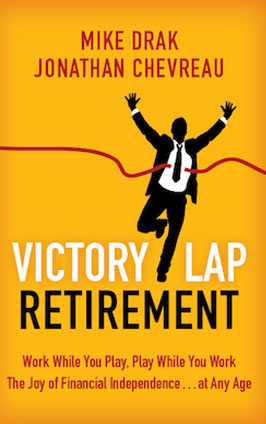
Mike Drak and Jonathan Chevreau, co-authors of Victory Lap Retirement (published, October 2016) are not the first to head out on this crusade. Apart from the material on the larger subject of aging and longevity, in my library I must have at least 19 books, in addition to the stacks of reports, studies and new models on the subject of Retirement.

Over the twenty years in the career services industry, where I worked directly with business executives in their later life transitions – leaving the corporate crow’s nest, as I call it, I can appreciate where Mike and Jonathan are coming from in their take on this. I have produced three retirement programs since 2001, and in the process suffered from metaphor madness, developing novel ways of reframing the concept of retirement and our later life journey.

However, this Drak & Chevreau volume is a welcomed new addition to this crusade. The book, by way of its novelty, weaves the conversation from the threads of a concept called Findependence, as the cornerstone of a Victory Lap Retirement.  So here we go. Rather than a traditional book review, here in this blog post, I present views of the authors as shared through interview questions with them in late October.
Authors Interview

Mark’s Q: Your co-authored book, early on, takes a shot across the bow at the “financial media & financial services industries” in the way they persist to push “Retirement” as if it were some final destination. (There seems little shift between the 1970’s London Life’s Freedom 55, to Prudential’s 2016 Race for Retirement campaigns for example.) What one new key message should marketers take from reading Victory Lap that could become a differentiator in their marketing?

Mike: The industry is using the same commercials that they used 40 years ago. The only difference is that they are now in color. The world of retirement has changed significantly over the years and most people cannot afford nor do they want to live the lifestyle portrayed in their commercials.

Banks assume more money equals better retirement, which is wrong thinking. Banks are good with the investment piece but they need to become more involved with the lifestyle piece. How can you ever know if you have enough if you do not have a firm handle on what type of retirement lifestyle you want in retirement and what that lifestyle will cost?

Mark’s Q: At one point in Chapter 3, you make the point that: “Compounding the problem is the lack of financial education our children receive in school.” You also say in Chapter 4 that the importance of financial independence is a prerequisite to the new stage of life you call “Victory Lap Retirement.”  Let’s play here. What do you think about an opportunity for you to design/deliver a “Findependence” course relatable to high school teenagers that didn’t use the word Retirement? What then would the main message sound like to them?

Jon: We’d say there is an opportunity there. Continue Reading…

Considering a Sale Leaseback on a principal residence

Quiet street with new houses and condo buildings on the background.This idea came to me while away fishing and the more I think about it the more appealing it becomes.

Sale leasebacks are common in the commercial property arena but I can’t recall seeing it discussed with respect to residential property.  I googled “sale leaseback residential property” and was pleasantly surprised to find that some people are already doing it.

Based on what I know, and my own particular situation, here is how it should work in theory.  My wife the Contessa would like to live downtown by the waterfront in Toronto one day. Austin is our only son still living with us, with our other two boys somehow managing to escape. So when Austin eventually, leaves the house will be largely empty. There is a good chance that Austin will move into residence in downtown Toronto when he goes to university in three years.

My mother, who is 92, is in a nursing home close to my house and I wouldn’t consider moving while she is there. Why move, complicate my life further and create unnecessary pressure?

My idea is to sell in the spring if residential real estate prices stay high and the market stays hot. I would negotiate a minimum five-year lease, which will allow me ample time to simplify and de-cumulate, getting rid of a lot surplus stuff accumulated over the years.

My Options

Continue Reading…

My recent blogs: KIPPERS, insecure retirement, annuities, post-Trump investing

depositphotos_30337045_s-2015
KIPPERS. Should parents dip into retirement savings to help their kids?

As regular Hub readers may know, I often write financial articles for other (mostly) digital media, usually the Financial Post, MoneySense.ca and Motley Fool Canada. Here’s some of the most recent blogs or columns, with links via the headlines.

Nearing Retirement and still insecure about your finances? Sadly, you’re not alone. (FP, Nov. 17)). This came out of a survey released this week by Mackenzie Investments that suggested many of us actually feel less secure financially about retirement the closer the actual date arrives. One reason is grey divorce and another perhaps related one is dipping into retirement savings to help adult children.

The latter idea was explored In an earlier FP blog I wrote this week: When Boomers should turn the taps off (or on) when it comes to financial assistance for their kids. (FP, Nov 15). There I pass along a term I learned from occasional Hub guest blogger Doug Dahmer of Emeritus Retirement Solutions: KIPPERS, also mentioned in the photo caption above.

KIPPERS stands for Kids in Parents’ Pockets Eroding Retirement Savings.  I also mentioned this in a short segment on this topic on Tuesday with Peter Armstrong on CBC’s On the Money show.

A few weeks earlier, the CBC aired another segment between me and Armstrong titled You’ve never going to retire, and Here’s Why.

Canadian Personal Finance Conference this weekend

That of course touched on the new book I’ve coauthored with Mike Drak, Victory Lap Retirement. The FP has also been running excerpts of the book the last several Mondays. You can find the first four here. Number 5 is slated for next Monday. By the way, co-author and fellow blogger Mike Drak and I both plan to attend the Canadian Personal Finance Conference 2016 this weekend in Toronto. Hope to see other financial bloggers there!

Last weekend, the FP ran a my column on Locked-in Retirement Accounts (LIRAs): The RRSP’s less flexible cousin: Everything you need to know about the LIRA.  Watch for a followup column that addresses reader queries on this topic.

Earlier this week, Motley Fool Canada ran my take on investing in the post-Trump-victory world: Don’t dump your long-term investment plan over Trump’s victory. And it’s just published my latest quarterly report for Stock Advisor Canada, this one on CRM2 and Best Interest (only subscribers with a user name/password combo can access this).

Over at MoneySense.ca on November 11th was the online version of my most recent column from the November issue of the magazine, which is on annuities: How to win using annuities in retirement.

Hey, no one promised my Victory Lap Retirement would be easy!


How a Personal Pension Plan can mimic gold-plated DB pensions

jplaporte
Jean-Pierre Laporte

By Jean-Pierre Laporte

Special to the Financial Independence Hub

There are approximately 1.2 million Canadians capable of saving for their retirement and mimicking the ‘gold plated’ pensions of federal civil servants and teachers.  Are you among them?

It’s well-known in policy circles that traditional defined benefit (“DB”) plans are better for employees but worse for the employers that underwrite them.

Why? Because the nature of the pension promise itself builds in an assumption that there will be sufficient assets, on an actuarial basis, to replicate a certain level of income, well into retirement.  If markets do well, the promise is met.  If markets underperform, these DB plans require that the employer  dip into its corporate pockets to make up the difference through ‘special payments’.  Short of a corporate insolvency, the DB model offers a guarantee of financial security that does not exist in any other type of tax-assisted plans (such as the RRSP, DPSP, PRPP or Defined Contribution plans).

While the mention of DB Plans conjures up visions of large public sector behemoths like the Ontario Teachers’ Pension Plan or the Healthcare of Ontario Pension Plan, they also exist at the other extreme:  small professional corporations created by a single individual to carry out a given profession.  Recently, small business owners and professionals are turning to the Personal Pension Plan (“PPP”), a type of registered pension plan that offers both DB and Defined Contribution (DC) accumulation methods under a single roof, with the freedom to select between the two each year.

The reason why the PPP works so well at the individual professional corporation (“PC”) level is that the interests of the plan member and of the shareholder are perfectly aligned. In years of market underperformance the requirement that extra tax-deductible contributions (special payments) be made, is simply a transfer of wealth from the owner’s taxable corporate pocket to his/her tax-deferred personal pension pocket.  Likewise, strong market performance can lead to a “contribution holiday” for the PC and an even safer retirement pension for the shareholder/member.

Upgrading from RRSP savings to PPP savings

Continue Reading…

Survey finds financial security beats milestones like buying a home and a car

wuxiznbo
Laurie Campbell, Credit Canada Debt Solutions

In one of my books I’ve argued that young people should adopt the slogan “Freedom, Not Stuff” as a way to remind themselves that financial independence beats accumulating possessions via debt.

Now a survey being released by Credit Canada Debt Solutions and Capital One Canada has released a survey saying Canadians think financial security beats milestones like buying a home or a car. The two organizations are celebrating ten years of building financial literacy through Credit Education Week, which runs this week (Nov 7 to 11th).

The survey of 600 in four major regions of Canada asked consumers to share insights into their financial wins. While there’s a perception that Canadians hold the goal of home ownership above all else, the survey found that in reality, they rank milestones like buying a home (12 per cent) or car (8 per cent) as less important financial wins than feeling financially secure in their daily lives (25 per cent).

“There is so much to learn from the positive, everyday financial experiences of our friends and family,” says Brent Reynolds, Managing Vice President of Capital One Canada. “Milestone moments like a new home or car may garner more ‘likes’, but it’s the experiences not easily shared in 140 characters that are most impactful – like how we took charge of our finances or recovered from a financial stumble.”

80% reported a financial win this year

Continue Reading…