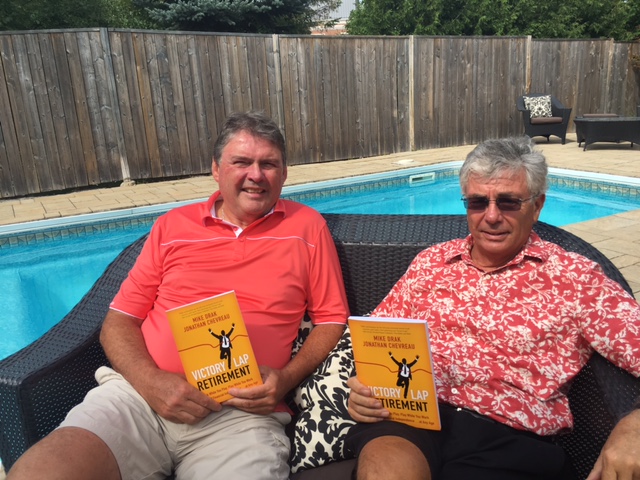
Coauthors Mike Drak (L) and Jonathan Chevreau (R).
As the accompanying photograph of me and coauthor Mike Drak shows, the book Victory Lap Retirement has finally come off the printing presses.
It will be a few weeks before it is available in bookstores but it can be ordered and delivered now directly through the web site VictoryLapRetirement.com.
The photo was taken Thursday at Mike’s Toronto home. As you can see from our casual poolside attire, we’re trying to live the lifestyle described in the book, and summarized by the subtitle Work While You Play, Play While You Work.
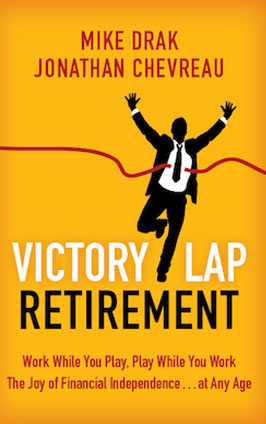
You can also see the yellow book cover is now in rotation on the front page of the Hub, along with the US and Canadian editions of Findependence Day and the summary Kindle ebooks titled A Novel Approach to Financial Independence.
At some point we’ve all daydreamed about what our retirement might look like. For some, a cabin in the woods might be their dream life. Others may want a condo near the beach or high-rise apartment in the city. Many daydreams also include travel, both in and outside the U.S.
Ample Hollywood movies about the joys and headaches of the retirement life have given nods to the recreational vehicle (RV) retirement lifestyle as well. From ex-CIA man Jack Byrnes’ sleek black Fleetwood RV in Meet the Fockers, to David and Linda Howard’s homier Winnebago in the movie Lost in America, RV living may represent a luxury life of leisure for many Americans.
One former co-worker of mine, shortly after his retirement, sold his home to buy a fancy new RV. While I was able to meet him at his retirement party and do a short quiz on his reasoning, the decision never quite added up for me. I decided to do some additional research to determine if RV-living was a sound and viable financial decision for my own retirement.
Full-time RVers, also known as full-timers, are people who live, work, and play in their RVs. Often they plan their lives and moves well in advance, but they’re also known to pick up and go on a whim, or to follow the weather on a seasonal basis.
However, there are a few considerations when contemplating the full-time RV life. Here’s a breakdown of points to ponder while deciding whether it’s the best lifestyle for your needs.
Finances
RVs can be purchased in a wide price range – anywhere from $3,000 to $3 million – which makes them perfect for any budget. Continue Reading…
Friday July 29th will be a day that I will remember for the rest of my life. After thirty-eight years, I finally packed in my banking career. I suppose my co-author Jonathan would call this my Findependence Day!
To be honest, it will take some getting used to as my banking job played an important role in my life. It provided financial security for my family and gave me a good reason to get out of bed most mornings.
My career, like most careers, had its good and bad points. Overall though, it was a good ride and one that I will miss to some degree, but I had to leave in order to publish Victory Lap Retirement and create my blog.
Banks really don’t like it when employees write books or blogs because it might not align with the story that they are trying to convey. Banks get nervous when employees stand out and don’t fit in, when employees invent something that is outside the approved message.
Banks are very protective of their brand. They want the customer experience to be the same in every branch across the country. They want every employee to talk, walk and act the same. They desire a high degree of predictable sameness, as it’s easier to control.
Why banks still sell the old version of Retirement
My latest MoneySense Retired Money column is about when to take Old Age Security (OAS) benefits and has been posted at MoneySense.ca. Click on the highlighted text to access the full version here: Why I’m taking Old Age Security right at 65.
As the piece goes into in more depth, the Government incentivizes those in their 60s (including Yours Truly) to defer the date for commencing receipt of benefits of the Canada Pension Plan (CPP) and Old Age Security. The longer you delay between 65 and 70 (or in the case of CPP, beyond age 60), the better the ultimate payout: wait till 70 instead of 65 and OAS will be 36% higher and CPP 42% higher.
Reasons for Deferring CPP may not also apply to OAS
However, the circumstances surrounding CPP and OAS are not identical, so in my own case I plan to take OAS as soon as it is on offer, less than two years from now, while I will endeavour to defer starting the receipt of CPP for as long as I won’t need the money.
Are you like so many Canadians? You have a good paying job, are in a two-income household, own a home and yet you run out money before you run out of month?
The majority of Canadians are spending more than they make. If this sounds like you, you’re not alone. We are trying to put some money aside for the future as we have been told we should, but we also want to enjoy today; take that trip, get a new car, renovate the kitchen. We cannot just live for tomorrow. WE WANT TO ENJOY TODAY.
The reason we have this shared experience is that we never went to school to learn how to “handle” our finances or how to manage our CASH FLOW. With so many different companies from financial institutions to consumer goods vying for our money, managing our cash flow on a monthly basis can be very difficult for many people; myself included.
Certified Cash Flow Specialist
With a four-year business degree and a CFP (Certified Financial Planner) and CLU (Chartered Life Underwriter), one would think that I would have received a formal education in cash flow planning as well, but I didn’t; at least not until I received an actual formal education in cash flow planning and became a CCS (Certified Cash Flow Specialist). Continue Reading…