Tag Archives: Financial Independence

Retired Money: Why I won’t defer my OAS past age 65

OASMy latest MoneySense Retired Money column is about when to take Old Age Security (OAS) benefits and has been posted at MoneySense.ca. Click on the highlighted text to access the full version here: Why I’m taking Old Age Security right at 65.

As the piece goes into in more depth, the Government incentivizes those in their 60s (including Yours Truly) to defer the date for commencing receipt of benefits of the Canada Pension Plan (CPP) and Old Age Security. The longer you delay between 65 and 70 (or in the case of CPP, beyond age 60), the better the ultimate payout: wait till 70 instead of 65 and OAS will be 36% higher and CPP 42% higher.

Reasons for Deferring CPP may not also apply to OAS

However, the circumstances surrounding CPP and OAS are not identical, so in my own case I plan to take OAS as soon as it is on offer, less than two years from now, while I will endeavour to defer starting the receipt of CPP for as long as I won’t need the money.

Continue Reading…

The critical role of planning for Cash Flow

ennio_4-1500x1058
Ennio Longo

By  Ennio Longo

Special to the Financial Independence Hub

Are you like so many Canadians? You have a good paying job, are in a two-income household, own a home and yet you run out money before you run out of month?

The majority of Canadians are spending more than they make.   If this sounds like you, you’re not alone.  We are trying to put some money aside for the future as we have been told we should, but we also want to enjoy today; take that trip, get a new car, renovate the kitchen. We cannot just live for tomorrow.  WE WANT TO ENJOY TODAY.

The reason we have this shared experience is that we never went to school to learn how to “handle” our finances or how to manage our CASH FLOW. With so many different companies from financial institutions to consumer goods vying for our money, managing our cash flow on a monthly basis can be very difficult for many people; myself included.

Certified Cash Flow Specialist

With a four-year business degree and a CFP (Certified Financial Planner) and CLU (Chartered Life Underwriter), one would think that I would have received a formal education in cash flow planning as well, but I didn’t; at least not until I received an actual formal education in cash flow planning and became a CCS (Certified Cash Flow Specialist). Continue Reading…

Rediscovering your Inner Child in your Victory Lap

Return to Inner ChildThe other day I was talking to a gentleman about how, in our Victory Laps, we have the opportunity to start living like a kid again. He thought that was a little weird, but I think I finally won him over by triggering some long forgotten memories in him.

Remember back to when you were a kid in school. Back then, we had no fears and anything seemed possible. We dreamt such big dreams, like competing in the Olympics or becoming the president of a large company.

Life used to be such an adventure back when we were young but unfortunately over time we tend to bury our hopes and dreams, deep down inside us. We are driven to obtain financial security for our families and save up enough for eventual retirement but at some point we allow ourselves to be assimilated by our jobs and start following the crowd.

We end up acting like everyone else, without knowing exactly where they are taking us, and live by rules drawn up by someone else. As a result, many people just sit back and watch their dreams slowly wither and die. They follow the same dull, boring daily routines, and feel overwhelmed by the pace of their lives, their jobs, debts owed and family obligations. When we allow our dreams to die our soul isn’t far behind.

Young people have little in the way of financial resources, but seem to have the ability to live where they want, travel where they want, and have no fear of doing what they want to do in life. We can learn (perhaps re-learn is a better word) a lot by watching and listening to our kids.

The challenge we boomers face is to find a way to open our minds and take a new approach to life as our past experiences and old prejudices keep getting in the way. Don’t settle for just getting by and start looking at the world with fresh eyes. We all need to start living again just like when we were kids.

If You Don’t Do It Now, You Never Will!

Continue Reading…

Slap Shot: How pro athletes can (legally) “skate by” high tax rates

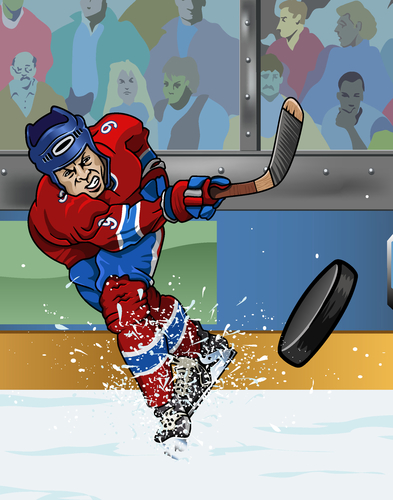
Cartoon-style illustration: a shooting hockey player Uniform similar to Montreal's oneBy Trevor R. Parry,  M.A., LL.B,LL.M (Tax), TEP

Special to the Financial Independence Hub

For many Canadians, the state of our beloved national game reached a nadir when none of the seven NHL franchises qualified for last year’s playoffs. This wholesale failure has given rise to the over-analysis and questioning that only a nation of amateur general managers could produce.

What’s the armchair consensus about the source of Canada’s poor performance? Some would-be GMs decry economic maladies they believe are unique to the Canadian franchises, while others bemoan the current lacklustre state of the Canadian dollar — while still others point to punitive rates of taxation introduced by federal and provincial governments in recent years.

While the first two factors may be the likely cause in the delay in awarding an expansion franchise to Québec City — which, as a Habs fan, I am particularly distressed by as we await the return of our primordial enemy — the latter factor, whilst a reality, can largely be eliminated through recourse to a financial strategy that has now existed for fully 30 years.

Introducing the RCA

In 1986 the federal government amended the Income Tax Act to include the Retirement Compensation Arrangement rules. Better known as an “RCA,” this is the only structure available in Canada that allows supplemental retirement benefits to be funded on a tax-deductible basis. Continue Reading…

Financial planning for Retirement: uncertainty is certain

Sandi-Casual-Small
Sandi Martin

By Sandi Martin

Special to the Financial Independence Hub

If you’re planning for retirement and make the mistake of scrolling through any finance section in a slow news week, you have to ask yourself: what kind of questions are they asking to produce breathless headlines like these?

  • Half of Canadians don’t think they’ll be able to retire comfortably: poll
  • Many Canadians believe they will run out of money 10 years into retirement, poll finds
  • Retiring Canadians will see ‘steep decline in living standards’: CIBC

If a friendly pollster called you in the middle of dinner and asked “Have you saved enough for retirement?,” how would you answer if you were only given the choice between “yes,” “no,” and “I don’t know” and wanted to get off the phone and back to your family?

I doubt that the statisticians or infographic designers would be happy if “it depends on what you mean by ‘enough’” were added as a fourth option, but I’d bet a lot of money that it would be the single most frequent response if were presented as an option.

Leaving aside that most of these studies and polls are commissioned by banks and mutual fund shops whenever their managed asset levels get lower than they’d like, let’s talk about how silly it is to frame retirement planning around the concept of “enough,” as if “enough” was something we could universally, quantitatively measure.

What people mean when they talk about “having enough for retirement”

Continue Reading…