Tag Archives: investing

Tackling your Stock Market fears

By Anita Bruinsma, CFA

Special to the Findependence Hub

Investing has become more accessible to more people over the years. The emergence of mutual funds, ETFs, online brokers and robo-advisors has given pretty much everyone the means to invest. So why are so many people still reluctant to invest, and in particular, why don’t they think they can do it themselves? Judging by the people I’ve talked to the answer is: they’re scared. 

This is unfortunate and unnecessary. The investment industry has made investing look so complicated. We are led to believe that we need an MBA, a Bloomberg terminal and a proficiency in Excel modeling to invest. This is absolutely not true. Investing can be simple when you buy and hold broad-market ETFs. 

Compounding the problem are the tales of fortunes lost in the stock market, either by gambles taken or being swindled by an unscrupulous financial sales person. These horror stories, although real, are uncommon, and like many of our fears, are bigger in our imaginations than in reality. 

Investing can be simple

Have you heard of imposter syndrome? That’s when you think you aren’t talented or skilled enough to deserve your job, your income, or the accolades bestowed on you. I had terrible imposter syndrome when I was hired as an equity analyst 16 years ago. I thought everyone around me was way smarter than me when it came to investing in the stock market. 

Over the years, though, I realized that so much of what people were talking about was irrelevant, and the excessive amount of information and analysis was unnecessary. The highly-paid “experts” who came to meet with us couldn’t simply say “The stock market goes up over the long term.” Why would anyone be paid to give that simple piece of insight?

The thing is, that’s all that matters. The fact that the U.S. stock market has, historically, always recovered from dips and crashes and continued the march upward is all that matters. Don’t let all the other market-related noise distract you from this point.

Fewer decisions, better outcomes

Here’s how to de-complicate investing: don’t make predictions. The smartest investors on Bay Street don’t try to guess where the market is going: they buy their investments and hold onto them for the long term. The more decision-making you remove from investing, the better off you’ll be. This means don’t pick stocks and don’t choose when to get in and out of the market. Buy ETFs or index mutual funds that mirror the broad market, buy when you have the money, and sell when you need it.  Continue Reading…

The Rear-View Mirror and U.S. stocks: A Contrarian Indicator

By Noah Solomon

Special to the Financial Independence Hub

As we have written before, sentiment and emotions can have an outsized influence on investor psychology and investment decisions. Relatedly, there is a powerful inclination among investors to perceive markets that have outperformed as being less risky than those that have underperformed.

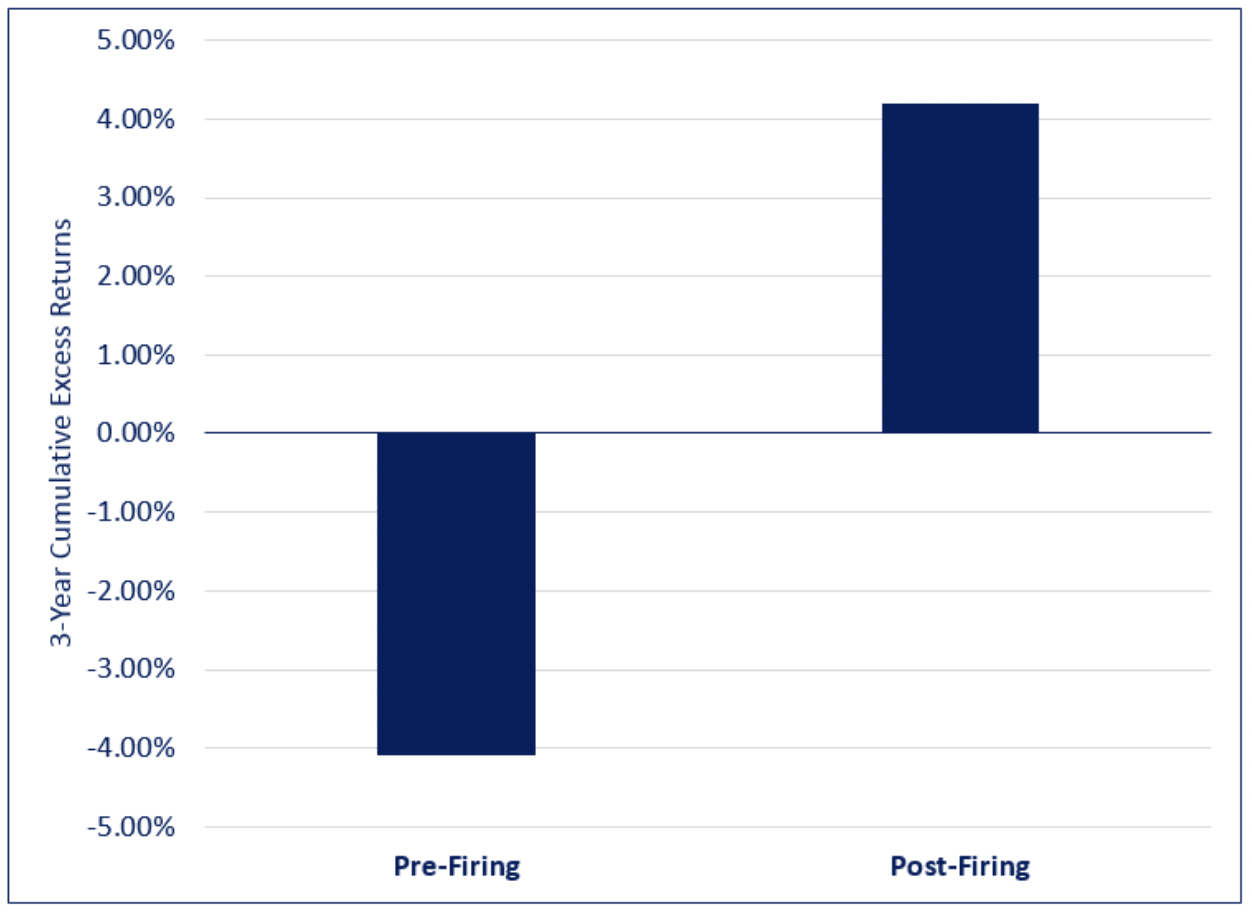
Interestingly, this tendency exists not just among individual investors, but is also prevalent in the professional investment community. A 2008 study by finance Professors Amit Goyal and Sunil Wahal explored the performance of investment managers who had been fired by institutional investors. The analysis compared the managers’ performance in the three years before being fired with their subsequent three-year performance.  The results of the study are summarized in the following graph.

The Selection and Termination of Investment Management Firms by Plan Sponsors

On average, fired managers had poor performance in the three years preceding their termination, with average annual underperformance of 4.1% vs. their benchmarks. This figure should come as no surprise, as you wouldn’t expect that they were fired for knocking the lights out! However, what may be counter-intuitive to many is that these managers tended to subsequently outperform, with average annual outperformance of 4.2% over the three years following their termination.

Clearly, not only does looking in the rear-view mirror fail to prevent you from hitting something that is in front of you but may in fact cause it!

The other takeaway is that even seasoned, institutional investors can be swayed by short-term performance, which in turn can lead to decisions which are both ill-timed and economically perverse.

Beware the Mean Reversion Boogeyman

Last year saw a continuation of a long-established trend of U.S. stock outperformance, with the S&P 500 rising 28.7% as compared to 8.3% for the MSCI All Country World Index (ACWI) Ex-U.S.  From the end of 2008 through the end of last year, the S&P 500 rose at an annualized rate of 16.0%, producing a cumulative return of 587.3%. In comparison, the ACWI Ex-U.S. Index rose at an annual rate of 8.6% and delivered a cumulative return of 190.7%.

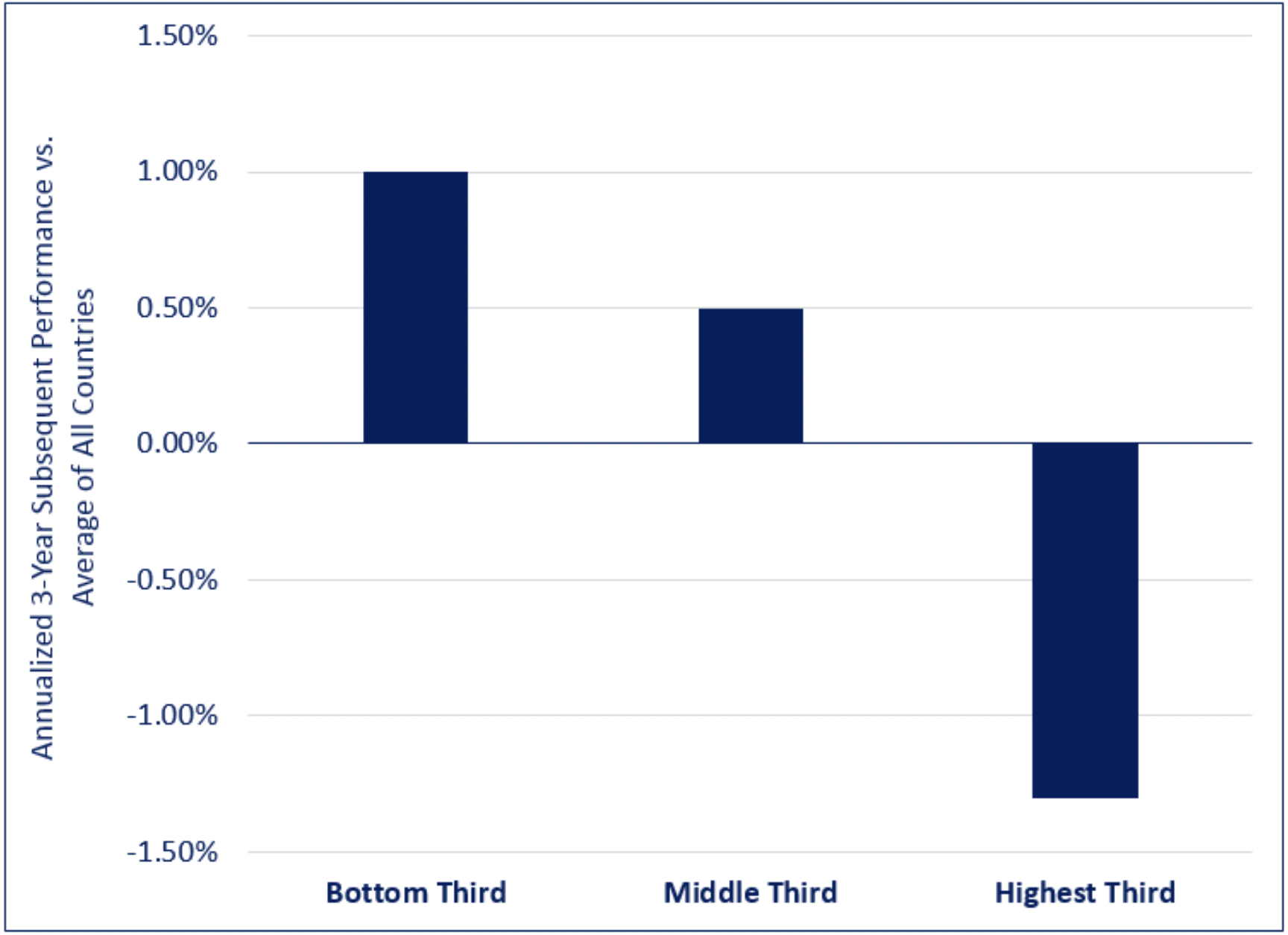
The outperformance of U.S. stocks argues for actively reducing U.S. exposure and increasing allocations to other regions, as the mean-reverting, contrarian nature of investment manager performance can also be applied at the country level. The following chart covers the period from 1970-2021 and includes the U.S., U.K., Germany, France, Australia, Japan, Hong Kong, and Canada. Specifically, it illustrates the results of investing every three years in a portfolio of country indexes based on their trailing returns over the previous three years.

3-Year Performance of Countries ranked by Trailing 3-Year Performance

The chart brings fresh perspective to the standard regulatory disclosure language in the marketing materials of investment funds, which states that “Past performance is no guarantee of future returns.”

Outperforming countries tend to become subsequent underperformers : those that have had superior returns over the past three years tend to produce relatively poor results over the next three years. Conversely, underperformers tend to subsequently outperform: those that have lagged over the past three years tend to outperform over the next three years. Continue Reading…

Gen Z is Canada’s most engaged generation for tracking Financial Goals

Move aside, Boomers: Gen Z is coming through!

According to BMO’s annual Investment Survey, Gen Z is now Canada’s most engaged generation for tracking financial goals.

Younger Canadians are flexing their financial savvy by evaluating their financial goals and plan more frequently than any other cohort: including Boomers!

According to the survey, 62% of Gen Z (aged 18-25) and 54% of Millennials (age 26-41) review their financial goals at least quarterly, with 41% of Gen Z and 29% of Millennials doing so monthly. In comparison, only a third (36%) of Boomers (aged 58-67) review their financial plans at least once a quarter and only 15% of them do so monthly.

“It’s exciting to see the next generation of Canadians building solid financial habits and establishing a foundation early” said Nicole Ow, Head, Retail Investments at BMO, in a  press release, “Real financial progress is a lifelong pursuit as our goals and circumstances change throughout our lifetime. We encourage Canadians of all ages to consider ways not only to grow their wealth and work towards immediate financial goals, but also to ask their advisor how they can align their investments with their values, define their longer-term goals, and protect and share their wealth with their loved ones and the causes that mean the most to them.”

Social media a big influence

While the survey found the majority of young Canadians rely on advice from a professional when making financial decisions, what’s more interesting is the additional sources they are seeking out for guidance. Many are currently working with a financial advisor, and 47% of Gen Z and 32% of Millennials say they were referred to their advisors on the advice of a trusted friend or family member. The impact of social media on the financial habits of young Canadians also mustn’t be overstated. A third of Gen Z and 22% of Millennials refer to financial influencers and social media for their investment decisions. In comparison, only 7% of Canadians over 55 utilize these sources.

Barriers to Entry

Among younger Canadians with savings primarily held in cash, half of Gen Z and close to two fifths of Millennials say the primary reason for this is that they do not know how to invest. Whether it’s not knowing where to begin, or being unsure who to trust with their finances, a lack of basic financial literacy skills being taught in schools may be partly to blame for this. Thankfully, the previously mentioned alternate sources that young Canadians seek out can help to educate those feeling overwhelmed. Continue Reading…

Investing during Wartime: How does the Geopolitical Climate impact your Financial Planning?

By Steve Lowrie, CFA

Special to the Financial Independence Hub

Don’t let Geopolitical Strife destroy your Investment Resolve.

This month, I was planning to write about financial planning for small- to mid-size business owners, including ways to optimize your personal and corporate tax planning. I believe many of you will find the information useful, so I promise to publish that soon.

But not now. Not after Putin invaded Ukraine. It feels wrong to go about business as usual while most of us are asking important questions about this geopolitical crisis.

By no means do our financial concerns detract from the greater, human toll. That said, if I can help you remain resolute as the world justifiably severs Russia’s access to capital markets and the global economy, perhaps we can both do our part to restore justice in Ukraine.

So, let’s talk about geopolitics and investing during wartime. Here are my key takeaways:

Big picture, geopolitical events’ impact on financial markets are usually short-lived

To help you keep your financial wits about you, consider Vanguard’s historical perspective on how the U.S. stock market has responded to other geopolitical crises over the past six decades. As Vanguard’s chart depicts in the article Ukraine and the Changing market environment, the turmoil has typically translated into initial sell-offs. But markets have also exhibited remarkable resilience, delivering returns in line with long-term averages as soon as six months later. That’s not to predict the same outcome this time, but it reinforces the wisdom of betting for vs. against the market’s staying powers.

Credit: Vanguard – Ukraine and the changing market environment

In Vanguard Canada’s recent article, When the markets seem to turn against youGreg Davis, Chief Investment Officer recommends a steadfast approach:

“A new dimension of risk has entered the financial markets with heightened tensions in Ukraine …

We know this, however, about equity markets in the context of geopolitical risks: they’ve been resilient, much as markets have always been resilient in the face of various risks. We expect the markets to work themselves out, reaching new heights over time and at varying paces …

So now is not the time to give up your fortitude. Now is the time to take it all in with a deep breath, knowing that this day would come — and knowing that it will pass.”

Speaking of predictions, ignore those who claim to know what’s going to happen next

In their landmark studies on political forecasts documented in their book, Superforecasting: The Art and Science of PredictionWharton professor Philip Tetlock (a Canadian, by the way) and co-author Dan Gardner found that we’re unlikely to do our net worth any favors by depending on the “expert” predictions you may be seeing on the daily news:

“People who generate better sound bites generate better media ratings, and that is what gets people promoted in the media business. So, there is a bit of a perverse inverse relationship between having the skills that go into being a good forecaster and having the skills that go into being an effective media presence.”

In other words, those forecasts you’re hearing are more likely to sound like sure (often scary) bets, and less likely to be reasoned reflections on the many ways any given event might play out. In fact, evidence suggests, the more certain an expert seems about their forecast, the more skeptical you should be about its worth.

Continue Reading…

Dealers putting Clients’ Retirements in Jeopardy

By Nick Barisheff

Special to the Findependence Hub

Over time, most investment dealers have implemented misguided policies that will negatively affect their clients’ investment portfolios and their ability to achieve a secure retirement.

There are two main policies that have negative impacts on investors’ portfolios. One is restricting investments to a client’s original Risk Tolerance in the Know Your Client application form (KYC). When opening an account, the client will advise the dealer of their Risk Tolerance.  Most clients will indicate that they are medium risk. On March 8, 2017, the Ontario Securities Commission (OSC) implemented risk rating rules that require all mutual funds to rate their fund according to 10-year standard deviation. In 2018, I published an article entitled New Mandatory Risk Rating is Misleading Canadian investors.

Prior to the OSC’s implementation of the risk rating rules, on December 13, 2013, the OSC issued CSA Notice 81-324 and Request to Comment – Proposed CSA Mutual Fund Risk Classification Methodology for Use in Fund Facts. My comments on this policy were submitted to the OSC on March 12, 2014, along with comments from 50 other industry experts.  

I presented a paper to the OSC that argued that Standard Deviation is not an appropriate measure of risk, since the best-performing mutual fund and the worst-performing mutual fund in Canada had the same Standard Deviation.  The measure of Standard Deviation of an investment does not reduce the risk of incurring losses.

A better, more accurate methodology would have used downside standard deviation or the Sharpe or Sortino ratios which measure risk adjusted returns. Nevertheless, the OSC implemented risk rating rules requiring all mutual funds to rate the risk of their funds according to 10 year standard deviation.

As a result, if investments in a client’s portfolio exceeded the risk tolerance as indicated in the original KYC, the client was forced to redeem those investments, by the advisor’s compliance department. A number of BMG’s clients were forced to redeem their positions since our funds had a medium-high risk rating according to the OSC formula, and the clients’ KYC indicated medium-risk tolerance. A number of clients wanted to change the KYC in order to allow them to maintain ownership of our funds but were advised that, unless there was a significant change in their financial circumstances, they could not change their KYC. Continue Reading…