Tag Archives: investing

What are the unique skills required for investing in real estate?

By Curtis Brown

Special to the Financial Independence Hub

Real estate has been an extensive career opportunity for quite some time now. People have successfully made a living out of buying and selling of properties and houses. If you ask anyone who has been in this field for a long time, they will tell you it is not an easy job. You need to have excellent communication and convincing skills to flourish in the real estate market. But the trick is not just selling.

You should also have the knowledge to assess and know when to buy so you can get maximum profits out of it. Many successful real estate agents have had numerous happy clients over the years. It’s probably a good idea to look at the set of skills they possessed to get an idea about how you should hone and develop your skill in investing in real estate.

Understand market conditions and risks

The market has many facets. It can be very stable at one time and volatile the next moment. However, if you look closely, it follows a trend. You should be able to analyze these trends so you can take advantage of all the uphills and downhills. There is no denying the fact that there is always an element of risk associated with real estate. However, since you have decided to enter the game, you might as well take some. In case it pays off, the profits may be much more than expected.

Discipline has been the most important skill

This applies to almost all career choices, and its implication in real estate is even more significant. Discipline and patience are two virtues that you definitely cannot do without. Once you embark on the path of discipline and follow up with your clients religiously, you will be able to track down and understand potential customers easily.

Network and Management skills

Since real estate is all about communication and buying and selling, one thing of paramount importance here is the kind of network that you have. A lot of marketing in real estate is based on word of mouth, and heavy networking will help to build a good reputation in the market. You should also be able to manage multiple properties at once. This is one strategy that most successful real estate agents apply. They deal with more than one home and keep stacking up their profits one after the other. You will have multiple avenues of income through this method. Continue Reading…

10 ways to get retirement ready

By Mark Seed

Special to the Financial Independence Hub

You’ve worked your entire life. You put some money away; invested, watched that money now and then over time.

Yet instead of living it up for everything you’ve worked so hard for you’re counting coins to make ends meet.

I don’t want this to happen to me. I don’t want it to happen to you either.

Inspired by an article I read some time ago, why retirement might not work out for you, I’m going to go on the offensive: here are 10 ways I plan to get retirement ready.

Retirees or prospective retirees please chime in!

1.) I will favour stocks over bonds

Most retirees are worried about out-living their savings. With inflation as a massive wildcard in our collective financial future, this fear is not unwarranted.

One way to combat inflation is to own more stocks (for growth) than bonds (for income security when equities tank) in retirement. You could argue that a 70/30 stock to bond split might be a good starting point to enter retirement with.

I own 100% equities in our portfolio now. We have that bias to equities because I consider my future defined benefit pension plan “a big bond.” Eventual Canada Pension Plan (CPP) and Old Age Security (OAS) payments in our 60s will also be part of our fixed-income component.

Got a pension plan?  Lucky you.  Consider that a big bond.

Here is when to take CPP.

Here are the facts about taking OAS you need to know.

While it might be scary (for some) to watch the volatility of your stock portfolio go up and down like a yo-yo short-term, owning a nice blend of stocks and bonds should help you combat inflation rather well.

What % of stocks and bonds and cash do retirees out there use today?

2.) I will embrace diversification

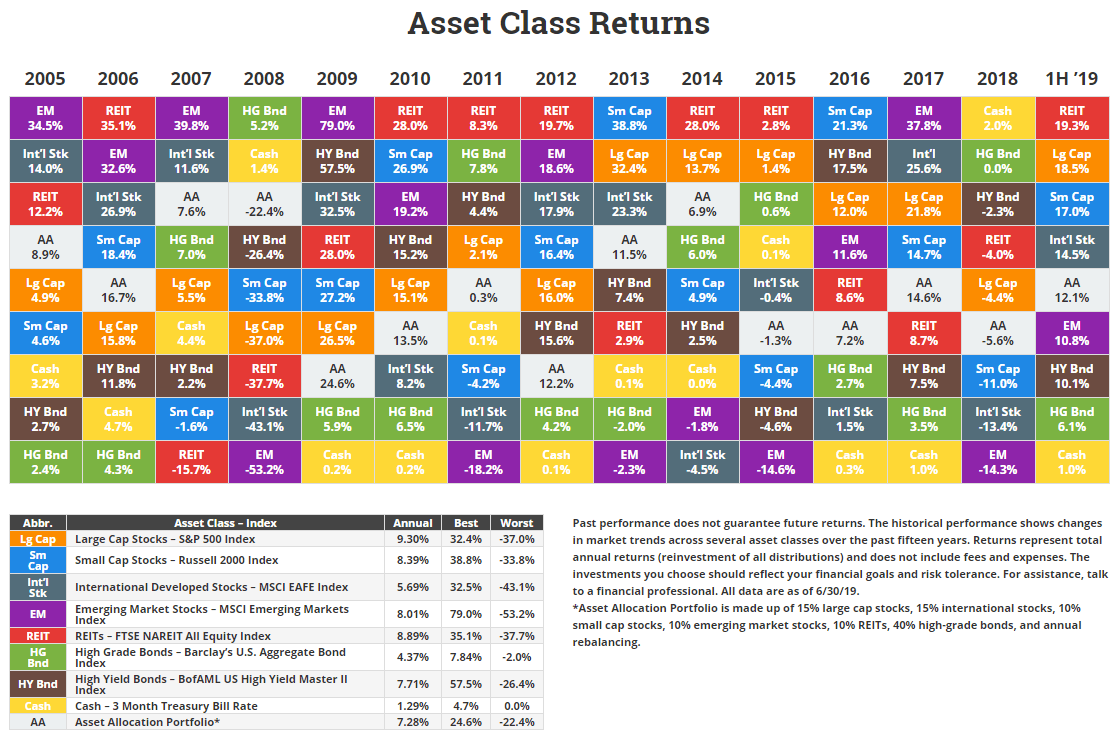
Diversification is important when it comes to investing because by doing so, you can enhance returns while reducing the portfolio risk long-term. A pretty great deal.

For most of us, diversification means an appropriate mix of stocks and bonds, a blend of small-cap, medium-cap, and large-cap stocks; owning various sectors of the economy; owning stocks from countries or investing in economies from around the world.

It can also mean owning assets that are not always correlated to common stocks, like real estate investment trusts (REITs).

Source: NovelInvestor.com

While diversification will never guarantee you big profits, it will help you eliminate the risk of investment losses given that not all assets move in the same direction at the same time.

When it comes to getting ready for my semi-retirement, I may consider owning some low-cost, all-in-one asset allocation Exchange Traded Funds (ETFs) to increase the diversification across my portfolio while simplifying my investing approach for my senior years.

These are some of the best all-in-one ETFs to own.

3.) I will consider a die-broke plan

My parents are very fortunate to have defined benefit pension plans and have a bit of RRSP/RRIF money to draw down in the coming few years. I’ll be working on their strategy this year.

They also own most (not quite all) of their home.

With good planning and careful spending in their 70s, they will definitely have enough money to live comfortably for a few more decades: thanks to their workplace pensions and government benefits.

However, they are not planning to leave any inheritance: and that’s more than OK with the kids (!).

They have a die-broke or at least a near die-broke plan to around age 95

I think this makes great sense.  Working backwards (from age 95), you can calculate a more measured approach to spending money now while earmarking some funds to fight any longevity risk.

At the end of the day, as our lawyer said recently to us when we closed on our condo purchase:  “it’s only money.”

Figure out your estate plan and work backwards.  I suspect in doing so that will help your retirement preparedness.

Do retirees reading this site have a die-broke plan or an estate plan?

4.) I will track my spending (in more detail)

Ideally, all any retiree would need to know is: is enough money coming in to cover what expenses are going out?

Consider the following as part of your back-of-the-napkin calculations:

  • Do you have a rolling monthly credit card balance? If so, you’re spending too much.
  • Do you have a growing line of credit balance? If so, you’re spending too much.
  • Are you able to keep a cash wedge or an emergency fund topped up with cash? If not, you’re spending too much.

To get to retirement in the first place, you probably needed a budget.  There is no reason why you shouldn’t keep one throughout retirement.

I plan to up my game in the coming years, to keep a more detailed tracking log of our spending as we enter semi-retirement.  This will allow me to better forecast any travel expenses we intend to incur.

For now though, I believe this is a better way to budget.

How do you budget?

5.) I will rely on multiple income streams

Canada Pension Plan (CPP) and Old Age Security (OAS) won’t be enough for us.  It might not be enough for you.

While a base-level of income security will be provided from both government programs, for most adults who have worked and lived in Canada for many decades, the sum of this income probably won’t be enough to cover all housing, food, transportation and health-related expenses.

By relying on multiple income streams, beyond government benefits, this will increase your chances to meet retirement income needs and wants.

Here are our projected income needs and wants in retirement.  Do you know yours?

6.) I will disaster-proof part of my life Continue Reading…

Canadian ETFs versus US ETFs


By Michael J. Wiener, Michael James on Money

Special to the Financial Independence Hub

When it comes to investing, we should keep things as simple as possible. But we should also keep costs as low as possible. These two goals are at odds when it comes to choosing between Canadian and U.S. exchange-traded funds (ETFs). However, there is a good compromise solution.

First of all, when we say an ETF is Canadian, we’re not referring to the investments it holds. For example, a Canadian ETF might hold U.S. or foreign stocks. Canadian ETFs trade in Canadian dollars and are sold in Canada. Similarly, U.S. ETFs trade in U.S. dollars and are sold in the U.S. Canadians can buy U.S. ETFs through Canadian discount brokers but must trade them in U.S. dollars.

Vanguard Canada offers “asset allocation ETFs” that simplify investing greatly. One such ETF has the ticker VEQT. This ETF holds a mix of Canadian, U.S., and foreign stocks in fixed percentages, and Vanguard handles the rebalancing within VEQT to maintain these fixed percentages. An investor who likes this mix of global stocks could buy VEQT for his or her entire portfolio without having to worry about currency exchanges. It’s hard to imagine a simpler approach to investing.

Investors who prefer to own bonds as well as stocks can choose other asset-allocation ETFs offered by Vanguard Canada, BlackRock Canada, or BMO. But the idea remains the same: we own just the one ETF across our entire portfolios. For the rest of this article we’ll focus on VEQT, but the ideas can be used for any other asset-allocation ETF.

Why would anyone want to own a set of U.S. ETFs instead of just holding VEQT? Cost. It’s more work to own U.S. ETFs and trade them in U.S. dollars, but their costs are much lower. To see how much lower, we need to find a mix of U.S. ETFs that closely approximates the investments within VEQT. Readers not interested in the gory details of finding this mix of U.S. ETFs can skip the end of the upcoming subsection. Continue Reading…

Mental Accounting and how we spend money

We all have quirky behaviours when it comes to managing money. One trick we fall victim to is called mental accounting. We separate our money into different types of mental accounts, with different rules, depending upon how we get it, how we spend it, and how it makes us feel.

An easy example is when you have a fund set aside for something like a vacation or house down payment while at the same time carrying high-interest credit-card debt. Or how you decide to spend a $1,200 tax refund versus what you’d do with $100 per month if you had the right amount of tax coming off your paycheque in the first place.

I’m guilty of mental accounting every month when I budget $1,000 for groceries, $200 for dining out, $125 for clothing, and $75 for alcohol. I manipulate those mental accounts all the time, like when I overspend in one category and just take it out of another (shifting a meal from ‘dining’ to ‘entertainment’ for example).

The Mental Accounting challenge

Why do we assign money to these mental categories? One answer is to control how we think about it. If we were perfectly rational and could figure out the opportunity costs and complex trade-offs of every single financial transaction then it wouldn’t matter how we label our money: it would just come from a big pool called ‘our money.’ It’s just money, after all; totally fungible and interchangeable.

But because we’re human with cognitive limitations and emotions we need help with our money decisions. That’s where mental accounting comes in and acts as a useful shortcut for what decisions to make.

Another interesting way we classify our financial decisions has to do with the length of time between when we bought an item and when we consumed it.

Nobel Prize winner Richard Thaler studied wine purchases and consumption and found that advance purchases of wine are often thought of as investments. Months or years later, when the bottle is opened and consumed, the consumption feels free, as if no money was spent on wine that evening. Continue Reading…

Theranos’ Elizabeth Holmes and Wolff’s new Trump book: parallel cautionary tales?

Theranos founder Elizabeth Holmes and the book exposing the scam

Being a frugal kind of guy in Semi-Retirement, whenever possible I like to get books out from the library, whether old-fashioned physical books, e books or audio books. The main problem with this, however, is that you usually have to wait several weeks or even months to get to the head of the line for the latest bestsellers.

On a recent long weekend (the one before this one!) two bestsellers arrived the same day, which meant the pressure was on to read them in the three weeks allotted. Neither was likely to qualify for renewal, since there was a long queue of other readers waiting for their return.

The first, which arrived in e-book format, was Bad Blood, a book I had ordered several weeks earlier and has only recently slipped off the bestseller list. The other one was brand new: Michael Wolff’s followup book on Donald Trump, entitled Siege: Trump under Fire. On this one, I got really lucky, just happening to be in the library a day or two after the local branch’s local copy went on display.

Still, suddenly I had two books to read at once, which meant that anything else I either owned or was more likely to be renewable had to be put aside. No one said being frugal was easy!

I ended up reading both books over a long three-day weekend by adopting a strategy of reading a chapter in one, then switching to the next chapter in the other. Which is how I realized there were some fascinating parallels between the two books. It was something of a surreal experience, as I’m sure no one else on the planet would have read these two books simultaneously in this fashion.

Billionaires, or Thousandaires?

Both involve supposed American billionaires, although this point is debatable about both subjects. Trump’s billions are often supposed to be fanciful, which is why one New York Times columnist once earned Trump’s ire by dubbing him a “thousandaire.”

The other was a billionaire for awhile, at least on paper but these days she may not even be a thousandaire. I’m referring to Elizabeth Holmes, a young Stanford dropout who hero-worshipped Apple’s Steve Jobs and started a blood-testing company in California called Theranos.

The only problem, as Bad Blood recounts at length, is that apparently Theranos supposed ground-breaking technology didn’t work. Google Elizabeth Holmes and you can find a bunch of short videos that describe the sordid tale if you missed it the first time around and don’t wish to join the library queue for the book.

Blinded by ambition and the quest for fame and wealth, it appears Holmes and her much older partner/lover (Ramesh “Sunny” Balwani), cut numerous corners and forgot the first rule of health care is to first do no harm. They raised billions from investors, in the process fooling such retail giants as Walgreens and Safeway. Holmes had founded the firm in her early 20s and used her influential rolodex to suck in many investors who should have known better.  She also was famous for emulating Jobs and his attire of a black turtleneck sweater. And finally, as any number of Google searches will demonstrate, she pitched her voice a few octaves lower so as to impress prospects and investors with a deep baritone she must have felt would allow her to be taken more seriously.

Will Trump’s reign also end in tears?

Wolff’s Siege was released just a year after his previous Trump bestseller, Fire & Fury, and relies just as much on input from Steve Bannon. As I read and alternated chapters between the two books, it was fascinating to watch the unravelling of Holmes and to wonder whether Wolff was describing a similar unravelling of the Trump presidency. Certainly, Wolff depicts an isolated and desperate president and has predicted it will all end in tears: not necessarily ours but of Trump’s. Continue Reading…