
Tag Archives: investing

How to create a pension for the Average Joe: 65 with as little as $200K in Savings

By Billy and Akaisha Kaderli, RetireEarlyLifestyle.com

Special to the Financial Independence Hub

We know many of our readers are not “average.” However, if average Joe can support his retirement on as little as US$200,000 savings, imagine what you can do with the amount you have!

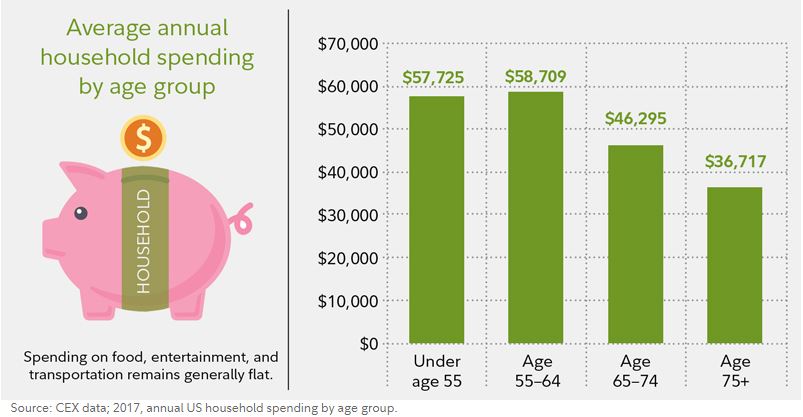
By reading the chart below, you can see that the average spending for retirement households age 65 – 74 is US$46,000.


It is tough to make that $46k amount with only Joe’s savings, so what should he do?

Social Security

The average recipient today (in the United States) collects US$1,461 a month, or US$17,532 a year. Joe’s SS check is average and he has a wife who also collects the average Social Security amount.

$17,532 times 2 (people) = US$35,000 per year.

Not quite the $46,000 that they need but getting closer.

Hopefully, Joe has his retirement money invested in VTI (Vanguard Total Stock Market) or SPY (S&P 500 Index) and is making market gains equaling around 10% annually.


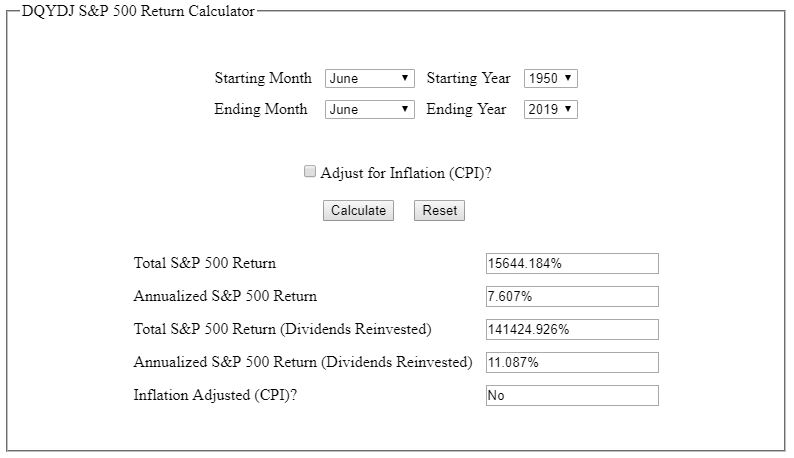
Here you can see that since the 1950’s — about when Joe was born — the S&P 500 has had an annualized return of over 11%, dividends reinvested, but let’s use 10% as a more conservative projection.

Remember, Joe has to make up $11,000 to match his average spending ($46,000). But let’s give Joe an extra one thousand dollars per year so he can pamper Mrs. Joe with occasional gifts and dinners out.

So, he needs $12,000 out of the $200,000 in savings per year to make up the difference in spending. That’s an extra $1.000 per month.

Invested in the S&P 500 — based on 69 years of returns and using 10% as the annual return — after his first year he would have $220,000 minus $12,000 withdrawal = $208,000.

Now Joe has $47,000 in annual income: $35,000 from Social Security and $12,000 from investments.

Plus, his $200,000 has grown to $208,000, a 4% gain outpacing inflation at the current rate of less than 2% per year.

Their Social Security payment is also indexed to inflation so as inflation rises, so will their Social Security. Continue Reading…

Motley Fool: Best vehicles for an Emergency Fund

What are the best investment vehicles for holding a safe and highly liquid Emergency Fund? That’s the focus of the third in my latest series of blogs for Motley Fool Canada introducing the basic principles of establishing Financial Independence.

You can find the latest instalment by clicking on the highlighted headline here: One Essential Tip for Achieving Financial Freedom.

In the first two installments of this new series of articles, we looked at two key steps toward Financial Independence: jettisoning debt and, once that is accomplished, applying the resulting surplus to savings and ultimately long-term investments.

As the latest blog argues, you could even argue that an emergency cash cushion should take precedence over both debt elimination and saving/investing.

What should you be looking at in an Emergency Fund? First, you need liquidity: the ability to access the cash at a moment’s notice. Second, you want safety of capital, which really means cash equivalents or fixed income, not equities normally held with a time horizon of more than five years. Third, assuming some sort of fixed income that’s not locked up like a 5-year GIC, you want at least a reasonable rate of interest to be paid on it.

Normally, you shouldn’t regard RRSP investments as an emergency cushion, since you’ll have to pay tax to access the funds. Most people will try to keep relatively high cash balances in their chequing accounts that can serve as a cushion, although typically these accounts pay next to nothing in interest income. One possibility is short-term or redeemable GICs that may pay somewhere between 1 and 2% per annum. Another good place to “park” such funds is a High Interest Savings Account (HISA).

As the name suggests, HISAs pay high amounts of interest, usually more than 2%. According to this source, several pay more than that: as of mid 2019, EQ Bank was paying 2.3%, Motus Bank up to 2.5%, Tangerine was offering a promotional rate of 2.75%, and Motive Financial was paying 2.8%, Wealth One Bank of Canada was paying 2.3% and WealthSimple 2%. Pretty nice returns for liquid cash cushions! Continue Reading…

Motley Fool: How to move from Saving to Investing

What’s the difference between Saving and Investing and how do you move smoothly from the one to the other?  Motley Fool Canada has just published the second in a new series of articles by me about the basic steps towards Financial Independence, or what I call “Findependence.” You can find the first one, which ran early in June, here; and the new one by clicking on the highlighted text here: 2 critical steps toward Financial Independence.

The first article discussed how the journey to Findependence hasn’t even begun while you’re still in debt. To paraphrase one of the characters in my book Findependence Day, you can’t even begin to climb the tower of Wealth until you get out of the basement of debt.

It’s nice to be free of debt, whether high-interest credit card debt, student loans or even a mortgage. It’s a big step moving from negative net worth to being merely broke, where your assets and liabilities cancel themselves out. Being free of all debt is certainly a nice place to be if you’ve been anxious over being hounded by creditors. But it’s not financial independence either, which is the stage of life when all sources of income more than meet your monthly financial needs.

As the followup article summarizes, you want to move from Debt elimination to the intermediate step of Saving, and then from Saving to true investing. Saving is being a loaner — you lend money to a bank or other institution and receive a small amount of interest back as well as your principal upon maturity. But to be an investor you want to be an owner: a business owner, through stocks or equities, or more broadly through a diversified basket of equity ETFs.

The end of the piece references a piece by Investopedia about the difference between investing and saving. You can find their explanation here. It says saving is for emergencies and purchases, by which they mean immediate needs. Investing is about a longer-term horizon (defined as seven or more years) and entails more risk than saving. That’s why they refer to the “risk free” return of investing in cash, treasury bills and the like.

Investing is about Money begetting Money

The beauty about saving is that, once the process is begun, it sets the stage for when  money begins to beget still more money, a process that will ultimately happen even while you’re sleeping. So does investing: the difference is that saving is a kind of junior partner to investing: it works a bit for you, but nothing so hard as true investing for the long term. Saving begets small amounts of money; ultimately, investing begets huge amounts of money: eventually enough to live on whether or not you choose to work another day in your life. Continue Reading…

Taylor’s golden rule of Stock Market size indices

By Dr. Bryan Taylor, Chief Economist, Global Financial Data

Special to the Financial Independence Hub

Global Financial Data has collected extensive data on stocks from the United States and the United Kingdom covering over 400 years. With this, GFD has generated indices that cover the history of the stock market from the incorporation of the Dutch East India Company in 1602 to the current market in 2018-2019.

One question that the creation of size indices creates is how many components should be in the large-cap, mid-cap and small-cap indices. Where should large-cap, mid-cap and small-cap begin and end? Currently, each index company treats large-cap, mid-cap and small-cap indices differently. Let’s look at how different index companies treat market capitalization.

Standard and Poor’s has three size indices for the United States with 500 shares in the large cap index, 400 in the mid-cap and 600 in the small-cap. The 500-share index was introduced in 1957, the 400-share Midcap was introduced in 1981, and the Small Cap Index was introduced in 1994. The proper weights for the three size indices was not calculated when the indices were introduced, so the S&P 500 Composite represents 90% of total market capitalization, the Midcap 400 7% and the Small Cap 3%.

The idea for a small-cap index was introduced by Russell in 1987 and the data was extended back to 1978. Russell has 1000 stocks in their large cap index and 2000 in their small-cap index. However, this creates an even greater imbalance for the large cap stocks since the Russell 1000 represents about 92% of the total market cap in the United States and the Russell 2000 represents about 8%.

Morningstar and MSCI have more balanced approaches to the size categories. Morningstar refers to the top 70% of stocks as large-cap stocks, the next 20% as mid-caps and the bottom 10% as small-caps. MSCI divides the US stock market into 300 Large Cap stocks, 450 Midcap Stocks, 1750 Small Cap Stocks and the remaining stocks (around 1000) as Micro-cap stocks. By our calculations, this would give about 70% to the Large Cap 300, 16% to the Midcap 450, 13% to the Small Cap 1750 and 1% to the Micro-Cap 1000.

Taylor’s Golden Rule

The problem with creating long-term indices is that the number of stocks that listed on the exchanges and over-the-counter grew dramatically over time and the number of stocks in the large-cap, mid-cap and small-cap groups vary accordingly. During most of the 1800s, there weren’t even 500 stocks listed on all of the exchanges in the United States. So how do you determine how to allocate stocks to the large cap, midcap and small cap categories if the number of stocks in existence is constantly changing? Continue Reading…

Should you invest in pot stocks? How do you invest in the cannabis sector?