Tag Archives: investing

The straight dope on Marijuana investing

By Chris Arthur

(Sponsor Content)

Is all the buzz around marijuana investing deserved? How did the value of marijuana stocks get so high in the first place? Why are they currently on a bit of a low? And with valuations at a discount, is now a good time to get in on the action?

Clearly, there are big risks. But there are also big rewards for investors in this fast-growing new industry. After all, marijuana legalization is scheduled to take place very soon.

Anyway, it seems inevitable at this point. How can you add marijuana to your investment mix? With Canadian investors in mind, we took an in-depth look at these questions.

Legalization isn’t as simple as when the House of Commons votes to create a new marketplace. Many politicians are enthusiastic. However, they know that there are many other considerations and costs involved. For those interested in marijuana investing, it’s top of mind.

The marijuana marketplace has grown up fast, even before legalization

When is the absolute best time to invest in the fast-growing marijuana industry? Actually, that was probably more than a year ago. Canada’s Prime Minister campaigned on legalizing marijuana in the last election. The thinking was to disrupt the black market. At the same time, while they could create a windfall of tax revenue and they’d get a substantial cash infusion from a legalized marijuana industry.

In response to the enthusiasm, investors poured money into cannabis companies. Some of these quickly went from penny stocks to high-flying billion-dollar firms.

For instance, the market cap of the top five cannabis stocks alone grew by 400%. Canopy Growth Corp., the leader in Canada, has a market cap of over $5 billion. If you got in early enough, you saw a 261% return on your investment. Aurora Cannabis had a slightly smaller market cap. However, it posted a 1-year return of 353%. PharmaCan Capital’s stock was up 385%.

The whole reason we saw such startling triple-digit returns for marijuana stocks year? Deregulation. Sooner or later, it’s coming.

A bigger market than just Canada

Marijuana legalization creates a global opportunity. It is not confined to the Canadian marketplace. However, it is a also a unique situation. The usual big gorilla on the block, corporate America, is a no-show. Consider legalization in individual American states like Colorado and California. There, federal law still cuts American companies out of the competition.

That means, for once, Canadians can step over their southern cousins and become global leaders in a brand-new industry. This is green pasture territory. It is a dreamy prospect for investors looking for profit.

The marijuana industry includes over 85 companies with a combined market value of $30 billion. Some believe the global medicinal marijuana marketplace alone could be worth US$31.4 billion by 2021. According to Eight Capital, it could be worth $180 billion by 2025. Some think Canadians might be coming late to this market. Medical cannabis programs started here as early as 2001. If anything, we set the trends.

However, the big growth we have seen so far isn’t likely to continue forever. Investors looking into this industry need to manage their expectations.

Today, marijuana investing is about diversification. After all, there’s volatility. You’re betting on companies that must prove their worth by generating sales. What kind of sales? That’s the billion-dollar question.

Not every marijuana start-up has all the answers. So, what are paying customers really looking for? That is still up for debate.

Overview: Where the marijuana industry is today

There are different kinds of potential customers for marijuana. The first, smaller group is the smokers. But the second group includes people who consume cannabis in other ways. After all, customers can do it through food, beverages, supplements or other means. Also, medical marijuana is a big potential area of growth. Additionally, there are specialty products that cross over into the bigger food and beverage territory.

According to Evolve ETFs’ research, in 2015, there were just five countries where medical marijuana was legalized (or in the process of being legalized). By 2017, that shot up to 25 countries.

Canada is a leader in this sector. It legalized medical marijuana in 1999. The big breakthrough though came in 2015. There were new rules to allow value-added products. The Supreme Court said restricting legal access to only dried products was unconstitutional. This opened up the market with new product lines. That in turn transformed the medical marijuana landscape.

The number of adult Canadians who use recreational marijuana could be about 20 per cent of the population. How do we know this? The government is trying to get a better handle on the actual number. It’s tracking the THC-laced product that winds up in our sewers. Canadians spent $5.7 billion on marijuana for medical and non-medical purposes in 2017. Market studies estimate the value of the Canadian recreational marijuana market in 2018 to be about $7.9 billion.

Beverages will likely be big business for the marijuana industry. Energy drinks and health supplements of every variety will separate themselves from the pack by infusing them with marijuana extracts. Some companies are planning cannabinoid-infused beverages for launch in 2018. These products have huge potential for sales.

It could be an easy way for companies outside the marijuana industry to get a foot in the door in this growing industry. Alcohol giant, Constellations Brands, owner of Corona, purchased a 9.9% stake in Canopy Growth Corp (WEED.TSX).

Risks in marijuana investing

There are still many questions around the legalization process. Uncertainty is sure to prompt additional volatility. Continue Reading…


How much can you expect for investment returns?

“How much am I going to make?”

That’s likely the most reasonable question that an investor could ask. When you sign up for a savings account or GIC it’s usually the rate of return that lured you in, or got your attention. We know that many savers are ‘rate chasers’. They go from bank to bank, playing each bank against the other bank, asking for more, asking for a higher interest rate on their savings account or GIC.

I often had clients brag to me that they could get a savings account at 1.5% at so-and-so bank or credit union. I’d reply “That’s great, go for it, but I work in investments, I’m talking about earning triple or quadruple or more than that rate over time.” Of course, I would always qualify that there was the potential to earn that greater rate or return.

Did I mention that 1.5% don’t impress me much?

Of course, at this stage of the conversation I would probe the client’s savings accounts and whether or not they had a more than ample Emergency Fund. Typically, advisors will suggest that you hold 3-6 months of total spending needs in a savings account. That said, everyone knows their own personal situation and what types of emergencies that might pop up – and potentially the costs of those emergencies.

Separate short-term and long-term money

Another important practice is to separate our short-term monies and our long-term monies. Once we’re covered with that short-term emergency bucket, we move on to growth and try to make our long-term monies work real hard. You will also have day–to-day monies in a chequing or savings account.

One of the biggest mistakes Canadians make is to have too much money in “high interest” savings accounts. Guess what? That 1-2% is not going to take you to the retirement promised land. In fact, monies in a savings account are usually going backwards, it’s not making you a dime once you factor in inflation. A long term historical average for inflation is in the area of 3%. If you’re earning 2% in a savings account, you’re losing 1% spending power, each year.

Your $100,000 that you have today might feel like (or spend like) $90,000 or less in ten years. Start to extrapolate that over a few decades and the effect is greatly exaggerated. Inflation is nasty. Here’s an example that will also show my age. When I was a kid, I would take 25 cents to the movies to buy treats. With those 25 pennies I would be able to buy a pop and chips, I think I may have also been able to buy a 3-pack of gum. Yes, I also spent a lot of time in the dentist’s chair. Can you get anything for a quarter these days? I didn’t think so. Talk about losing spending power. And no, I did not grow up in the era of the Great Depression. I ‘grew up’ in the best decades of all time: the 60s and the 70s.

Only stocks can outstrip inflation

Now certainly, the 70s experienced some ‘hyper’ inflation so the effect was exaggerated. But inflation is there and it’s powerful, even in the 2.5 – 3% range. Continue Reading…

How investing makes it easier to achieve Financial Independence

By Gary Bordeaux

Special to the Financial Independence Hub

If you are looking for a way to secure your financial future, learning how to invest your money can help accomplish that goal. There are a variety of investment vehicles that can be tailored to fit your needs, timeline, and risk tolerance.

Let’s take a look at some of the specific reasons how investing helps a person obtain financial independence (aka “Findependence”).

Make money both today and tomorrow

If you are interested in generating a steady income from your investment portfolio, you can buy dividend stocks or a REIT (Real Estate Investment Trust). You make money today by receiving a dividend payment every month or quarter. You make money in the future by holding the security as it appreciates in value. When it reaches what you feel is the height of its value, feel free to sell it and lock in a profit. It is also possible to hold stocks in a trust that can benefit children, grandchildren or other beneficiaries after you pass on.

Obtain returns greater than the Rate of Inflation

Thanks to inflation, a dollar that you hold in your hand today will be worth the equivalent of 98 cents a year from now. This is because the price of goods will increase by an average of 2 per cent per year. In some cases, inflation can reach 4 per cent or greater in a given 12-month period.

As a general rule, stocks will appreciate by about 7 per cent per year, and that amount is higher if a stock offers a dividend. What this means is that you are increasing your net worth above what it takes to keep up with cost-of-living increases. Over a period of years or decades, you could accrue tens or hundreds of thousands of dollars that can be used to enhance your lifestyle.

Improve your chances of owning a home

Let’s say that you are looking to buy your first house. You could decide to buy a single-family unit with a monthly mortgage of $1,000 that you are responsible for paying on your own. However, another option is to buy a duplex that you can both live in and derive income from. At the very least, having a tenant living in the other half of your home will decrease the monthly mortgage payment.

The money that you save can then be used to improve the home or make other investments. If you make improvements to a property that is used for rental purposes, it may be possible to write off the amount of those repairs on a state or federal tax return. Continue Reading…

This is Easy Street for Canadian investors

By Dale Roberts

Special to the Financial Independence Hub

Investing is simple. We are all familiar with the KISS acronym. Simplicity is the key to successful investing. I have been reading and studying investing and investment strategies for decades and came to the conclusion that for the most part “nobody knows nothing.”

Great. All that research and tens of thousands of hours of study and I came back to the fact that I don’t need to know much at all. What a complete waste of time? No not at all. The thousands of hours of study showed me why I, we, don’t need to know much. We do not need to be experts when it comes to investing. As I like to write: It ain’t rocket surgery. Here’s how you find Easy Street.

What is an investment portfolio? In its basic form we can think of a portfolio as having two components: great companies for greater growth potential and bonds to manage the risk. Those bonds work like shock absorbers on the portfolio to reduce the risk or volatility. The more bonds in the portfolio, the lower the risk level of the portfolio.

A typical portfolio will hold great blue-chip companies (stocks) such as Apple, Google, Microsoft, Facebook, Johnson & Johnson, Berkshire Hathaway (Warren Buffett’s company), Coca-Cola and on and on. On the Canadian side we’ll hold Tim Hortons, the big Canadian banks, the telco companies such as Bell, Rogers and Telus, plus railroad companies such as CN and CP Rail and major energy players such as Suncor and Enbridge and on and on.

The rich are business owners

We know that the richest people on earth are usually business owners. We’re going to join them. We’re going to own a piece of those businesses. When enough of those companies do well, you do well. And certainly not every business is going to do well: that’s why you own a bunch of ’em. And that’s why you’ll own great companies in Canada, US and around the globe. And we don’t have to know how to analyze those companies, we can simply go and buy the ‘entire’ stock market. Here’s What is Index Investing and why it’s simply a superior form of investing. It’s so easy we call it Couch Potato Investing.

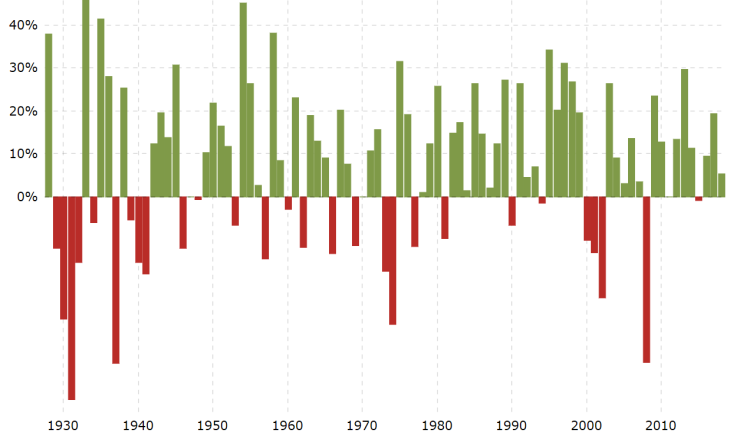
And back to risk or volatility. Certainly stock markets mostly go up over time, but they do correct or go down with regularity; it’s a normal and expected part of investing. For the potential of those 9-10% annual returns from stocks we need to accept some risk. Keep in mind that stocks can go down by 50% in major stock market corrections. That’s not everyone’s cup of tea to watch their investment portfolio get cut in half. That’s why many or most investors will need some bonds in the portfolio. Bonds are fixed-income investments and are typically less risky than stocks. A bond pays you a fixed payment on a regular basis and bonds can also go up in value when stocks go down – think teeter totter.

A portfolio with a very generous amount of bonds would have only decreased by about 10%-15% in the last major market correction. For the period of 2008 to end of 2009, here’s a comparison of the US stock market (S&P 500) as Portfolio 1, and a Balanced Portfolio as Portfolio 2.

We see that the all-stock portfolio declined by 50% while the Balanced Portfolio with a 70% bond component declined by just over 15%. By the end of 2009 that conservative Balanced Portfolio is almost back in positive territory while the all-stock portfolio still has more of that hill to climb.

Percentage in Bonds a critical decision

The most important decision that will be made, or the most important question answered will be “What percentage of bonds do you need?” What is your risk tolerance level? What roller coaster do you want to ride? You get to decide. Continue Reading…

The Future is not quite now: A calm perspective on gloomy predictions

Here are a couple of conversations I’ve been involved in recently. Does any of it sound familiar?

Conversation with a retired engineer. He asked, “What do you think about this driver-less cars business? Has anybody even considered how many people this will throw out of work? We have to do something about this! Otherwise, joblessness will go so high that it will cause a depression.”

Conversation with a middle-aged family doctor/real-estate investor. He said, with complete confidence, “I’m cutting back on my medical career and moving into real-estate development. Long before I want to retire, I expect my job to disappear due to competition from AI (artificial intelligence).”

When listening to predictions, especially gloomy ones like these, keep in mind that nobody can consistently predict the future. Also remember that the most widely accepted gloomy predictions are especially prone to fail. That’s because people, as individuals, react to and prepare for predictions of doom. They work on the problem before its predicted arrival time. Sometimes they offset it entirely.

Y2K was the ultimate example

The ultimate example came on the first day of this century, with the non-arrival of the so-called “millennial bug,” or Y2K for short.

In the late 1990s, computer consultants warned that at the stroke of midnight on December 31, 1999, computers around the world would freeze up because of a problem with their data-storage limits. Computers used to use just two digits to designate a year. So they wouldn’t be able to tell what came after 1999; ‘00’ could mean 1900 or 2000. The problem had a simple fix, however. By the last day of 1999, most computer owners had attended to it. Damage from the predicted crisis was negligible.

Today’s predictions — gloomy and hopeful — revolve around the expectation that computer speeds will continue to rise, and computer costs to drop, at much the same rate as they have for the past half century.

This trend has led to exponential growth in the processing power of computer chips, coupled with an exponential drop in their cost. This leads to casual-conversation predictions like the two I mention above: artificial intelligence will soon lead to legions of unemployed taxi, truck and bus drivers; and legions of unemployed family doctors will follow soon after.

The logical flaw here is that exploding computer power at shrinking cost is a technological advance. But there are social, legal and practical limits to how quickly business can translate these technological gains into real-world progress (or problems, depending on how you look at it).

Computer makers don’t need government permission to raise the speed of their chips. In contrast, makers of driverless cars face all sorts of problems, long before they make any money.

The shift to driverless vehicles will happen gradually, over a period of decades. After all, driving in traffic involves far more surprises than a champion Go player faces on the playing board. Drivers have to deal with changing weather, full sunlight and deep shadow, unpredictable human drivers with varying skills, unpredictable pedestrian web surfers, potholes, snow-covered street markings and so on.

The shift from human to AI doctors will occur at an even slower pace — in line with how long it takes to earn a driver’s license on the one hand, and a medical license on the other. AI will replace family doctors some time after it replaces the voice and chat help lines that people use when they have a problem with a computer, a cell phone or a utility bill.

Assume technological process leads to economic progress

People have a long record of guessing wrong about the impact of new technology, and on how long it will take for the new technology to become part of daily life. You’ll guess right much more often if you just assume that technological progress eventually leads to economic progress. Continue Reading…