Posted By
 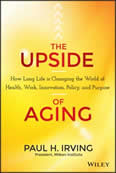 Today’s blog title comes from Chapter 14 of The Upside of Aging, a book we mentioned several weeks ago at sister site FindependenceDay.com. This is recommended reading for anyone nearing the traditional retirement age. It consists of 16 essays from various experts, all of whom look at the topic of longevity through various lenses: urban planning, global demographics, healthcare and pharmaceutical research and so on. For example, Ken Dychtwald of Age Wave pens an interesting essay titled “A Longevity Market Emerges.”
Pictured below is Dan Houston, president of Retirement, Insurance and Financial Services for the US-based Principal Financial Group, who wrote the chapter I flagged in the title.
Retirees can expect one spouse to reach 90

Houston begins by observing that because of longer expected life spans, the mind-set around retirement is evolving, and for the better. “Couples age 65 now have a 45 per cent chance that at least one will live to age 90,” Houston says, citing the Society of Actuaries, “This may be the first time in history where someone spends more years in retirement than in a traditional working career.”
The downside is of course financial: living another 20 to 40 years after leaving the workplace comes with a “substantial cost,” Houston says, “one that has to be funded. It’s an increasingly challenging prospect given inflation, the high cost of health care, and the risk of outliving savings.”
Try living on $400/month
The statistics, at least in the U.S., are not encoring. Fewer than four in ten pre-retiree households (aged 55 to 70, not yet retired) have financial assets of US$100,000. And even if they did have that amount on the nose, it would generate guaranteed lifetime income of just $400 a month.
Many think they’ll need less income in later life than recommended and many plan to draw down on assets at such high rates (9% a year on average) that assets will be depleted within 13 years. The recommended “safe” annual withdrawal rate is closer to 4%. They underestimate the cost of unreimbursed health care costs: in the U.S. Houston estimates a moderately health retired couple will need US$250,000 just to cover health care expenses and premiums throughout retirement. This is one area that Canadians may be ahead because of our universal health care system.
Don’t count on working in retirement
I’ve said before that the solution to this is to “just keep working,” but of course this may not always be an option. It’s a sad fact that agism still prevails in the workplace and costly older workers may be asked to leave before they’re ready to do so; and eventually body or mind may not permit full-time work even if one can find a willing employer. Houston says pre-retirees tend to overestimate their ability to work for income in retirement: more than two thirds expect to be able to supplement retirement income with some work but in reality, only one in five retirees actually works. That statistic, Houston observers, “reflects availability of work, as well as ability to work.”
Just as disturbing is the fact that 55% of American workers, and 39% of retirees, report having a problem with their level of debt. And those who do manage to save are not saving enough: 43% of workers report that neither they nor their spouse is currently saving for the future, while 57% report the total value of savings and investments is under US$25,000.
Four key investment risks
Even where there is ample savings to invest, Houston lists for key risks: inflation, market volatility, income and longevity. These are all linked: the longer you live, the more inflation can cut into your income. Consider this alarming stat on inflation’s power to erode savings: a dollar invested int he S&P500 in 1971 grew to $2.27 by 1982 but on an inflation-adjusted basis, that dollar depreciated to 96 cents. Houston notes that even annual inflation of 3% will cut a retiree’s purchasing power in half.
This calls for investments that have a fighting chance against inflation: Houston mentions Treasury Inflation-Protected Securities (TIPS, known in Canada as Real Return Bonds or RRBs); commodities, global REITs, natural resource stocks and Master Limited Partnerships.
As if that’s not all enough to keep a retiree awake at night, Houston reminds readers that the “insolvency” date for America’s Social Security system keeps moving closer: 2033, according to Washington’s May 2013 estimate. Meanwhile the over-65 population will double between 2010 and 2050.
As has been noted elsewhere, every day 10,000 baby boomers turn 65. While Canada’s combo of CPP and OAS seems on relatively solid ground, I continue to believe the best way to prepare for a long-lived retirement is to spread your income sources around: employer pensions, savings in RRSPs, TFSAs and non-registered plans, the government plans mentioned above, some part-time work or business income and perhaps rental income from investment real estate.