
Hub Blogs

Hub Blogs contains fresh contributions written by Financial Independence Hub staff or contributors that have not appeared elsewhere first, or have been modified or customized for the Hub by the original blogger. In contrast, Top Blogs shows links to the best external financial blogs around the world.

David Trahair’s contrarian stance: Be a loaner, not an owner

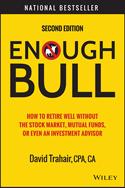
125_Enough_Bull_High_Res_Cover_FinalBy Jonathan Chevreau

Financial Independence Hub

In this summer’s series on the 7 eternal truths of personal finance, one of the articles was entitled Be an Owner, Not a Loaner, which reflects the usual financial industry advice that stocks are more likely to generate long-term investment returns than cash or bonds.

There is of course a contrary view to this eternal truth and it’s best contained in the new second edition of David Trahair’s book, Enough Bull, originally published early in 2009, right at the bottom of the financial crisis..

Trahair, a chartered accountant and author, could as easily have titled his book Be a Loaner, Not an Owner, because he’s adamant that stocks (i.e. equities), whether individual or pooled through mutual funds or ETFs, are just too risky for the average person.

The book cover includes a small image of a bull (as in a steer), so clearly the title Enough Bull is a double entendre: as in no more bullish prognostications on the stock market, as well as no more bovine excrement, whether dispensed by the animals or financial advisors.

Skeptical about the financial industry and its central belief in stocks Continue Reading…

Why tech-savvy millennials are automating their investments

Profile picture_Mike Katchen
Michael Katchen, Wealthsimple

By Michael Katchen

Special to the Financial Independence Hub

When we launched Wealthsimple 12 months ago, investors in Canada had just two options to manage their money: Do it yourself or hire an advisor.

Doing it yourself is low cost, but overwhelming for most investors. It requires a level of knowledge, interest, and confidence to manage your life savings completely solo. Hiring an advisor is easy, but can be expensive and intimidating, even if you have a large enough balance to meet high account minimums.

At Wealthsimple, we’re building a third category: automated investing with on-demand advice. This new category combines the low costs of doing it yourself (DIY) with the real advice and sophisticated approach of a full-service advisor.  We built cutting-edge technology to automate a passive investing approach and digitize the entire account opening and reporting experience. It’s convenient, allowing customers to open an investment account in 10 minutes, with no paperwork or branch visits required. And it’s not just robo-investing or robo-advice, it’s real advice delivered by real Portfolio Managers by phone, email, video chat, or text message.

So who uses an automated investment solution? Definitely not your average investor!.

What an automated investment client looks like

In an industry where 90% of clients are over 50 years old, clients of automated investment services are almost half that age. The average Wealthsimple client is a first-time investor, just starting to put money aside for both short and long-term goals.  Our clients range from 19 to 89, but 80% are under 40 years old and the average is under 30. Continue Reading…

Tips for Older Travelers

older_travelers3
Akaisha with Billy

By Akaisha Kaderli

Special to the Financial Independence Hub

Billy and I have been on the road meandering through continents for over two decades. While we like to think of ourselves as spry, flexible and ready to take on the world, truth is, we are no longer twenty or thirty years old. Traveling at our age of 63 presents challenges that we didn’t have when we were younger. Energy levels have changed and our bodies require different comforts in order to feel well.

If you are in your fifties and sixties with active wanderlust, independent journeying is still possible. Take advantage of what we have learned over the years.

The Importance of Sleep

The value of sleep is a priority that we protect, since its absence is felt for the next day or two – creating havoc in moods, energy level and even decision making. Whenever possible, we no longer take red-eye flights. Air travel has become more complicated in recent years and it’s enough to handle the new requirements, the lines, and the disorientation of time zones without adding severe sleep schedule interruptions. Besides, what’s the rush? Continue Reading…

The hidden risks of investing money in prepaid funerals

1
Patrick McKeough, TSInetwork.ca

By Patrick McKeough, TSINetwork.ca

Special to the Financial Independence Hub

Pat McKeough responds to many requests from members of his Inner Circle – a select group of customers who receive subscriptions to all four of his newsletters and are entitled to ask him specific stock and investment questions. Every week, his comments on the most intriguing questions of the 7 days go out to all Inner Circle members. Below is a highlight from these Q&A sessions.

There’s no limit to the types of financial questions Inner Circle members can ask Pat and his team of investment experts. Aside from asking for advice about investing money in specific investments (such as stocks or exchange-traded funds), members ask a wide range of other investment questions as well.

For example, a member recently asked whether there is any advantage to investing money in a prepaid funeral. So you can get a sense of how the service works, I’d like to share this question, and our answer, with you. I hope you enjoy and profit from it.

Reader Question: What’s your view on prepaid funerals? At 57 years old, it seems reasonable to me to lock in funeral costs at today’s prices and pay for it now. This makes even more sense since I can reasonably expect to live another 25 years. Funeral costs for any level of funeral have doubled every 10 years over the past 30 years, according to the brochure. Does this make sense to you?

Pat McKeough: This sounds like a consumer decision, but it’s really an investment decision, as well. When you prepay a funeral, you are investing money in a highly specialized fixed-return investment. You pay now, and get a fixed return (consisting of preselected funeral services) at an indeterminate point in the future — the few days or weeks after your death. Continue Reading…

Maximizing Finances as a Young Adult

business, people and money concept - smiling businesswoman with dollar cash money over gray background and forex graph going upBy Jenna Batten

Special to the Financial Independence Hub

For young people seeking to become financially independent, one of the most important underlying principles of frugality is making the most of your existing assets. Put simply, this means learning how to spend only what you must, how to invest strategically, and how and when to save.

Here are a few tips on how to address each of these points:

Spend Wisely

Being frugal with your money is always a good idea, and for some it’s a fairly basic practice: you spend only what you need, when you need to, without gratuitous or unnecessary expenses. However, even those who believe themselves to be strategically frugal with their finances may be surprised to see how many costs they can cut if they really sit down and analyze the situation.

Thankfully, doing so has become easier than ever before thanks to, you guessed it, an app—or rather a whole slew of apps, designed to assist in financial tracking. You can read about a number of these apps at Daily Worth, although the most popular options are Mint and GoodBudget. Both tools help to provide you with a comprehensive, visual display of what you spend and what your overall financial situation looks like.

With these sorts of tool handy, or simply with a detailed financial tracking system of your own, you can effectively create a budget based on your own financial situation and your particular habits. You can then adjust your spending habits wherever possible to ensure that you’re spending no more than you really need to.

Invest Strategically

Continue Reading…