Once you achieve Financial Independence, you may choose to leave salaried employment but with decades of vibrant life ahead, it’s too soon to do nothing. The new stage of life between traditional employment and Full Retirement we call Victory Lap, or Victory Lap Retirement (also the title of a new book to be published in August 2016. You can pre-order now at VictoryLapRetirement.com). You may choose to start a business, go back to school or launch an Encore Act or Legacy Career. Perhaps you become a free agent, consultant, freelance writer or to change careers and re-enter the corporate world or government.
RRSPs are a valuable tool for many taxpayers, which is why they are the backbone of many retirement plans. Getting the most out of your RRSP often involves thinking several years ahead, rather than just when the contribution deadline is looming.
Here are five RRSP strategies to get you thinking beyond the basics:
Claiming RRSP deductions
Most of us claim our RRSP deductions in the tax year we make the contribution, but you don’t have to. In fact, you can choose to deduct only a portion or none at all and carry it forward.
If you expect to move into a higher tax bracket next year from say, a big promotion, or the sale of rental property, you should still make your contribution to take advantage of tax-free compounding. But, it may be worth waiting to claim the deduction the next year (or later) when your marginal rate will be higher and you will get a substantially bigger tax refund.
To decide if an investment belongs in your portfolio for retirement, you need to take a close look at its attributes or features. But, just as important, you need a close look at how well the investment suits your needs. A superficial look can steer you in the wrong direction.
From time to time, for instance, investors say “Now that I’m retired, I can’t invest in stocks any more. I can’t risk a 30% to 40% drop in the value of my portfolio.” But these same investors may buy annuities without considering the fact that annuity rates are related to bond yields. Both are at historically low levels. A revival of inflation could do extraordinary damage to the purchasing power you get from the fixed returns on bonds or annuities.
Retirement planning and four key factors to consider when investing for retirement
Retirement planning is the process of setting retirement goals, estimating the income needed to meet those goals and assessing your potential sources of retirement income. These days, more investors suffer from what you might call “pre-retirement financial stress syndrome.” That’s the malady that strikes when it dawns on you that you don’t have enough money saved to be able to earn the retirement income stream you were banking on. The best way to overcome this is with sound investing.
Additionally, here are four key factors to consider for retirement saving:
How much you expect to save prior to retirement;
The return you expect on your savings;
How much of that return you’ll have left after taxes;
How much retirement income you’ll need once you’ve left the workforce.
Should you consider investment products in your portfolio for retirement?
The financial industry has created income-producing investment products to cater to investors who are wary of stock-market uncertainty. These products can provide steady income that’s higher than bond interest, or dividend yields from stocks. However, these products are almost always subject to hidden fees and risks that continually drain your capital, or leave it vulnerable to unexpected losses.
Successful investors understand that occasional market plunges are normal and unavoidable. A drop of 30% to 40% in stock prices is rare. But after the plunge ends, stocks bounce back and eventually recover. Meanwhile, if you follow our Successful Investor approach, you’ll still have dividend income. What’s more, you don’t need to (and probably won’t) sell at the low in prices.
You can maintain reserves for your cash flow needs by selling some stocks every year, during times of high and low prices.
“The more bells and whistles, the lower the monthly income,” from annuities, says Caring for Clients’ Rona Birenbaum,
My latest MoneySense Retired Money column looks at the case for laddering annuities in order to avoid the problem of committing funds to annuities at interest rates that are only now coming off their historic lows. You can retrieve the whole article by clicking on the highlighted text: A low-risky annuity strategy to beef up your retirement cash flow.
Many investors are already acquainted with the concept of “laddering” guaranteed investment certificates (GICs), or bonds with different maturities. Maturity dates are staggered over (typically) one to five years, so each year some money comes due and can be reinvested at prevailing interest rates. This minimizes the likelihood of investing the whole amount at what may turn out to be rock-bottom interest rates, only to watch helplessly as rates steadily rise over time.
The same applies when it comes time for retirees or near-retirees to annuitize. At the end
of the year you turn 71 you must decide whether to convert your RRSP into a RRIF,
cash out and pay tax (few do this), or thirdly to annuitize.
Fortunately, annuitization isn’t an all-or-nothing decision. You can convert some of your RRSP to a RRIF and some to a registered annuity. You can take a leaf from the GIC laddering
concept and buy annuities gradually over five, ten or even more years. As regular Hub contributor Patrick McKeough observes in the piece, laddering annuities can reduce the potential downside: “You could buy one annuity a year for the next five years. That way, your returns will increase if interest rates rise, as is likely.”
Tally up how many annuities you may already have
Mind you, few observers believe in converting ALL your disposable funds into annuities. After all, as another Hub contributor — Adrian Mastracci — notes, you need to take inventory of the annuity-like vehicles you already may have, or expect to have: such as employer-sponsored Defined Benefits, CPP or OAS. Some investors may have a high component of annuity-like income without realizing it, and many families may already have five or six such sources of annuity-like income.
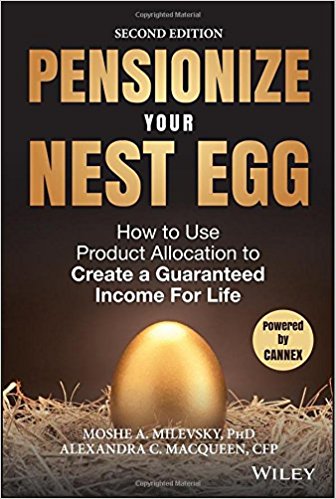
Certainly you need to consider both the benefits and drawbacks of annuities. The main benefit is they are a form of longevity insurance: making sure you never outlive your money no matter how long you live. There’s a case for having enough annuities that your basic “survival expenses” (shelter, food, heat, transport etc.) are taken care of no matter what. Finance professor Moshe Milevsky is also quoted in the article to the effect there are compelling financial and psychological reason to at least partly convert to annuities. And Milevsky is famous for making a distinction between “REAL” pensions (like DB pensions) that behave like annuities, as opposed to vehicles like RRSPs and TFSAs, which provide capital that only have the potential to be annuitized. Hence the title of Milevksy’s excellent book, Pensionize Your Nest Egg.
But annuities are not perfect. Apart from the common reluctance to commit to buying annuities at today’s still-low interest rates, there’s also the matter of the irreversible nature of the decision to convert some capital to an annuity. You’re handing over a large chunk of change to an insurance company and should you die earlier than expected, they in effect “win,” to the partial detriment of your estate. If on the other hand you live to 120, then YOU “win.”
There are a lot of life situations that can lead someone to retire much earlier than they had initially anticipated. It could be illness, injury, the need to move quickly, an emergency family circumstance, or even a company closing its doors. Why you’re being forced to retire isn’t nearly as important as the silver lining you need to find in your situation, and what steps you’ll take to get there.
1.) Get a great Savings plan
Your normal savings account may not be enough to carry you through. It might help to change your current savings account to one that gives you a better interest rate, particularly if you’re going to consolidate your retirement accounts. It might also help to supplement your savings with some investments that will grow with time.
2.) Work out your new Budget
People in retirement often live on fixed incomes, especially if their spouse is also retired. You need to be sure your money can go as far as you need it to, and that might mean breaking apart your old budget and determining where and how you can best reduce costs while maintaining your quality of life. There are some easy-to-use smartphone apps that might help you do that.
3.) Downsize your Home
The expenses of maintaining a household are high. If you’re retired, you probably don’t need all the extra space anyway. Finding a roommate can help, and so can selling your previous home to purchase a smaller home that’s easier to maintain. Often times, utility bills will significantly go down on a smaller property. You’re also gaining some extra cash and a little more financial longevity.
4.) Find affordable alternatives
Monthly costs, like health insurance and cellular phone bills, can often add up to a lot of money. You might want to consider shopping around for a better deal. Continue Reading…
My latest MoneySense Retired Money column has just been published, which tackles that perennial personal finance chestnut of whether to take early or delayed CPP benefits. You can find it by clicking on the highlighted headline here: The Best Time to Take CPP: if you don’t know when you’ll die.
That’s a pretty big “if,” of course since with rare exceptions, our futures are unknowable. As readers of the piece will discover, there is a fair bit of personal anecdotes there, which is hard to avoid in a beat known as “Personal Finance.” As the column notes, we’ve written before that in theory it makes sense to delay CPP as long as possible, since monthly benefits are 42% higher than if you took them at 65. And while you can take CPP as early as age 60, you’d pay a 36% penalty to do so compared to taking it at the traditional age 65.
Since experts are all over the place on this one and have valid arguments for either side, it’s interesting that in practice very few Canadians actually wait till age 70 to start their CPP, even if it is an inflation-indexed guaranteed-for-life annuity. Government stats show age 60 is the single most popular option: according to the federal government’s 2016 data, of the 312,251 who began collecting CPP that year, 126,954 did so right at age 60, with the second most popular start date being age 65, when 93,460 started to collect. Only 4,844 waited until 70.
The balanced case for the traditional age 65
As I relate in the MoneySense piece, I still haven’t started to collect CPP myself, even as my 65th birthday looms this coming April. Continue Reading…


 Posted By
  RRSPs are a valuable tool for many taxpayers, which is why they are the backbone of many retirement plans. Getting the most out of your RRSP often involves thinking several years ahead, rather than just when the contribution deadline is looming.
 Posted By
 Posted By
 Posted By