


Debt & Frugality

As Didi says in the novel (Findependence Day), “There’s no point climbing the Tower of Wealth when you’re still mired in the basement of debt.” If you owe credit-card debt still charging an usurous 20% per annum, forget about building wealth: focus on eliminating that debt. And once done, focus on paying off your mortgage. As Theo says in the novel, “The foundation of financial independence is a paid-for house.”

Is a fixed-rate or variable-rate mortgage right for you?


By Alyssa Furtado, RateHub.ca

Special to the Financial Independence Hub

Interest rates in Canada have rarely seen such lows, which makes borrowing money to buy a home pretty attractive. But when you start looking around for the best mortgage rates, homebuyers face a choice of going with a variable-rate or a fixed-rate mortgage.

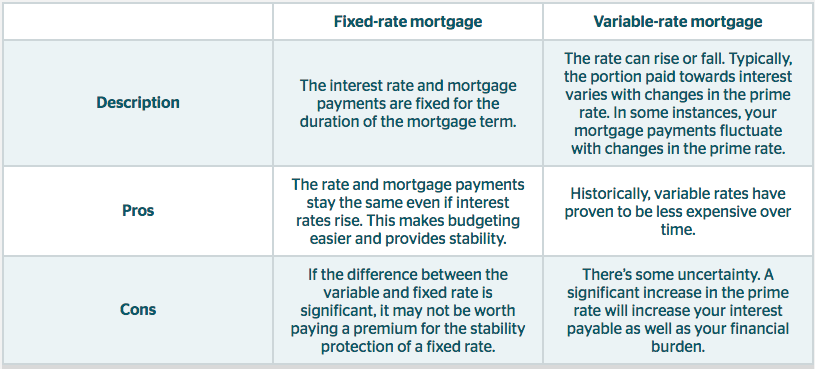
So what’s the difference? A variable-rate mortgage follows interest rates as they move up and down. And a fixed-rate mortgage is locked in for a certain term. Sounds simple, but deciding which option works for you can depend on a number of factors. Here are some essential pros and cons:

Fixed-rate mortgages

Pro: Added security

You don’t have to worry about whether your payments will change because of economic factors you can’t control during the mortgage term. This makes long-term financial planning much easier.

Say you get a five-year fixed-rate mortgage, with a 2.5% interest rate. Regardless of whether interest rates go up or down elsewhere, the rate will stay at 2.5% for the entire five-year period. This allows you to set it and forget it until it comes time to renew your mortgage, at which point you’ll need to renegotiate your rate. At this point your rate could be higher or lower.

Con: Added expense

The luxury of knowing your rate will remain the same will likely cost you, as fixed rates tend to be higher overall.

Variable-rate mortgages

Pro: You can save a bundle

Although by no means guaranteed, historically borrowers save more money over time with this method. Your rate is correlated to the prime lending rate, which can fluctuate. Your rate is quoted as the prime rate plus or minus a certain percentage, such as prime minus 0.4%. In this instance, if the prime rate is 2.7%, your mortgage rate will be 2.3%. Such a small percentage might not look like it will affect your payments, but the savings will add up significantly over time.

Con: Rates can always go up

The variable-rate option comes with a certain risk. If your bank’s prime lending rate changes, the interest moves up or down in conjunction with it. The amount you actually pay your lender on a regular basis (biweekly, monthly, etc.) won’t necessarily change. If the interest rate goes down, more money from your payment will go toward paying down the principal. If the rate goes up, more of the payment will be eaten up by interest, and sometimes your regular payment can also rise. Continue Reading…

Choosing ETFs: the best ones are diversified and have low MERs

If you want to include the best ETF investments in your portfolio, then it’s important to consider a variety of components. That’s because all Exchange-Traded Funds aren’t created equal

ETFs are one of the most popular and most benign investing innovations of our time: and the best ETF investments can be great low-fee ways to hold shares in multiple companies with a single investment.

The best ETFs practice “passive” fund management

The best ETFs practice “passive” fund management, in contrast to the “active” management that conventional mutual funds or some new ETFs provide at much higher costs. Traditional ETFs stick with this passive management: they follow the lead of the sponsor of the index (for example, Standard & Poors).

Sponsors of stock indexes do from time to time change the stocks that make up the index, but generally only when the market weighting of stocks change. They don’t attempt to pick and choose which stocks they think have the best prospects.

This traditional, passive style also keeps turnover very low, and that in turn keeps trading costs for your ETF investments down.

We think you should stick with “traditional” ETFs.

The best ETF investments have lower MERs

The MERs (Management Expense Ratios) are generally much lower on ETFs than on conventional mutual funds. Continue Reading…

How to save money on TV, Phone and broadband packages

By Jeremy Dawson

(Sponsored Content)

Many people have made the blunder of subscribing to TV, phone or broadband packages without due diligence about the kind of service they are paying for. This leads them to pay hefty bills on a monthly, quarterly or yearly basis without realising that they can actually save more on those subscriptions.

They only realise they have been getting a raw deal when a friend alerts them to a better service with which they have experimented. In most cases, these people still see adverts of cheaper subscriptions online or in the media, but they are skeptical to try new services with which they have no experience.

Before subscribing to any TV, phone or broadband services, it’s advisable to conduct thorough research, both online and offline. This will help you identify the service provider with the best yet affordable deal. Some people have the notion that a cheap service provider offers low-quality products and hence, they tend to stick to the overrated and sometimes inferior services. There are various factors to look for when shopping around for the best service provider for TV, phone and broadband, which can save you a considerable amount of money in the long-term.

Type of subscription

The first factor you may want to consider when choosing the best service provider for TV, phone and broadband packages is the kind of subscription. Different service providers have diverse types of subscriptions, depending on the kind of services they are offering. Continue Reading…

25 factors that impact Life Insurance premiums

By Chantal Marr, LSM Insurance

Special to the Financial Independence Hub

Life insurance protects your family financially, but it can also be huge strain on your budget. Over the years, even a small savings in your premium can really add up. The following factors are used to determine the rate you will pay. Not all of these factors are controllable; however, there are some lifestyle changes you can make to lower your premium.

1. Age at Time of Purchase

The younger you are at the time of purchase, the lower your rate will be. Insurance experts say the sooner you buy a policy, the better. Chris Huntley, life insurance agent at Huntley Wealth and Insurance explains, “Age is the most important contributor to both term and whole life insurance rates. If the insured outlives the initial term, the insurance carrier must adjust the premium to reflect their new age.”

2. Your Health History

Insurance providers need to know of any health problems you may have had in the past to determine your risk factor. Chronic illnesses could result in higher premiums. According to Canada Protection Plan, “Generally, insurance underwriters review an applicant’s medical history, and assign a rating based on the presence (or lack there of) of common medical conditions.”

3. Current Health

Most insurance providers require a medical exam to determine how healthy you are. The doctor will look for signs of high blood pressure and other conditions that may lead to future problems. If you are in good health, you will typically qualify for lower rates. “Your health is a key indicator of the risk you pose to an insurer and will directly impact not only your ability to get a policy but how much you’ll pay for the policy.” Richard Laycock, senior insurance writer.

4. Your Weight

Obesity can lead to all types of health problems. Being overweight or obese can put you in a higher risk category for insurance purposes. “Life insurance premiums are also based on your weight, or at least the proportion of your weight to your height. There are ranges and a theoretical norm at the center, that indicate a “normal” proportion. To the degree your own height-to-weight ratio varies from the ideal range, you will pay more in premiums,” says Neal Frankle, CFP.

5. Hazardous Occupations

Continue Reading…

A Millennial’s Jump Start on Personal Finance

By Trevor McDonald

Special to the Financial Independence Hub

Most millennials aren’t taught personal finance beyond the few who soaked up “lessons” from having an allowance or chores while growing up. Given the increasing use of digital currency, from tapping phones together to send money, depending on Venmo and utilizing bitcoins, ask a millennial how to write a check or balance a bank account and few can give a succinct answer: but does that even matter? Has personal finance changed so much in the past few decades that its definition is due for an overhaul?

Financial literacy and well-being is and always will be vital. How it’s defined and its best practices evolve as we do. Just like any type of “health,” financial health requires setting a strong foundation, teaching and practice. It’s strange that we have an entire generation in full-fledged adult categories without a clue of how to handle their finances.

Consider this the starter kit for millennials:

1.) Credit score management

 The importance of credit scores isn’t going anywhere. In fact, they’re more important than ever with some employers using credit scores to narrow down job candidates. Make sure to monitor your credit score, check your credit report regularly for errors, and make your payments on time. This will help ensure you maintain a healthy score. There are other ways improve your credit score that you might not know, too, such as snagging a tradeline where you’re added onto a person’s credit account who already has a solid score. A tradeline company can manage this, linking paying customers to a tradeline account so any messiness of blending finances with personal relationships is avoided.

2.) Buffering that nest egg

Having at least three months’ worth of living expenses in “liquid cash” that’s easily accessible is a reasonable starting point. Some financial experts recommend one year, but a year’s salary can sound very overwhelming. Start socking away funds in an emergency account by using an app that rounds up purchases and siphons funds to this account so you don’t even notice.

3.) If possible, entrepreneurs and business owners should seek out life in specific states or overseas

Millennials are the generation of entrepreneurs, and this makes personal finance even stickier. Where you live plays a huge role in your ability to build wealth. Obviously some regions have higher costs of living than others, but every state also has a different income tax. There are seven states, including highly desirable ones like Florida, that boast a zero per cent income tax rate. Moving abroad often allows for foreign earned income exemption in which you don’t pay any state income tax (of course) but also no federal taxes except social security and Medicare.

4.) Budget, budget, budget

Continue Reading…