EBooks

EBooks

Retired Money: How to beat the banks at their own game

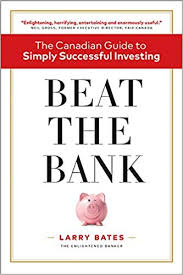
My latest MoneySense column reviews the new book by ex banker Larry Bates, titled Beat the Bank. As the headline suggests, it’s all about how to beat the banks at their own game, which ironically can mean owning the big bank stocks themselves! The full column can be retrieved by clicking on the highlighted text here:  Tips for DIY investors on beating the Big Five banks.

The formal launch date for the book is this Thursday: September 13, 2018. I first met Bates over lunch in March as his manuscript was nearing completion, where he expounded on what he called the “two Bay Streets.” Old Bay Street and its secrets are the focus of chapters 4 and 5, and New Bay Street is chapter 6.

Old Bay Street is not the investor’s friend

Most experienced investors will have encountered Old Bay Street at some point. This is the traditional investment industry: the commission-based mutual fund and brokerage industry, insurance company reps, investment “specialists” in the bank branches and various salespeople who call themselves “advisors.”

New Bay Street = Discount Brokerage, ETFs & fee-for-service planners

The New Bay Street includes providers of low-cost index funds or Exchange-traded Funds (ETFs) or online robo-advisers that automate the purchase and rebalancing of ETFs along with setting asset allocation.

At 62, Bates is well into his own “Victory Lap,” leaving employment for self-employment. Actually, his New Bay Street model isn’t all that new, as it describes models similar to what I myself described back in 1998 in my own financial book, Findependence Day. My version consists of buying ETFs at a discount brokerage and using a fee-for-service financial planner. The same year, similar principles were also described in Stop Buying Mutual Funds!, by Mark Heinzl, now a Globe & Mail stock market columnist.

Dinosaur banks have the lowest T-REX scores

Bates has fashioned something he calls T-REX scores  This is an acronym for Total Return Efficiency Index Score. A T-REX score of 100% would be paying absolutely no fees at all, no matter how long your time horizon.

Mutual funds with 2% annual fees would have T-REX scores of 54% over 20 years and true fees of 46%, but the longer you hold, the worse the performance; thus, over 40 years the T-REX would be 41% and the true fee 59%. Fees of 3% inflict even more damage. This is the basis for his statement that long-term customers of Old Bay Street lose half their money to fees. You can find more at his website at www.larrybates.ca.

The pure DIY model of buying individual stocks or bonds at a discount broker yields the highest scores: a T-REX of 96 to 99%. (Remember, the higher the better, with 100 being perfect).

Continue Reading…

Gold guru Peter Schiff says Goldmoney deal will draw millions to BitGold

schiff
Peter Schiff (Twitter.com)

Author and US-based gold guru Peter Schiff is teaming up with a Canadian gold fin-tech company — Goldmoney Inc. — in a deal both parties expect will accelerate the firm’s growth into “millions” of users seeking a “real-money” alternative to the “fiat” currencies of the world’s central banks.

Initial details were revealed on Friday, when Toronto-based Goldmoney Inc. (trading as XAU on the TSX), announced its plan to acquire Schiff Gold Inc. (SGI) and form a marketing and service agreement with Schiff (pictured left).

The Hub last looked at Goldmoney and its Bitgold in this post in March: BitGold: a cure for savers frustrated with low or negative interest rates? The link also contains my blog on this for the Financial Post.

And we looked at a couple of recent books on the soaring gold price in a Hub post in June. You can find the review, which includes Schiff’s The Real Crash, in this Hub review titled The New Case for Gold. The link also contains my blog on this for Motley Fool Canada.

The Goldmoney release describes Schiff Gold Inc. (“SGI”) as a “private, US-based dealer in precious metals” that was launched in 2010 under the name Euro Pacific Precious Metals. It in turn was described as “one of the largest and fastest growing retail gold dealers” that services a large client base with buy and sell orders for precious metals, storage and vaulting arrangements and gold & silver IRA arrangement services.”

Schiff is the “LeBron James of the gold market”

Continue Reading…

Exploring the ExPat Lifestyle in Mexico’s San Miguel de Allende

FullSizeRender(1)
View of San Miguel from top of the Rosewood Hotel (Photo J. Chevreau)

Last week, my wife Ruth and I enjoyed a week’s vacation in San Miguel de Allende, which is located in central (and landlocked) Mexico. We’d been to Mexico several times over the years but never this particular community, which is not handy to a major airport.

It was also our first trip to Latin America in about five years, since we had been taking our February breaks in Florida in more recent years.

Ironically, San Miguel was prominently featured in the old magazine I published around the year 2000: The Wealthy Boomer. At the time, I remember being impressed by the fact the cost of living for semi-retired American and Canadian baby boomers was roughly half what it was in our home countries. This theme was also applied to various Asia locations in a Hub blog last year featuring the book Planet Boomer. See also my post, titled 5 Asian locations where retirement is more affordable than North America.

Trading high taxes for crime?

Back during the days of the tax-and-spend Jean Chretien Liberals, I found the Mexican expatriate fantasy quite compelling, so much so that I listened to Spanish instructional tapes on my long commutes to the National Post’s bunker then located in Don Mills. But the fantasy of becoming a tax exile/early retiree faded once the Conservative Party achieved power and seemed to offer at least the hope of more reasonable levels of taxation (the Tax-free Savings Account being a major positive example.)

Meanwhile, the unremitting press over drug-cartel-related crime in Mexico reached a crescendo in the last few years so we stopped visiting for a spell.  Continue Reading…

Review: Conrad Black’s Rise to Greatness

FullSizeRender-2
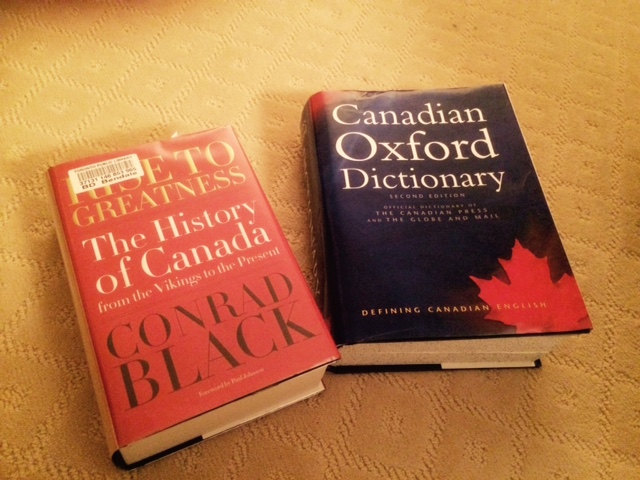
Companion volumes?

By Jonathan Chevreau

With Christmas just a week and a half away, the burning question about Conrad Black’s new Rise to Greatness is this: Would you like a family member to buy you a copy and place it under the tree? Alternatively, is there someone in your circle who would appreciate such a gift?

With a suggested retail price of $50, this is more than you’d spend on most books. On the other hand, once wrapped it will have an impressive bulk. Weighing in at 1,106 pages it’s at least two-and-a-half inches thick (I measured it).

And as you can see from the photo, there is a close connection between this massive book and a dictionary. If you really want to benefit from Black’s Rise to Greatness: The History of Canada from the Vikings to the Present, you need to have a dictionary at hand, as I did. Continue Reading…