Family Formation & Housing

For young couples starting families, buying their first home and/or other real estate. Covers mortgages, credit cards, interest rates, children’s education savings plans, joint accounts for couples and the like.

52% of Canadians support new Mortgage Rules

By Penelope Graham, Zoocasa

Special to the Financial Independence Hub

It has now been four full months since Guideline B-20 – a slew of new mortgage qualification requirements – hit Canada’s borrowers in the wallet.

Under the new regulations, those applying for a new mortgage, and who are paying at least 20 per cent down on their home purchase, must qualify at either the Bank of Canada’s benchmark rate (currently 5.14 per cent), or their mortgage contract rate plus 2 per cent, whichever is higher. While the mortgage payments will be made at the borrower’s actual rate, this is the government’s way of shock-proofing lending, ensuring borrowers can still make their payments should rates rise exponentially.

Experts have stated that Guideline B-20 would slash the average home buying budget by 20 per cent, and knock as many as 10 per cent of buyers out of the market altogether. Market conditions have proven softer in the months following the new rule, with national prices falling 10.4 per cent in March, and an exodus from more expensive home types to the lower end of the market, such as condos for sale in Toronto.

But have they truly dissuaded Canadian home buyers from entering the real estate market?

To find out, Zoocasa polled just over 1,400 Canadians from all provinces, as part of the second-annual Housing Trends Survey. Respondents were asked for their sentiments and experiences as a result of B-20, and the overall rising interest rate environment.

Majority not impacted by Stress Test

According to the data, the majority of recent home buyers have withstood the introduction of Guideline B-20 unscathed; of those who purchased a home between October 2017 (when the new rules were first announced) and March 2018, 48 per cent say there was no change whatsoever to their buying timeline.

However, 27 per cent reported they rushed their purchase as a result, while 6 per cent delayed buying. An additional 19 per cent who bought homes weren’t actually aware of the new mortgage rules at all.

Also, the impact has been more significant on those who have no yet purchased their home: while 40 per cent stated B-20 hasn’t changed their mind about buying, 15 per cent will delay their home purchase, and a full 15 per cent now feel homeownership is out of reach altogether. Continue Reading…

Are you financially ready to buy your first home?

By Allan Tran

Special to the Financial Independence Hub

Buying a home is usually the biggest investment you’ll make. Can you afford it?

Recent surveys show that potential buyers are concerned about interest rate increases and new federal lending guidelines. Many people are delaying their home purchases. It can be hard to know when to take the plunge or hit pause. Try these exercises:

Simulate the total expense

When talking to mortgage brokers and real estate agents, you can get preoccupied with rates, what you can get approved for, and listing prices. Those matter, but figure out the bottom line. Can you swing the total costs and still live your life?

Calculate your expected fixed home ownership costs: mortgage payment, property tax, home insurance, utilities, etc. Take that total and compare it to what you’re paying now for rent. The difference is what you’ll need to be able to cover.

Now, set that amount aside every month for a year. That’s long enough to experience all the ups and downs of your annual expenses. See whether you can handlethe monthly savings for the home you want for a sustained period

Take a hard look at your spending

Saving for a home, then managing the ongoing expense, can require a shift in spending habits. You can’t do that without a handle on where you actually spend your money.

Review the last three months of your credit-card statements and other bills. Look at wants versus needs. Think about what costs you could have avoided and how those add up. For instance, many costs that we tap a card for are variable. You can likely avoid some. Try and park that money into savings.

Another strategy is to force savings by tying it into spending. Say you spend $20 a week on coffee. Yes, you can save $1,000 a year by foregoing that. But you want coffee. Well, you also want a home. How about putting the equivalent towards it? It’s just a way of disciplining yourself to save for a bigger dream.

Force accountability

If you’re buying a home with a partner or spouse, get a joint account where you can’t pull out money without both signing off. This will help you think twice about spending and hold each other accountable.

Many couples have different spending and savings habits. The point is to train you to have honest conversations about finances. If you’re going to own a home together, you need to be on the same financial page before, during and after the purchase.

Stress test yourself

The Office of the Superintendent of Financial Institutions has new rules around mortgage underwriting. Potential home buyers must be able to handle a minimum qualifying rate: the greater of the five-year Bank of Canada benchmark rate, or the contracted mortgage rate plus two percentage points. Continue Reading…

Toronto Housing: Implications for Canadian Banks

By Jeff Weniger, CFA, WisdomTree Investments 

Special to the Financial Independence Hub

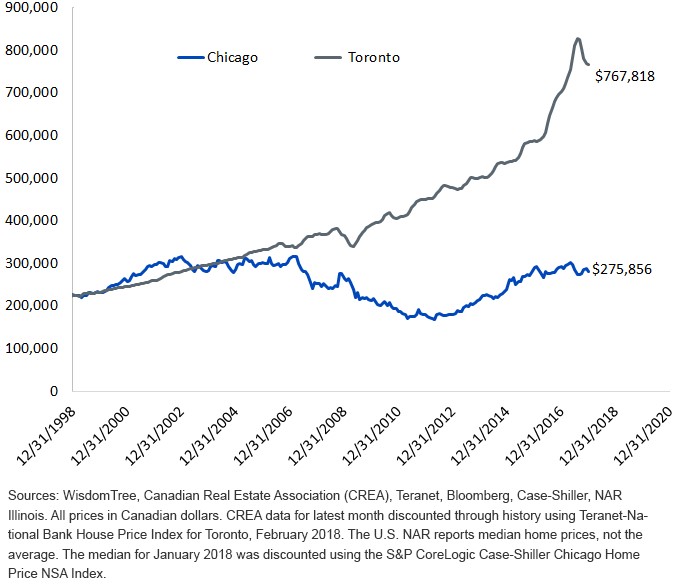
Is the footing getting shaky in Ontario housing? The Teranet–National Bank National Composite House Price Index for Toronto rose 272.8% from its inception in July 1998 to the peak last summer. Everyone knows nothing of the sort happened to wages. The average Canadian earned $579 a week back then and $988 today, a 69% change.1 Something is amiss, and maybe the bell was rung in July 2017.

The Toronto housing market appears to have turned on a dime, and the home price index is off 7.3% through 2/28/2018 (figure 1). Aside from the index’s 10.9% fall during the global financial crisis, this is the sharpest decline in Toronto residential real estate since the index’s inception in 1998.

Figure 1: Teranet–National Bank National Composite House Price Index, Toronto

When home prices quadruple in the span of one generation, with much of the appreciation in recent years taking on a “just buy before getting priced out forever” mentality, the natural concern is that  the 7% drawdown might be just a taste of what is yet to come.

This is where we are reminded that MSCI Canada has 43% of its weight in financials,2 and almost all of that is in the big banks. Canada is unique in that its banking system, for better or worse, is concentrated in the five national champions.3 The U.S. has 4,888 commercial banks,4 so major indexes like the S&P 500 do not have the same domination of Bank of America or Wells Fargo as the big players do on the TSX. In fact, in the developed world, Canada’s degree of sector concentration is akin to only Hong Kong, with hardly any other industrialized economies as reliant on so few key sectors. Continue Reading…

Where is the most affordable housing for Singles?

By Penelope Graham, Zoocasa

Special to the Financial Independence Hub

It’s no secret that Canadian real estate is expensive, with home ownership financially out of reach for many in the nation’s largest urban centres. Detached Toronto houses, for instance, fetched an average of $1,282,240 in February: and that follows an 18.6 per cent decline from the year prior.

Affordability in Vancouver remains at an all-time low; according to a recent report from RBC, the lender’s Senior Vice President and Chief Economist Craig Wright stated Vancouver home buyers “are being challenged by the worst affordability levels ever recorded in Canada.”

Well beyond expert advice

Financial experts commonly recommend that for homeownership to be financially sustainable, shelter costs should not exceed a third of a household’s take-home pay. This is easier said than done in the majority of Canada’s markets: and not at all possible in some regions for those purchasing a home on a single income, according to data compiled by Zoocasa.

To determine the level of affordability in each market, the study determined the median home price-to-income ratio, based on regional home prices reported by the Canadian Real Estate Association, and median household incomes from Statistics Canada.

This ratio determines how many years it would take to pay off a home using 100 per cent of a household’s annual income:  the higher the ratio, the longer the timeline. And, while dual-income households have their fair share of affordability challenges in hot markets, the numbers paint an impossible picture for solo buyers.

For example, in Vancouver, where a single-income household brings in a median annual salary of $38,164, and the average home cost $1,071,800, homeownership outweighs incomes by multiple of 28. A home in the City of Toronto would set said buyer back 19 years for their home purchase.

Even most affordable markets too pricey for Singles

However, in a market as varied as Canada’s, affordability can change drastically by market, yet single-income households are still theoretically paying too much on homeownership in even the most affordable regions. Houses for sale in Hamilton, a popular secondary market to Toronto, still cost single buyers 15 times their income while in Saint John — the most affordable Canadian market — the average home price of $171,596 still outstrips the regional median income of $39,163 by four times.

Continue Reading…

Top Ten questions & answers on Medical Tourism

Medical building in Guatemala City

By Akaisha Kaderli

Special to the Financial Independence Hub

Because Billy and I live a lifestyle of travel, we often get readers asking us basic questions about medical tourism. Below we have the answers to some of the most common questions we get asked. How do you know if this option will work for you? The following should help you decide.

Q: I have heard the term “Medical Tourism,” but what exactly is it?

A: Generally, Medical Tourism refers to going elsewhere other than your own city or state/province to receive medical care. For example, people in the U.S. have been going out of their home state to Mayo Clinic or Cleveland Clinic for years, and no one thinks twice about it. Canadians will come to the U.S. for procedures perhaps because they don’t want to deal with long waits in their own home country or maybe they have other personal reasons.

Today, there are dozens of countries like Thailand, Mexico, Costa Rica, India, Guatemala, Singapore and the Philippines which offer excellent medical care delivery in ultra-modern facilities for very affordable prices.

The importance of medical tourism – and this cannot be overstated – is that its availability offers options to those who are:

  • Under-insured
  • Self-insured
  • Not insured and,
  • For procedures not approved in the USA (or the patient’s home country).

Q: Is Medical Tourism expensive? And how does one choose a hospital or country?

A: In terms of budgeting for medical tourism, we think it’s a good idea to have an emergency fund, or institute your own style of a Health Savings Account, where you only utilize that money for health related issues.

When you purchase medical care overseas, you will know how much it will cost before you purchase. There is no guessing game because you check off what you want as if from a menu. If you want to have an “Executive Physical” for instance, you can choose all the features you would like: lung x-ray, bone density test, colonoscopy, full panel blood tests, and so on, and with every choice, your total at the bottom of the page changes. You see beforehand what your cost outlay will be and what price everything is individually.

The delivery of medical care in the States is expensive and out of the reach of many. If you have a high deductible, and you go out of network, sometimes that deductible doubles.

Treatment in the States for a heart condition or cancer can cost hundreds of thousands of dollars. Not so overseas.

A heart valve replacement in the States can cost US$170,000 but will run you US$24,000 in Guatemala City. Chemotherapy in the States runs about $75,000 but is under $20,000 in Guatemala City. A bone marrow transplant can cost up to $200,000 in the U.S., but will run up to $25,000 in India. A spinal fusion runs between $80-100,000 in the United States but will cost you $6-10,000 overseas.

There are many medical tourism concierge services available and websites of hospitals in various countries have their prices listed for procedures. Continue Reading…