General

Spooked by the stock market? Here’s the answer

By Dale Roberts, cutthecrapinvesting

Special to the Financial Independence Hub

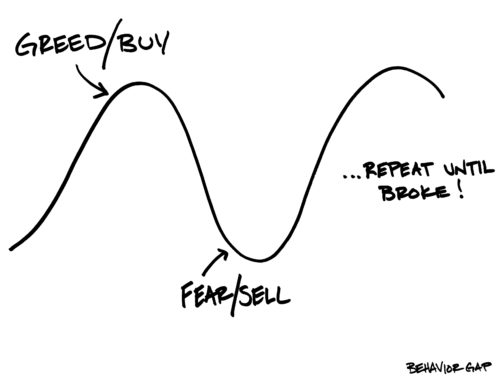
Most investors do not like volatility. They do not like looking at their investment account balance observing that they’ve ‘lost money.’

Of course, you have not lost money until you buy an asset at a certain price and then sell at a lower price. You’ve then just realized your losses. You have not lost money when your portfolio value goes down. And in fact, swings in portfolio values are just par for the course. Stocks and bonds and real estate change in price (with wild swings at times) in regular fashion: it’s normal behaviour. If the stock markets have you spooked, there is a simple and timeless plan of action.

With this strategy, you can ‘win’ if stocks go up. You can win if stocks go down. It’s a strategy that worked during the worst period in stock market history: the Great Depression of the 1930s .

The answer of course is adding money on a regular schedule. In the investment world they call it dollar cost averaging; we can abbreviate that to DCA. There is no need to guess about which way the market is going to go today, next week, next month, next year, or even the next five years. We simply expect or hope that the markets will go up over longer periods, as they have throughout history.

Stock market history

U.S. stocks, S&P 500

You can see that there is lots of green on the board. Stocks mostly go up. It is those pink years (on the table) that usually trip up many investors

The key to long-term wealth building is being able to invest through those down years. And in fact, adding money in those years is quite beneficial as the stocks go on sale.

But keep in mind that stocks can stay under water for extended periods.

Dollar cost averaging

Now this is a consideration for those who have very little exposure to stocks, or who have been out of the markets for quite some time. That event is not as rare as you might think. Many investors have left the markets, though they recognize that they need to be invested to reach their financial goals and enjoy a prosperous retirement. They also want their wealth protected from inflation.

Here’s the demonstration: investing through the initial stages of the Great Depression.

In the above charts we see equal amounts invested, but the dollar cost averaging strategy still delivered positive returns in a vicious bear market. Buying at those lower prices was very beneficial. Now keep in mind for the above to work, the markets have to go up over time. They have to recover. And historically they have.

Time reduces risk

Here is a wonderful graphic that demonstrates the returns over various periods. Our odds increase as we lengthen the time period that we remain invested.

And a table that frames the probabilities of positive returns.

Charlie Bilello

Spread out that lump sum

If you are sitting on a large sum that you want to get invested you will have to have a plan. Over what time period should you get those monies into the market?

If you start investing and the markets keep going up, great. Mission accomplished. The money you’ve invested has increased in value. You are collecting dividends along the way.

But of course when we enter a stock market correction, your total portfolio value will decline. Though you might get enough of a head start so that your money invested remains in positive territory.

At that point when markets are declining, remember that lower prices are good. The stocks are going on sale. And of course, you do not have to invest in an all-equity portfolio. You can dollar cost average into a balanced portfolio.

I’d suggest that you spread the money out over 2 or 3 years. For example, If you are on the 2-year plan and have $100,000 to invest and you’re investing every month, you’d invest $4,167 per month.

You can’t time the markets

For those who already have substantial assets invested, you can’t move in and out of the markets. We don’t know when the corrections will occur. The most reasonable course of actions is still dollar cost averaging. That said, whenever you have money to invest, stock market history says get it invested. The sooner the better.

From My Own Advisor here ‘s – Dollar cost averaging vs lump sum investing.

Invest within your risk tolerance level

This is key. If you get scared and sell, you might lose money.

You might have to accept a lower-risk portfolio that is likely to earn less over time compared to a more aggressive stock-heavy portfolio or balanced portfolio. It’s also possible that you do not have the risk tolerance to invest (at all), even in a very conservative ETF portfolio. If that is the case you would have to stick with GICs and high-interest savings accounts. You might add to your real estate exposure for growth. In retirement, you might use annuities to boost your income.

For savings we use EQ Bank. 3-and 6-month GIC’s now 2.05%

To help gauge your risk tolerance level and the appropriate level of portfolio risk, please have a read of the core couch potato portfolios on MoneySense. You’ll find a table within that post that breaks it down.

If you are risk averse, you likely need a managed portfolio and advice. You might consider a Canadian Robo Advisor. These investment companies provide lower-fee portfolios at various risk levels. Advice is also included. A few of these firms also offer financial planning.

At Justwealth, you get access to advice and financial planning. In fact, you’ll have your own dedicated advisor.

Justwealth. The Canadian Robo Advisor that knows when to get personal.

They will do a risk evaluation to see if investing is right for you, and then you will be placed in the appropriate portfolio(s). And once again, you’ll be offered the greater financial plan as well.

Start investing

Preet [Banerjee] puts some of the above in video form [YouTube.com]. Preet also goes over how much you might market over various time frames, at different rates of return.

The key is to not be frozen on the sidelines. We might refer to that as ‘paralysis by analysis’.

Build wealth at your own comfort level, at your own pace. You will learn as you go. You can build up your comfort level for risk and volatility. It’s quite possible that you can increase your risk tolerance level over time. We develop risk callouses.

Walk before you run, perhaps.

Robo Advisors are a great training ground for investors.

Thanks for reading. We’ll see you in the comment section. If you’re not sure what to do, feel free to flip me a note.

Dale Roberts is the Chief Disruptor at cutthecrapinvesting.com. A former ad guy and investment advisor, Dale now helps Canadians say goodbye to paying some of the highest investment fees in the world. This blog originally appeared on Dale’s site on Feb. 12, 2022 and is republished on the Hub with his permission.

When did Retirement Income Planning get so complicated?

Photo by Gustavo Fring from Pexels

By Ian Moyer

(Sponsor Content)

Retirement planning used to be easy: you simply applied for your government benefits and your company pension at age 65. So, when did it get so complicated?

Things started to change in 2007 when pension splitting came into effect. While we did have Canada Pension Plan (CPP) sharing before that, not too many people took advantage of it. Then Tax Free Savings Accounts (TFSA) came along in 2009. At first you could only deposit small amounts into your TFSA, but in 2015 the contribution limit went to $10,000 (it’s since been reduced to $6,000 per year). Accounts that had been opened in 2009 were building in value, and the market was rebounding from the 2008 downturn. Registered Retirement Savings Plan (RRSP) dollars were now competing with TFSA dollars and people had to choose where they were going to put their retirement money.

In 2015 or 2016 financial planners suddenly started paying attention to how all of these assets (including income properties) were interconnected. There were articles about downsizing, succession planning, and selling the family cottage. This information got people thinking about their different sources of retirement income and which funds they should draw down first.

Of course, there is more to consider, such as the Old Age Security (OAS) clawback. When, where, and how much could this affect your retirement planning? People selling their business are often surprised that their OAS is clawed back in the year they sell the business, even if they’re eligible for the capital gains exemption. Not to mention what you need to do to leave some money behind for your loved ones. Even with all this planning, the fact that we pay so much tax when we die is never discussed, although the final tax bill always seems to be the elephant in the room. We just ignore it, and hope it’ll go away.

Income Tax doesn’t disappear at 65

Unfortunately, income tax doesn’t disappear at age 65, and you need time to plan ahead so you can reduce the amount of tax you pay in retirement. A good way to do this is to use a specialized software that takes all your sources of income and figures out the best strategy to get the most out of your retirement funds. Continue Reading…

MoneySense Retired Money: CDRs reduce currency risk of US stocks for Canadian investors

https://www.neo.inc/

My latest MoneySense Retired Money column looks at the newish CDRs, or Canadian Depositary Receipts. You can find the full column by clicking on the highlighted text: CDRs versus U.S. Blue-chip stocks: which makes more sense for Canadian investors?

CDRs resemble the much more established American Depositary Receipts (ADRs), which I’d wager most seasoned investors have used. See also this article on CDRs republished on the Hub early in 2022: Should you invest in CDRs? 

ADRs were launched by J.P. Morgan in 1927 for the British retailer Selfridges and are a way to gain easy access to global stocks in US dollars trading on US stock exchanges. According to Seeking Alpha, among the ten most actively traded ADRs are China’s Baidu [Bidu/Nasdaq], the UK’s BP [BP/NYSE], Brazil’s Vale [Vale/NYSE], and Switzerland’s Novartis. Here’s Wikipedia’s entry on ADRs.

Dividends paid by ADRs are in US dollars. Canadians are of course free to buy ADRs just as they buy US stocks or US ETFs trading on American stock exchanges. But they will have to convert their C$ to US$ to do so, and ultimately if they plan to retire here, they will have to pay again to repatriate that money.

By contrast, CDRs give Canadian investors a way to buy popular US stocks (particularly the FAANG stocks) in Canadian dollars and trading on the Canadian NEO exchange. As you can see in the above image, there are also such popular stocks as Pfizer, Berkshire Hathaway, IBM and MasterCard. You can find more information at CIBC, which developed CDRs. As you might expect, CIBC puts a positive spin on CDRs, saying they provide the “same stocks, lower risks,” with a “built-in currency hedge,” while also offering “fractional ownership, easier diversification.”

They even went so far as to trademark the slogan “Own the company, not the currency.” A video found here says that while Canadian stocks only account for 3.1% of the world’s stock market capitalization, most Canadians have 59% of their investments in Canadian stocks. To the extent foreign [and especially American] stocks have generated stronger returns, arguably Canadians are missing out. It suggests that one reason for this is Foreign Exchange.

CDRs may be of particular advantage to younger investors with limited wealth, since they are a way of accessing high-priced stocks that may have prohibitive minimum investments. For example, Amazon (AMZN) currently costs a whopping US $3,200 for a single share. Compare that to the CDR version, AMZN.NE, which costs just C$20 a share. Generally, the CDR version has the same ticker as the underlying US stock, so be careful when you are buying to specify which version you wish to acquire.

If the US company pays a dividend, then so will the CDR. The two main advantages then are that you don’t get dinged on currency conversions between the US and Canadian dollar, and those with modest amounts to invest have the equivalent of buying fractional shares in some of their favorite stocks. Since most retirees will spend their golden years in Canada, you can diversify beyond Canada’s resource and financial-concentrated market, but still have your assets and dividends in Canadian dollars.

CDRs still count as Foreign Content

When I first heard about CDRs, I had a faint hope that perhaps they would not be considered foreign content by the Canada Revenue Agency. However, that is not the case. So investors with large foreign taxable portfolios will be disappointed to learn that even though they trade in Toronto, CDRs are still considered foreign content, so must be included in the CRA’s requirement that portfolios with more than C$100,000 (book value) must complete its T1135 Foreign Income Verification Statement.  The MoneySense column goes into this aspect in more depth.

Target Date Retirement ETFs

Image licensed by Evermore from Adobe

By Myron Genyk

Special to the Financial Independence Hub

Over the years, many close friends and family have come to me for guidance on how to become DIY (do-it-yourself) investors, and how to think about investing.

My knowledge and experience lead me to suggest that they manage a portfolio of a few low-fee, index-based ETFs, diversified by asset class and geography.  Some family members were less adept at using a computer, let alone a spreadsheet, and so, after they became available, I would suggest they invest in a low-fee asset allocation ETF.

What would almost always happen several months later is that, as savings accumulated or distributions were paid, these friends and family would ask me how they should invest this new money. We’d look at how geographical weights may have changed, as well as their stock/bond mix, and invest accordingly.  And for those in the asset allocation ETFs, there would inevitably be a discussion about transitioning to a lower risk fund.

DIY investors less comfortable with Asset Allocation

After a few years of doing this, I realized that although most of these friends and family were comfortable with the mechanics of DIY investing (opening a direct investing account, placing trades, etc.) they were much less comfortable with the asset allocation process.  I also realized that, as good a sounding board as I was to help them, there were millions of Canadians who didn’t have easy access to someone like me who they could call at any time.

Clearly, there was a looming issue.  How can someone looking to self-direct their investments, but with little training, be expected to sensibly invest for their retirement?  What would be the consequences to them if they failed to do so?  What would be the consequences for us as a society if thousands or even millions of Canadians failed to properly invest for retirement?  

What are Target Date Funds?

The vast majority of Canadians need to save and invest for retirement.  But most of these investors lack the time, interest, and expertise to construct a well-diversified and efficient portfolio with the appropriate level of risk over their entire life cycle.  Target date funds were created specifically to address this issue: they are one-ticket product solutions that help investors achieve their retirement goals. This is why target date funds are one of the most common solutions implemented in employer sponsored plans, like group RRSPs (Registered Retirement Savings Plans).

Generally, most target date funds invest in some combination of stocks, bonds, and sometimes other asset classes, like gold and other commodities, or even inflation-linked bonds.  Over time, these funds change their asset allocation, decreasing exposure to stocks and adding to bonds.  This gradually changing asset allocation is commonly referred to as a glide path.

Glide paths ideal for Retirement investing

Glide paths are ideal for retirement investing because of two basic principles.  First, in the long run, historically and theoretically in the future, stocks tend to outperform bonds – the so-called equity risk premium – which generally pays long-term equity investors higher returns than long-term bond investors in exchange for accepting greater short-term volatility (the uncertain up and down movements in returns).  Second, precisely because of the greater short-term uncertainty of stock returns relative to bond returns, older investors who are less able to withstand short-term volatility should have less exposure to stocks and more in less risky asset classes like bonds than younger investors. Continue Reading…

Life imitates art big time with Zelenksyy’s Servant of the People re-airing on Netflix

The accidental politician: ex-comedian and now Ukraine president Vlodomyr Zelenskyy.

Netflix is again showing the popular Ukraine TV show,  Servant of the People, which of course stars Ukraine president Volodmyr Zelenskyy.

Here’s Wikipedia’s summary of the show, which it categorizes as political satire. [I’m using its spelling of his surname, which seems to vary by media outlet]

Airing first in the Ukraine in 2015, Netflix originally ran the show’s four seasons between 2017 and 2021 [with English subtitles]. Evidently interest has been rekindled by Zelenskyy’s Churchillian fight against Russia’s mad dictator, Vladimir Putin.

Last week, Netflix announced Season 1 of the series  was back. There are 23 episodes in the opening season, most of them about 25 minutes, although the pilot episode is twice that length.

I had missed it when it first came out but was keen to watch in light of the profile the war has generated for Zelenskyy. I’d be surprised if millions of Netflix viewers don’t think similarly and propel the show to the top of its rankings.

Based on the first nine episodes I’ve seen, it’s fascinating to see a modern democracy and actual shots of Kiev and other parts of a beautiful Ukraine as it was a few years before the February 2022 invasion: the highways and late-model cars, young people embracing social media, smart phones, Skype and Zoom calls and even crowdfunding for the teacher’s political campaign: talk about life imitating art! At one point, after a kiss, one character declares “I have to tweet this!” There are plenty of shots of TV news standup reports so familiar to North American viewers of CNN or Fox 24/7 cable news.

All of which makes a stark contrast with Russia’s current post-invasion Iron Curtain on independent media and social media, where the only sources of information are state-sanctioned television believed only by older Russians who aren’t technology literate. See a recent New York Times piece on the thousands of tech-savvy young Russians fleeing the country for Armenia and other parts of western Europe, where they gather in cafes with their Apple laptops and Smartphones.

“Shockingly prescient”

With the benefit of hindsight, it’s heart-wrenching to see so much foreshadowing of the calamity to come in the show’s occasional references to Russia and even to Putin himself in the opening episodes. At one point, the TV president says “Putin has been deposed,” quickly adding “I was kidding.”

Then, in episode 7, one character portrays the Zelenskyy character’s options as “to flee or to stay.”

Little wonder that in its review of the series last week, the Daily Beast describes it as “shockingly prescient.”

For those who are new to the series, here’s one website’s brief plot description:

“After a Ukrainian high school teacher’s tirade against government corruption goes viral, he soon finds himself sitting the president’s seat.”

Zelenskyy played a history teacher named Vasily Petrovych Goloborodko.  But life began to imitate art in earnest early in 2018, when a political party named after the television series was registered with the Ministry of Justice. In real life, Zelenskyy was elected President of Ukraine in April 2019, with more than 70 per cent of the second-round vote. Continue Reading…