General

Debunking a bogus Stock Market prediction

By Michael J. Wiener

Special to the Financial Independence Hub

It would be much easier to plan for the future if we knew what stock prices were going to do.  Bank of America has a chart with seemingly solid evidence that stocks will lose a total of about 8% over the next 10 years.  I’m going to show why this evidence is nonsense.  But don’t worry; I’ll do it without making you try to remember any of your high school math.

The Bank of America chart [shown on the left] looks intimidating to non-specialists, but I’ll summarize the relevant parts in easy-to-understand language.  The basic idea is that for each month since 1987, they looked at how expensive stocks were that month and compared that to stock market returns over the 10 years following that month.  They found that the more expensive stocks were, the lower the next decade of returns tended to be.  The hope is that we can just use the chart to look up today’s stock prices to see what stock returns we’ll get over the next 10 years.

In the chart, each dot represents one month from 1987 to 2010.  Notice that the dots are fairly close to forming a straight line.  Statisticians get excited when they see a strong relationship like this.  If the line were perfectly straight, we could just look up how pricey today’s stocks are (using a measure called the P/E or price-to-earnings ratio), and read off the average annual stock return we’ll get over the next 10 years.

The line isn’t perfectly straight, but it’s fairly close.  One measure of how close to a straight line we have is called R-squared.  For our purposes here, we don’t need to know much about R-squared other than 100% means a straight line, and as this percentage drops toward zero, the cloud of dots spreads out.  The chart indicates an R-squared of 79%, which is a strong relationship.

Also indicated on the chart is the prediction that stocks will lose an average of about 0.8% each year over the next decade.  However, if we imagine an oval surrounding the full range of dots, this chart predicts annual stock returns between about -3% and +2%.  If we knew future stock returns really would fall in this range, most people would sell their stocks.  But can we count on stock returns falling in this range?  It turns out that we can’t because the chart is deeply flawed, as I’ll explain below.

Problems

The first thing to observe is that this chart is based on about 34 years of stock market data, a little over 3 decades.  Because we’re talking about 10-years returns, you might wonder why there are more than 3 dots on the chart.  The answer is that it uses overlapping periods.  There is a dot for January 1987, then February 1987, and so on.

Consider the ten years of returns starting in January 1987 and compare this to the ten years of returns starting in February 1987.  They are the same in 119 of 120 months.  Each decade of returns starting monthly from 1987 to 2010 overlaps with 119 other decades.  There is a huge amount of redundancy in the chart.  Somehow we went from a 3-dot chart to one with hundreds of dots.

Using overlapping data isn’t always a bad thing, but it is in this case because there is just too little independent data to have any statistical significance.  To show this, I ran some simulations.  I created random stock market data and measured R-squared values.

The method I used for creating this simulated stock market data created returns that ignored stock valuations.  This means that using P/E values to predict stock market returns is futile with this simulated data; the R-squared value of the underlying probability distribution used in the simulations is zero.  To confirm this, I generated a million years of stock market data, and measured the R-squared value.  In a thousand repetitions of this experiment, all R-squared values were less than 0.02%.

However, coincidences are common when you examine very small amounts of data.  I ran simulations of 34 years of stock market data.  I repeated this experiment 100 million times.  Amazingly, in just over one-tenth of the simulations the R-squared value was above 79%, and in 51% of the simulations the R-squared was above 50%.  These seemingly strong correlations are what you get with small amounts of random data, even though the underlying probability distribution has no correlation at all (R-squared equal to zero).

What can we conclude from these experiments?  Continue Reading…

The Dividend Aristocrats for Retirement


By Dale Roberts, cutthecrapinvesting

Special to the Financial Independence Hub

The Dividend Aristocrats are U.S. stocks (members of the S&P 500) that have increased their dividends for at least 25 years or more. That index methodology will find incredible quality and it also offers a large cap bias. Large cap (capitalization) means that the companies are at the higher end with respect to what it would take to buy the company outright. It is the number of shares multiplied by the share price. The Aristocrat methodology has outperformed the market, and with lesser volatility. That might make it a solid approach for the U.S. stock component for a retiree, or for one who seeks better risk-adjusted returns. We’re looking at the Dividend Aristocrats for retirement, on The Sunday Reads.

Now certainly, when we bring up the subject of dividend investing, that will split many investors and stock market watchers into two separate camps. Many feel that it is a superior form of investing. At the other end of the entrenched opinion – dividends have absolutely nothing to do with investment success. They will argue that it is a zero sum game, the company is simply giving you money by way of a dividend and that reduces the value of the company by an equal amount.

What do those dividends find?

If we want to think of dividends or dividend investing as a factor, the argument can be that dividends find certain kinds of companies. Of course dividend investing will almost always find profitability (unless they’re faking it). Most dividends seek dividend growth and that can find companies with a longer history of increasing profits and increasing free cash flow. And when you stretch that dividend growth history to 10, 15, 20, 25 or 50 years that can find higher quality companies with incredible track records, sustainable moats and durable business models. While certainly not foolproof, the approach can lessen the chance of failure within a stock or large basket of stocks.

This post from S&P Global, the importance of stable dividend income offers this quote and fact …

Across all of the time horizons measured, the S&P 500 Dividend Aristocrats exhibited higher returns with lower volatility compared with the S&P 500, resulting in higher Sharpe ratios.

Better risk adjusted returns is appealing for many. But it can have even more importance for the retiree, as we have that sequence of returns risk.

Ploutos, Seeking Alpha

On Seeking Alpha, author Ferdis tracks and measures the quality of each Dividend Aristocrat. Here’s the most recent Dividend Aristocrats ranked by quality scores.

Readers will know that for our U.S. stock portfolio the approach has found many U.S. Dividend Aristocrats, so I like to check in on the Ferdis reports to see where our Aristocrats stand on the Ferdis scale. I continue to find that our Aristocrats are in the top echelons of quality. In fact the only stock at the bottom of the scale is our only loser – Walgreens.

The Dividend Achievers skims

From that U.S. portfolio link you’ll see that I skimmed 15 of the largest cap Achievers in early 2015. That index methodology insists on at least 10 years of dividend growth, and the Dividend Achievers (Appreciation) index applies proprietary financial health screens. Our stock performance suggests that the index skimming exercise found enough growth and truly excelled at that quality ‘thing’. Within the original mix of stocks were several Dividend Aristocrats.

I took a look at our U.S. portfolio returns and then offered this comment on the Ferdis post …

From my 2015 start date I beat the Aristocrats Index (ETF NOBL) by about 2.7% annual with much better risk adjusted returns. So ya, quality works. In the COVID correction I had about 35% less draw down. Dale’s Achievers were down by less than 21% in the correction.

Solid returns with lesser volatility and less draw down in major corrections was exactly the rationale for embracing the Achievers and Aristocrats for retirement.

And then when you add in a few solid quality U.S (no brainer) picks with decent growth prospects.

Our total U.S. returns are even more exaggerated as the 3 picks beat the Appreciation fund by 7.5% annual. They are AAPL, BLK and BRK.B (as a defensive stock market correction hedge – that’s an underperformer for the period).

That growth kicker has contributed greatly to the wonderful performance. As always past performance does not guarantee future returns.

Here’s the summary in chart form.

And setting the table for retirement.

Equal weight by stocks or ETF

An additional ‘bonus’ is that you can choose to equal weight the stocks. And that’s exactly what also happens within the Dividend Aristocrat Index. Here’s the current sector mix. The index is equal-weighted, that can contribute to a value tilt as well (finding greater current earnings accompanied by generous growth prospects). Continue Reading…

Why you should (or shouldn’t) defer OAS to Age 70

I’ve long advocated that anyone who expects to live a long life should consider deferring their Canada Pension Plan to age 70. Doing so can increase your CPP payments by nearly 50% – an income stream that is both inflation-protected and payable for life. If taking CPP at 70 is such a good idea, why not also defer OAS to age 70?

Many people are unaware of the option to defer taking OAS benefits up to age 70. This measure was introduced for those who retired on or after July 1, 2013 – so it is still relatively new. Similar to deferring CPP, the start date for your OAS pension can be deferred up to five years with the pension payable increased by 0.6% for each month that the pension is deferred.

OAS Eligibility

By the way, unlike CPP there is no complicated formula to determine your eligibility and payment amount. That’s because OAS benefits are paid for out of general tax revenues of the Government of Canada. You do not pay into it directly. In fact, you can receive OAS even if you’ve never worked or if you are still working.

Simply put, you may qualify for a full OAS pension if you resided in Canada for at least 40 years after turning 18 (when you turn 65).

To be eligible for any OAS benefits you must:

  • be 65 years old or older
  • be a Canadian citizen or a legal resident at the time your OAS pension application is approved, and
  • have resided in Canada for at least 10 years since the age of 18

You can apply for Old Age Security up to 11 months before you want your OAS pension to start.

Your deferred OAS pension will start on the date you indicate in writing on your Application for the Old Age Security Pension and the Guaranteed Income Supplement.

There is no financial advantage to defer your OAS pension after age 70. In fact, you risk losing benefits. If you’re over the age of 70 and not collecting OAS benefits make sure to apply for OAS right away.

Here are three reasons why you should defer OAS to age 70:

1). Enhanced Benefit – Defer OAS to 70 and get up to 36% more!

The standard age to take your OAS pension is 65. Unlike CPP, there is no option to take OAS early, such as at age 60. But you can defer it up to 60 months (five years) in exchange for an enhanced benefit.

Deferring OAS to age 70 can be a wise decision. You’ll receive 7.2% more each year that you delay taking OAS (up to a maximum of 36% more if you take OAS at age 70). Note that there is no incentive to delay taking OAS after age 70.

Here’s an example. The maximum monthly payment one can receive at age 65 (as of July 2021) is $626.49. Expressed in annual terms, that equals $7,553.88.

Let’s look at the impact of deferring OAS to age 70. Benefits will increase by 0.6% for each month of deferral, so by age 70 we’ll see a total increase of 36%. That brings our annual OAS pension to $10,273 – an increase of $2,719 per year for your lifetime (indexed to inflation).

2). Avoid / Reduce OAS Clawback

In my experience working with clients in my fee-only practice, retirees are loath to give up any of their OAS benefits due to OAS clawbacks. That means designing retirement income and withdrawal strategies specifically to avoid or reduce the OAS clawback.

The Canada Revenue Agency (CRA) calls this OAS clawback an OAS pension recovery tax. If your income exceeds $79,845 (2021) then you are required to pay back some or all of the OAS pension you receive from July 2022 to June 2023. For every dollar of income above the threshold, your OAS pension is reduced by 15 cents. OAS is fully clawed back when income exceeds $129,581 (2021).

So, does deferring OAS help avoid or reduce the OAS clawback? In many cases, yes.

One example I’ve come across many times is when a client works beyond their 65th birthday. In this case, they may want to postpone OAS simply because they’re still working and don’t need the income. In some cases, the additional income received from OAS would be partially or completely clawed back due to a high income. Deferring OAS to at least the next calendar year when you’re in a lower tax bracket makes a lot of sense.

Aaron Hector, financial consultant at Doherty & Bryant, says there is a clear advantage to postponing OAS if someone expects their retirement income to push them into the OAS clawback zone.

“Not only will postponement provide them with an enhanced OAS income, it will also in turn provide them with a higher clawback ceiling,” said Mr. Hector.

It might also allow the opportunity to draw down RRSP/RRIF assets between 65 and 70 which would reduce future expected retirement income (lower RRSP/RRIF assets = lower mandatory withdrawals between age 72 and death).

One could also stash any unspent RRSP/RRIF withdrawals into their TFSA. Growing their TFSA in retirement gives retirees the valuable ability to withdraw money tax-free any time and not have that income affect their means-tested benefits (such as OAS).

3). Take OAS at 70 to protect against Longevity Risk

It’s counterintuitive to defer taking pensions such as CPP and OAS (even with an enhanced benefit for waiting) because it forces retirees to tap into their personal savings – depleting their nest egg earlier and faster than they’d prefer. Indeed, people are reluctant to spend their capital.

Overlooked retirement income and planning considerations

By Mark Seed, MyOwnAdvisor

Special to the Financial Independence Hub

I’ve updated this retirement income planning post to reflect some current thoughts. Check it out!

I’ve mentioned this a few times on my site: there is a wealth of information about asset accumulation, how to save within your registered and non-registered accounts to plan for retirement. There is far less information about asset decumulation including approaches to earn income in retirement.

Thankfully there are a few great resources available to aspiring retirees and those in retirement – some of those resources I’ve written about before.

Retirement income and planning articles on my site:

One of my favourite books about generating retirement income is one by Daryl Diamond, The Retirement Income Blueprint

An article about creating a cash wedge as you open up the investment taps.

A review about The Real Retirement.

These are six big mistakes in retirement to avoid.

A review of how to generate Retirement Income for Life.

This is my bucket approach to earning income in retirement.

Here are 4 simple ways to generate more retirement income.

Can you have too much dividend income? (I doubt it!)

Other resources and drawdown ideas:

Instead of focusing on the 4% rule, you can drawdown your portfolio via Variable Percentage Withdrawal (VPW).

A reminder the 4% rule doesn’t work for everyone. Some people ignore the 4% rule altogether.

Getting older but my planning approach stays the same

As I get older, I’m gravitating more and more this aforementioned “bucket approach” for retirement income purposes. This bucket approach consists of three key buckets in our personal portfolio to address our needs:

  • a bucket of cash savings
  • a bucket of dividend paying stocks
  • a bucket of a few equity Exchange Traded Funds (ETFs).

My Own Advisor Bucket Approach May 2019

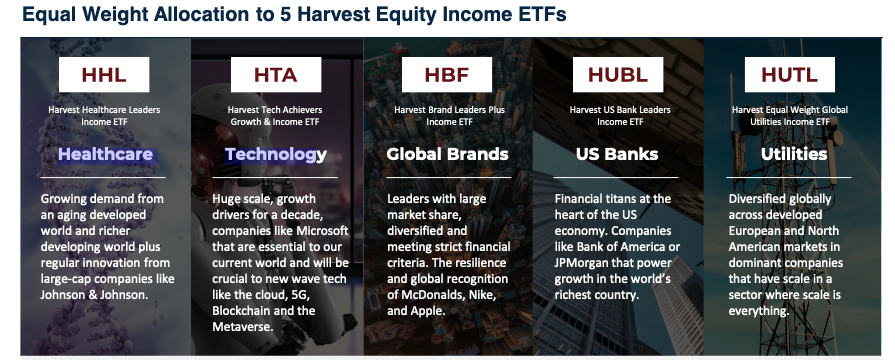
5 Harvest ETFs have yields over 5%

(Sponsor Content)

As interest rates have fallen, investors who have traditionally relied on bonds and bond-like investments for income have faced tough decisions. Finding safe and predictable income streams has been a challenge.

For many, this has meant turning to equities, particularly global brand leaders with strong businesses. While the share price of these companies rises and fall with the broader economy, they have strengths that allow them to continue to remain profitable in downturns while continuing to pay dividends.

A diversified portfolio of these large-capitalization multinationals helps to protect against economic risk and offers shelter and opportunity. The companies have strong cash flow and balance sheets, well-established businesses and a commitment to dividend growh. In downturns, their share prices tend to fall the least and recover first.

This strategy is at the heart of the Harvest ETFs philosophy. Harvest offers simple, transparent, competitively priced Exchange Traded Funds (ETFs) that own the most successful global businesses. Over time these companies generate steady growth and income. The Harvest way can be summarized as: Global leaders = high income + long term growth.

This thinking led Harvest to create a suite of ETFs that combine capital growth opportunity and monthly distributions with tax efficient current yields of between 5 and 8%.[i]

Harvest achieves this yield in two ways. It chooses global leaders, or the biggest and most dominant companies in their industry. The companies must have a history of profitability and weathering all economic cycles, plus a record of paying dividends that tend to rise over time.

Second, Harvest enriches the returns with a covered call strategy. Harvest is third largest option writing firm in Canada with seven of its 13 ETF’s having option writing strategies.

The covered call strategy adds to the basic dividend income safely by selling a portion of the potential rise in stock price in exchange for a fee. The fee limits the gain a bit, but it also acts as a cushion if share prices fall, because the fee is kept no matter what. Continue Reading…