General

Life Insurance and Covid vaccines: what we know now

LSMInsurance.ca

By Lorne Marr, CFP

Special to the Financial Independence Hub

No nation has been spared the impact of COVID-19 and Canada is no exception. With more than half a million cases and tens of thousands of deaths, the news of approved vaccines and the subsequent rollout is more than welcome. The vaccines mean a light at the end of a long, dark, scary tunnel. The vaccines will have an impact on every aspect of our (hopefully soon to be) post-COVID life, including life insurance. Here is how insurance professionals see that.Va

The impact of a COVID vaccine is still being scrutinized by the life insurance industry.

We are early in the game and new information is unfolding as we speak. Below is some initial reaction. Most of the executives we reached out to could not give a concrete answer due to all the uncertainty surrounding the vaccine. The ones who did respond said they are leaning towards “not asking a COVID-related vaccine question on applications.” The rationale likely stems from the fact that insurance companies do not currently ask if other vaccines are up-to-date or whether people are having other routine recommended health screening tests.

Other considerations include the vaccines not being available for everyone due to other health complications (currently Pfizer is not recommended for people with anaphylaxis type food and drug reactions).

Insurance companies will likely continue to review studies provided by the pharmaceutical companies that have produced the vaccine to understand what the risks will be overall after the vaccines are deployed.

Vaccine questions more likely for those over 70

Insurance carriers may be more likely to ask a COVID vaccine question to applicants over the age of 70 as they are in the highest risk category.

Norm Leblond, Vice President, Chief Underwriter and Claims Risk Officer at Sun Life Financial said, “The health and safety of our employees, clients and communities is our top priority. Since the start of the COVID-19 pandemic, we have been monitoring the evolving environment including the development of these new vaccines. We continue to take a long-term view of risk. It is too soon to fully understand what permanent changes the industry may need to make to our guidelines or requirements.” Continue Reading…

Lessons learned in diversification: reducing my Canadian home country bias

By Mark Seed, myownadvisor

Special to the Financial Independence Hub
Many financial advisors, analysts and investing gurus alike argue in favour diversification.

That said, there are some experts who claim owning about 30-40 individual stocks, in various industry sectors, will provide modest diversification to mitigate portfolio risk.

You can find some of those expert opinions on how many stocks are enough in this post.

Dedicated readers of this site will know I’m a fan of portfolio diversification myself, since I adhere to some personal rules of thumb when it comes to my DIY portfolio. Here are some of those rules of thumb:

  • I strive to keep no more than 5% value in any one individual stock.
  • I’m working on increasing my weighting in low-cost ETFs over time, more specifically, owning more of the U.S. market since I’ve had a long-standing bias to Canadian dividend payers in my portfolio.

You can always review some of my current holdings on this standing page here.

Why diversification?

Portfolio diversification aims to lower the volatility of my portfolio because not all asset categories, industries, nor individual stocks will move together perfectly in sync. By owning a large number of equity investments in different industries and companies, and countries, those assets may rise and fall differently; smoothing out the returns of my portfolio as a whole.

There is a close logical connection between the concept of a safety margin and the principle of diversification. – Benjamin Graham

As I contemplate semi-retirement in the coming years, this is what I’m considering for cash on hand to support any bearish equity markets or to ride out unfavourable market returns.

Diversification: applying some knowledge and lessons learned

With 2020 in the rear-view mirror, and a trying investing year for many to say the least (!), I decided to make a few portfolio changes so I could embrace diversification more while simplifying my portfolio as those needs for capital preservation draw nearer.

Today’s post outlines some of those changes, by account, and why.

1.)TFSA

I’ve admittedly been wrestling a bit for what to invest in, inside this account for the current 2021 contribution year.

I know I need some more U.S. and international exposure even with the recent comeback in many of my Canadian stocks since the market calamity began in March 2020.

In looking at my sector allocation to the oil and gas industry, I decided to cut complete ties in late-2020 with Inter Pipeline (IPL) after their dividend cut of 72% earlier in the year. You can see some of that dividend news I reported in this previous dividend income update.

I will use that money, along with new TFSA contribution room in 2021 to invest in some all-world ETF XAW amongst other investments.

XAW will provide far less yield inside my TFSA going-forward, which will impact the income generation machine that is my TFSA, but more importantly I think this fund will provide some much needed total return growth from ex-Canada.

XAW iShares December 2020

2.) RRSP

In a taxable account, Canadian dividend paying stocks earn favourable tax treatment thanks to the dividend tax credit. So, I keep those stocks there and see no reason to change that approach. Continue Reading…

How to think about Retirement Planning

We all need to think about retirement planning at some point in our lives. Relying on rules of thumb like saving 10% of your income or withdrawing 4% of your savings can get you part way there. But it’s also important to think about what retirement will look like for you. When will you retire? How much will you spend? Do you want to leave an estate? Die broke?

Here are some ideas to help you think about retirement planning, no matter what age and stage you’re at today.

Understand your Spending

Much of retirement planning is driven by your spending needs and so it’s crucial to have a good grasp of your monthly and annual spending – your true cost of living.

Of course, any plan that looks beyond one or two years is really more of a guess. What is your life going to look like in five, 10, or 20 years? How long are you going to live, and are you going to stay healthy throughout your lifetime?

We don’t know and so we use assumptions and rules of thumb to guide us. First, think of when you want to retire – is it the standard age of 65, or are you looking at retiring earlier or later? Then, it’s helpful to know that while life expectancy in Canada is around 82 years, there’s a significant chance that you’ll live much longer than that – so perhaps planning to live until age 90 or 95 would be more appropriate.

We’ve heard all types of rules of thumb on retirement spending, but the consensus seems to be that you’ll spend much less in retirement than you did during your final working years. You’re no longer saving for retirement, the mortgage is paid off, and kids have moved out.

In my experience, most people want to maintain their standard of living as they transition to retirement and so you might want to use your actual after-tax spending as a baseline for your retirement planning. Note, this does not include savings contributions or debt repayments, but your true cost of living that will carry with you from year to year.

Now you know your expected retirement date, your annual spending, and a life expectancy target: three key variables in developing your retirement plan.

How much do you need to save?

I remember using an online retirement calculator when I was younger and feeling depressed when it told me I needed to save thousands of dollars a month to reach my retirement goals.

The fact is, you do need to save for retirement and the best way to start is by setting up an automatic contribution to come out of your bank account every time you get paid. You’re establishing the habit of saving regularly rather than focusing on a “too-large-to-imagine” end result.

Treat retirement savings like paying a bill to your future self. You need to pay your bill every month or else “future you” won’t be happy.

There’s great research around automating contributions and also around increasing your contributions whenever you get a raise, bonus, or promotion. Remember, if you contribute 10% of your paycheque when you earn $60,000 per year but then get a raise to $70,000 per year, if you’re still saving $6,000 per year that’s now just 8.5% of your salary – not 10%.

Give “future you” a raise too.

It’s also important to remember that life doesn’t work in a straight line: we don’t just contribute a set amount and earn a consistent rate of return every single year. Our savings contributions could be put on hold for a period of time while we pay off debt, raise kids, or focus on other priorities. You could get a large bonus one year, but then no bonus for the next three years. Investment returns are also widely distributed and so instead of earning 6-7% per year you might get 12% one year, 5% another year, or lose 10% one year.

Don’t get discouraged if you don’t meet your savings targets one year because of some unforeseen expense. Life happens.

Forget about Age-based savings goals

Estimating retirement spending in your 20s or 30s is a pretty useless exercise. Again, we don’t know what our life will look like five, 10, 20 years down the road.

Here are the four areas that young people should focus on in their accumulation years:

  1. Understand how much you spend and where all of your money goes.
  2. Focus on spending less than you earn (or earning more than you spend).
  3. Establish both short- and long-term financial goals. It makes no sense to pour all of your extra cash flow into an RRSP, for example, if you plan on buying a car or getting married in 1-3 years.
  4. Set up automatic contributions into a long-term investing vehicle: a percentage of your paycheque that you can reasonably afford while still meeting all of your current expenses and short-term goals. This doesn’t have to be 10% but strive to increase the amount each year.

Many young investors want to know how they’re doing compared to their peers. I don’t think it’s useful to use any age-based savings goals as a benchmark or guideline. We all come out of the starting gate at different ages and with different circumstances.

Focus on being intentional with your money and establishing a savings habit early. Remember, this is about you and your retirement planning.

That said, once you get into the retirement readiness zone (say 3-5 years away from retirement) you should have a good grasp of your expenses and also the type of lifestyle you want to live in retirement. Your spending will drive your retirement planning and projections, so this is a critical piece to nail down.

Investing in Retirement

Investing has been solved in a sense that the best outcomes will come from staying invested in a risk appropriate, low-cost, broadly diversified portfolio of index funds or ETFs.

It’s never been easier to invest this way. Self-directed investors can open a discount brokerage account and buy a single asset allocation ETF. Hands-off investors can open a robo-advisor account. Even clients who choose to remain at their bank can insist on a portfolio of index funds.

That’s great in the accumulation stage, but what about investing in retirement? Besides potentially taking some risk off the table by changing your asset mix, not much needs to change.

Self-directed ETF investors can simply sell off units as needed to generate retirement income, or switch to an income producing ETF like Vanguard’s VRIF. Robo-advised clients can work with their portfolio manager on a retirement income withdrawal strategy.

The biggest difference might be a preference to hold a cash buffer of one-to-three years’ worth of spending (the gap between your guaranteed income sources like a workplace pension, CPP, and OAS, and your actual spending needs).

What about unplanned or one-time Expenses?

An emergency fund can be useful in retirement to pay for unplanned expenses. But, for routine maintenance and one-time expenses that come up every year, these should be built into your annual spending plan and budgeted for accordingly.

Your cash flows change in retirement as you move from getting one paycheque from your employer to receiving multiple sources of income, like from CPP and OAS (steady monthly income), maybe a workplace pension, and then topped-up by withdrawals from your personal savings. You may find that you need a large cash balance in the early stages of retirement while you adjust to your new reality.

Large expenses like a home renovation or new car should be planned for in advance and identified in your retirement plan so that appropriate funding is in place ahead of time.

Major unplanned expenses may require a change on the fly – and so using a home equity line of credit or dipping into your TFSA (tax free income) could help deal with these items in retirement. Many retirees quickly realize that their TFSA is an incredibly useful and flexible tool for both saving and spending.

Victory Lap Retirement?

Jonathan Chevreau and Mike Drak coined the phrase Victory Lap Retirement (read their book of the same name) with the idea that a full-stop retirement – in other words, going from 100% work mode to 100% leisure mode – was neither sustainable nor desirable. Continue Reading…

Fear the GIC Refugee renaissance

By John DeGoey, CFP, CIM

Special to the Financial Independence Hub

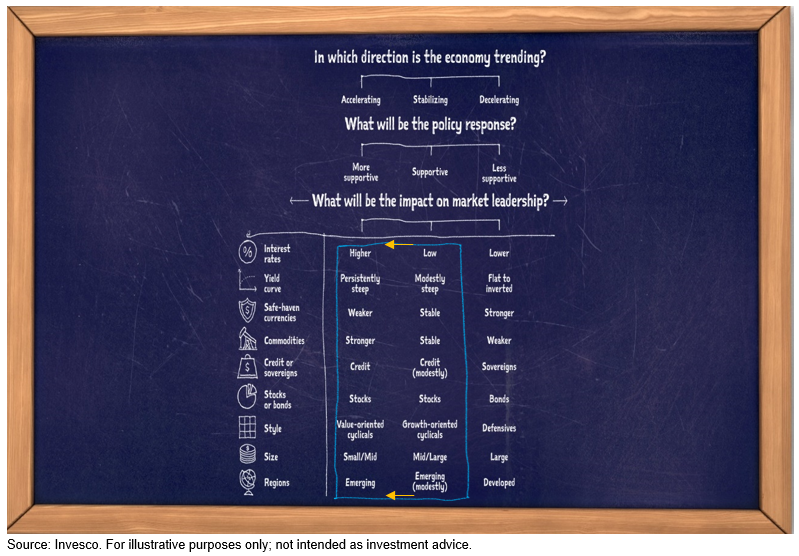
When I started in the business in September of 1993, it was a great time for new client acquisition.  The reason is simple: there were so many new clients to be had – in the form of first-time investors.  As interest rates plummeted from their all-time highs in the early 1980s, the fulcrum began to shift.  Specifically, as the risk-free rate (anything that could be attained on a guaranteed basis) dropped, people became increasingly willing to absorb risk.

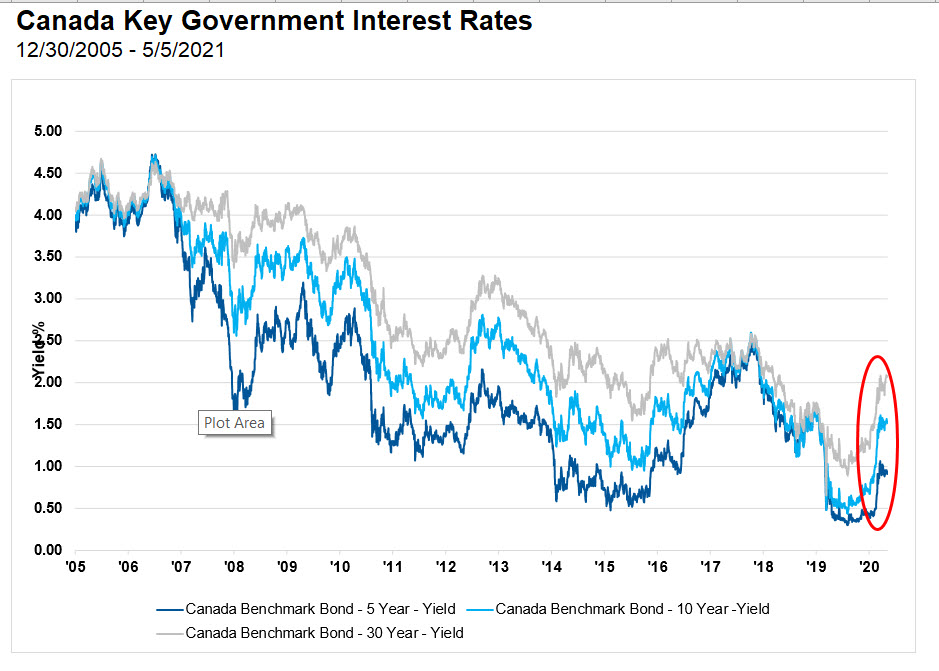
Starting around 1982, the long-term macro trend that continues to this day began.  That year marked the cyclical high in long-term interest rates (in the mid to high teens!) along with a multi-generation low in price/earnings ratios (well into the single digit range!).  For nearly 40 years, interest rates have been seeing a secular decline, while market valuations the world over have been creeping up.  The correlation is predictable.  As rates drop, people are prepared to take on increasingly large amounts of risk in their quest for financial reward.  Totally understandable.

Rates are essentially at Zero

Now that rates are essentially at zero throughout the developed world, the trend has become acute.  The question that people might now be asking themselves is: will people stay out of traditional income investments for the foreseeable future?  Continue Reading…

Ways to re-plan your Finances during Covid-19

By Donna Johnson

Special to the Financial Independence Hub

COVID-19 certainly has made 2020 a year to forget for some, and as it wraps up with the holidays and new year, many people are assessing their financial situations and determining the next steps. The good news is it does appear a vaccine and more medicines are on the way. But still, getting these treatments out to everyone and getting the virus under control will still take time, so reopening the economy completely may not happen for several months yet. In the meantime, Americans are trying to manage holiday expenses and future budgets until the tide turns.

Covid-19 savings reallocation opportunity

While it may be no fun to miss out on going to your favorite movie theater on Friday nights, or visiting your favorite theme park during vacation, consider the upside of this. The money you may have spent on all those activities is money you can tuck away for better use. Money you don’t spend as disposable income is money you can turn into either savings or investments. There are ways to use it that can be a return on investment if you do your planning right.

Building a emergency savings fund

The worst thing that could happen to you during a pandemic is getting laid off; in which case you will need savings to get by. Unemployment during the pandemic hit a high of about 14.4% back in April. But even if you’re still employed, sudden expenses like HVAC repairs, car repairs, and doctors’ visits still happen. When they do, you’re better off not putting all of those expenses on your credit card, or borrowing money from high-interest loans to pay for them. Instead, consider setting aside about $20-50 per week or per paycheck, let that money sit in a savings account untouched, and over time you’ll see it grow to potentially hundreds if not thousands of dollars in savings. And these savings should not be used for regular expenses like gas or rent, unless you’ve lost your job. But instead, prioritize sudden emergencies like car accident expenses or pipe burst repairs for these savings.

Use the time to refinance and tackle debt

Another thing you can do with extra savings is apply them to any outstanding debt accounts you have. Now one thing to note is that some debts such as federal student loans had payments suspended and interest rates set to zero. Continue Reading…