By Steve LowrieSpecial to the Financial Independence Hub
It’s now been nearly a decade since investors have had to face down a bad bear market. Long enough, apparently, that many have forgotten how painful that can be. Maybe that’s why I’ve been witnessing what seems like an uptick of speculative excess lately – aka, fad-chasing.
For example, there’s been performance chasing in real estate, and continued stockpiling of high-dividend stocks. At least these qualify as legitimate asset classes if they’re sensibly incorporated. In an increasing bid to turn up the heat, I’ve also been seeing investors bedazzled by far riskier ventures ranging from cryptocurrency to cannabis. This, despite decades of evidence suggesting what the future has in store for financial fads. A few lucky players make a fortune, but the vast majority who pile in after the run-up is noticeable are far more likely to be left holding the bag.
When the ducks quack, feed them
Everyone seems to have forgotten how risky a hot hand can be. Everyone, that is, except the Bay Street and Wall Street denizens who have a saying for these sorts of speculative runs: When the ducks quack, feed them. Meaning, as one source has described, “when investors want to buy something … that something is offered for sale. It doesn’t make any difference if Wall Street knows in its heart of hearts that that something (such as an IPO) is overpriced.”
Make no mistake. The typical Wall Street brokers and Bay Street bankers are no fools; they are opportunistic. If they see a chance to make easy money on a hot-hand trading frenzy, they’re happy to help you get in on the action. Whether you win or lose on your trades, they come out ahead on the transaction fees involved.
Likewise, the popular financial press makes its money by capturing your interest; not by advising you according to your highest interest. Case in point: As I write this post, the Yahoo Finance feed is prominently displaying Bitcoin pricing ahead of the Cdn/US dollar exchange rate and major international market returns. It’s also awash with ads promoting Bitcoin and other cryptocurrency for sale. So much for objective reporting.
As Reformed Broker Josh Brown once said: “The more you read about Wall Street history, the more you recognize it as the world’s most elaborate petting zoo – lambs, ducks, goats, cows and pigs herded into pens so that bankers and brokers can feed them pellets right from their hands. We are fed until the bursting point, we almost never walk away on our own.”
So before you decide to buy cryptocurrency, cannabis, or whatever is the next craze to come, here’s what I would suggest you do first: Think it over while taking a good long walk – most likely in the direction of “away.” Continue Reading…
Will Monday February 5th go down as the worst day ever for stocks? On this day the Dow Jones industrial average lost more than 1,175 points: the worst single-day point drop in its history. But was it really the worst day ever? Investors need some context.
The 1,175 point drop was indeed the biggest single-day point loss the Dow has ever sustained. But let’s remember the Dow has been soaring almost uninterrupted since March 2009 when it bottomed-out at 6,627 points during the global financial crisis. By the end of January 2018 it had reached a record 26,616 points.
Better to forget about points and focus instead on percentage gains and losses. Taken in this context the headline reads a bit different. The Dow plunged 4.6 per cent: its worst day since August 2011. It doesn’t sound nearly as gloomy.
Another way to frame this day is that the stock market has erased its gains from the start of the year. But 2018 is just one month old.
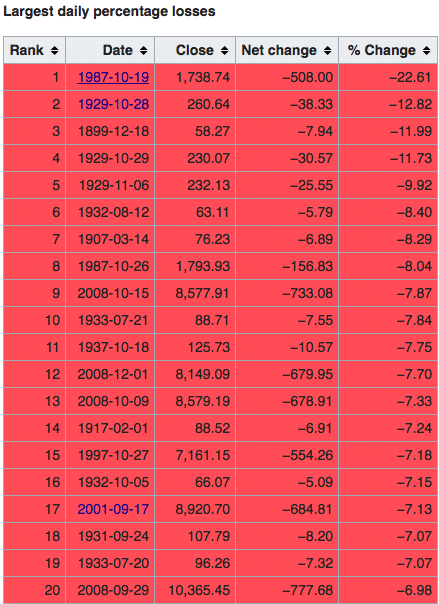
Where does this day rank in terms of largest one-day percentage drops in history? Will it live on in infamy like Black Monday, Black Tuesday, the Flash Crash, or the aftermath of the September 11th attacks?
Nope, not even close.
If you were thinking Monday’s 4.6 percent drop was a bloodbath then how would you have reacted to one of the top 20 largest daily losses of all time? This wasn’t even a blip on the radar.
We like to keep informed about the topic of retirement from the perspective of money managers and those in the financial fields.
You might have read some of these articles also; you know, the ones that say North Americans have not saved enough to retire.
Many of these pieces proclaim that you must save enough in your investments to throw off 80% of your current annual salary so you can afford a comfortable life away from a job. Lots of them will say that you need US$2 million in investments and woe to the person who thinks they can do it on less.
Approximately 10% of the households in the US have a net worth of one million dollars or more. What are the other 90% supposed to do? Not retire? What kind of common sense does this make? Expecting the regular “Joe” to meet this $2 million dollar mark is not realistic.
As you know, we have almost three decades of financial independence behind us. And while everyone’s idea of a perfect lifestyle sans paycheck is different, we can tell you that for these almost-30-years, we have kept our annual spending around $30,000 or less per year.
The secret: Living within your means
In all of our years of retirement and travel we cannot recall one retiree who regrets their decision to retire. In fact, most have told us that they wished they had done it sooner.
The Society of Actuaries (SOA) recently conducted 62 in-depth interviews of retired individuals across both the U.S. and Canada. These people were not wealthy and had done little to no financial planning. But the vast majority of them shared that they had adapted to their situation and live within their means. Meaning, they have adjusted their spending to the amount of money they have coming in every month.
So basically, it’s really that simple and this is why we say if you want to know about retirement, go to the source.
It doesn’t have to be complicated
In our books and in our articles about finance, we say over and over that there are four categories of highest spending in any household. We personally have made adjustments in all four of these categories, and have therefore reaped the benefits of having done so.
The financial guys and gals will have you tap dance all over the place with investment products, and a certain financial goal you must achieve. They will press upon you the seriousness of this decision to leave your job for a couple of decades of jobless living. We say it doesn’t really have to be that complicated, but it’s very important to pay attention to these four categories.
Doug Dahmer, CEO and founder of www.RetirementNavigator.ca has been a regular guest contributor to the Hub since its inception in November 2014. His focus is on Canada Pension Plan optimization, avoidance of retirement tax traps, and the creation of drawdown strategies during the decumulation side of financial planning. Some of these ideas have been used (with proper attribution) in various columns I’ve written in other media outlets, generally summarized here at the Hub.
However, Dahmer has been noticeably quiet lately. This blog explains why.
As the headline says and the adjacent image suggests, Doug is about to turn financial planning on its head. How? By democratizing access to financial planning, in the same way that Robo-Advisors democratized investing. This disruption of the planning industry is built upon a new planning platform called Better Money Choices.
Asked what motivated him to launch this venture Dahmer said more than 70% of Canadians say their greatest worries in life are centred around their financial futures. “Yet at the same time it is estimated that fewer than 15% of Canadians have a formal financial plan in place.”
As he talked to clients about this disconnect — why they resisted the idea of financial planning as an Rx to their financial stress — he discovered most people have no idea what true financial planning looks like.
Doug Dahmer, creator of BetterMoneyChoices.com
“The financial services industry has twisted the planning process into a tedious, time-consuming, onerous task that’s heavily biased toward the sale of financial products. What they hated most about planning, is that, more often than not, the conclusion to the process was always the same: spend less, save more, work longer, work harder. These recommendations were made while providing little in the way of understanding of the specific rewards these sacrifices would deliver.”
In short, Planning did not relieve their level of stress, it actually increased it!
Money doesn’t buy stuff, it buys choices
True planning was never meant to promote the sale of financial products. It’s supposed to be a process that allows you to explore the lifestyle choices you are thinking about, so you can discover their future financial implications before you need to commit to them. “Armed with this insight, you can then decide whether you’re willing to make the necessary sacrifices to bring them to fruition.”
Your most valuable asset isn’t money. It’s Time — and how you choose to spend it
Dahmer’s financial planning philosophy is based on the belief our lives are defined by the choices we make: the more good choices we make, the better our lives will be. His new site, BetterMoneyChoices.com, lets people quickly, easily and securely explore their lifestyle choices so they can better determine what outcomes they should focus on.
Everyone’s personal resources – time, money, energy, relationships and talents – are limited in some way. That forces each of us to make choices to accept less of one thing in order to obtain more of the things that are most important to us. However, seldom is “more money” what we are seeking.
It’s time the financial planning sector evolved with the times
Dahmer says technology has given us many low cost/no-cost, self-serve tools that make almost all aspects of our lives easier, but not yet financial planning. “My mission is to change this. By putting the focus on how you want to live your life instead of how much money you can accumulate, and making it easy for you to determine which set of choices will bring you closer to what you value most, the technology behind the Better Money Choices process will revolutionize planning.”
His goal is to make it a quick, easy and engaging process to determine the trajectory our lives are tracking. “I want to convert the misnomers that planning is an event that translates into an exact science to the reality that planning is an ongoing, never ending process of making a set of best guesses – projecting those best guesses into the future – then re-engaging with life to learn more.”
Such a process requires frequently returning to our ever-living planning platform to check our progress and improve upon our guesses. “Once people understand what true planning looks like and the huge benefits that can accrue by adopting this approach for directing them to better choices, their disdain for planning will finally disappear and they will rely on their planning tools with the same natural inclination they reach for their google maps when it comes time to choose how best to arrive at their desired destination.”
Exact pricing has yet to be determined, but Dahmer’s goal is to have a monthly subscription that is comparable to Netflix or Spotify.
Beta Testing
Dahmer is currently running a beta test to get user feedback, prior to it being released publicly (currently scheduled for April 1st, 2018, coincidentally a week before I myself turn 65).
Doug has asked me to participate as one of the early beta testers and I have agreed to do so. In the past week, I have been “playing” with the software with our own personal data and I can tell you already it’s an eye opener. Over the next few weeks on the Hub, I’ll report back to you on my experiences with the software and the impact this novel approach to planning has had on my own plans for the second half of my life.
After all, I’m hardly unique in turning 65 this year: some 1,100 other Canadians now do so each day. (Incidentally, I’ll be collecting my first Old Age Security cheque late in May but, as per the guidance of Doug and his new software, I’ve elected to wait until age 70 to collect the Canada Pension Plan. This too has been reported in my columns in the country’s two major daily newspapers or MoneySense.ca )
If you’d like to be one of the first to know when the site officially launches, you can sign up at www.BetterMoneyChoices.com.
Retirement investing advice is a subject we’re asked about all the time. And it’s one that we deal with on a practical day-to-day basis with our Successful Investor Wealth Management clients.
If you want to pay less tax on dividends while you’re still working, investing in an RRSP (Registered Retirement Savings Plan) is the way to go. That’s because dividends you receive in an RRSP grow tax free.
Is an RRSP the best savings plan for retirement?
RRSPs are a great way for investors to cut their tax bills and make more money from their retirement investing.
RRSPs are a form of tax-deferred savings plan. RRSP contributions are tax deductible, and the investments grow tax-free. (Note that you can currently contribute up to 18% of your earned income from the previous year. March 1 is the last day you can contribute to an RRSP and deduct your contribution from your previous year’s income.)
When you later begin withdrawing the funds from your RRSP, they are taxed as ordinary income.
A Registered Retirement Income Fund (RRIF) is a great long-term investing strategy for retirement
Converting your RRSP to an RRIF is clearly one of the best of three alternatives at age 71. Continue Reading…


 Posted By
 By Steve Lowrie
 Posted By


 Posted By


 Posted By