No doubt about it: at some point we’re neither semi-retired, findependent or fully retired. We’re out there in a retirement community or retirement home, and maybe for a few years near the end of this incarnation, some time to reflect on it all in a nursing home. Our Longevity & Aging category features our own unique blog posts, as well as blog feeds from Mark Venning’s ChangeRangers.com and other experts.
Dealing with Longevity Risk is a “hot topic,” according to someone who’s an expert on the topic. Read this “as told to” interview with Moshe Milevsky, the prolific financial author and finance professor at the Schulich School of Business.
The risk is that as people go from savers (Wealth Accumulation) to relying on retirement income (Decumulation), there’s always the danger of running out of money before you run out of life.
There is of course a solution called annuities but for some reason both investors and their advisors aren’t yet flocking to them. This may be because it involves losing control over your capital to an insurance company and is an irrevocable decision, at least for the portion of your capital being annuitized. Another reason is it often means that capital won’t be available to one’s heirs, depending on the options chosen.
Interest rates low, but mortality credits on annuities become important as you age
Even so, Milevsky tells the site that “single premium income annuities are often under-rated as a retirement planning tool.” Yes, interest rates are low but Milevsky argues that as you get older, mortality credits become relatively more important. In the end, it’s all about peace of mind.
In any case, no one ever said you have to annuitize ALL your capital. Read Milevsky’s piece and you may conclude that at least some of your capital might be annuitized at some point.
The other evening ten 60-ish baby boomers got together in a private home in mid Toronto to discuss Boomer retirement and related matters. There were two main groups: most were business owners who have been self-employed for 30 or more years. A handful (including myself and the hostess) had spent most of our careers working as employees in large organizations.
Long-time business owners looking for exit
In both cases, the great question before us was “What do I do with the rest of my life?” The business owners were concerned about exit strategies to monetize their years of sweat equity, which could include outright sale or passing the reins to younger family members.
Long-time employees looking to find a transition business
The other group is considering becoming business owners or entrepreneurs even at this late stage of life, or what I term “Boomerpreneurs.” We may or may not have left the workforce voluntarily but suddenly had some leisure and money to contemplate our next move.
In almost all cases, this was a high-achieving group and while one younger attendee (in his mid 50s) had spent a “mini retirement” of several months in Central America, most of us agreed we were in no way ready for endless days of daytime TV, golf or bridge. Some were conscious of the extended Life Expectancy theme underlying this website’s “Longevity & Aging” section, but others were acutely aware that we all entering the final few laps of the great race of life. The long-time business owners in particular seemed ready for a change, but were aware the transition or exit could well require four or five more years of continued effort.
Actually, this was the second time the group had met. I would have love to have attended the first one in October but had already committed to a three-week trip to Turkey. The focus of the first one was that many baby boomers can expect another 10,000 days of life on the planet, so what’s your plan on how you’re going to spend that time? As the facilitator, Alan Kay (more on him below) put it, it’s all about “repurposing yourself, not a blank canvas.”
Acquiring new skills — at 60
Interestingly, the hostess (one of only two women in the second meeting; the rest were obviously men) experienced almost the same events as I have in 2014. Both of us had quite independently chosen to attend Toastmasters weekly, to hone our public speaking and leadership skills (neither of which suggests sitting before a fire in your rocking chair). She is also attending a Rotman course that prepares you to assume positions on corporate boards. As if that weren’t enough, this high achiever is also taking acting lessons.
Does Business Ownership run in the family?
Her husband, and our host, has long been a business owner. In fact, long ago when I worked on a computer newspaper, I had naively written a piece about him extolling the fact that he was a “27 year old president” of his own computer company. At the salon, he said his own father was a business owner so it seemed a natural step for him at the time. I replied that my father was a high school teacher with security and a Defined Benefit pension plan, which may have explained why I tended to stick with salaried employment within other people’s businesses.
Regrets of the dying
We discussed life purpose, why we are even on the planet, and the five regrets of the dying, a piece published recently in the Globe & Mail. Some felt that one of the advantages of building something even at this stage of life would be to employ the generations following us, including our children.
There was a feeling it’s time to simplify, perhaps to slow down a tad but few seemed to seek a traditional “full-stop” retirement. Call it semi-retirement or phased retirement, depending on circumstances. I didn’t get the impression anyone was suffering financially, so the continued interest in remaining active was more about community, giving back and the like.
Naps in the home office
Some of us work from home, some still go to an office, even if they own the building in which it’s housed. Among the “work-from-home” crowd, which included our host and myself, we confessed there was the advantage of the occasional afternoon nap.
As for the session and what’s next, it’s all rather fluid although the hosts did facilitate an exchange of emails with the intent of connecting on Linked In. Certainly, this web site will happily describe further developments and facilitate communications between members and would-be members. There are, for example, our so-far-dormant discussion forums, which could be used to continue the dialogue in cyberspace. It was just such a salon that spawned the Huffington Post.
Alan Kay, The Glasgow Group
Pending permission from the other participants, I’ve erred here on the side of protecting actual identities but may update this blog or post new ones with actual names and coordinates as they arise. I can say the session was moderated by Alan Kay, who is happy to be identified as “a fully recovered ad guy, facilitating change through tools like stakeholder consultations and roundtables using his Solution Focus expertise.”
And yes, this often means sitting around a kitchen table like the one illustrated above; you can find him via his website here. Or contact me at jonathan@findependenceday.com.
This audio clip is from the More Than Money radio show from Calgary, recorded shortly after the Hub launched. The focus was on a MoneySense blog I’d written after the question “Will your retirement date be a surprise?” was posed in a Sun Life poll. But we also touch on the longevity theme that is the focus of the Longevity & Aging section here at the Hub. There’s also an update on the launch of the Hub and the recent e-books.
When you get to the show’s link, just press the small “Play” icon next to my name, or indeed the same icon next to any of the other guests’ names there.
A big aspect of planning for retirement is health and longevity. Back in the summer, I devoted a blog at the Hub’s sister site to Mark Venning of ChangeRangers.com. Venning helps clients prepare for two things: making the shift from employment to entrepreneurship, and also to help prepare for a future of extended longevity and life expectancy. That’s “why the word ‘Retirement’ doesn’t work for me. It’s about longevity planning,” he told me, “My core message is plan for your longevity, not for retirement.”
That’s one reason the Financial Independence Hub includes sections both on Entrepreneurship and Aging & Longevity. But we’re not just a site for the Boomers: we take an “Ages & Stages” approach to financial independence, starting with material for Millennials and their focus on debt reduction, family formation and home ownership. Then by the time we reach those in mid-life (call them Gen X if you will), the focus is on Wealth Accumulation.
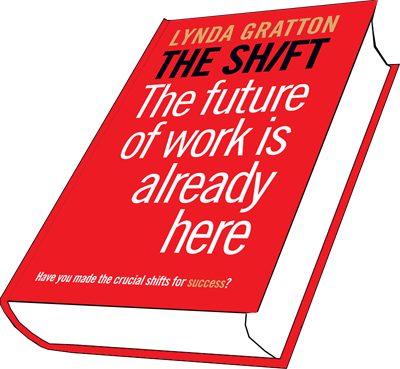
One of several book recommendations from Venning to his students — many of them terminated from full-time employment — is a book by Lynda Gratton called The Shift: The future of work is already here. It’s not brand new: my copy was published by Harper Collins in 2011. But it’s still relevant, especially to the generation of baby boomers, myself and Venning included, who are grappling with the issues of retirement planning.
Gratton, who is a business school professor, identifies five forces that are shaping the world of work, plus three “shifts.” They’re all worth summarizing here.
The 5 forces shaping our future
1.) Technology
2.) Globalization
3.) Demography and Longevity
4.) Society
5.) Energy Resources
The 3 shifts
1.) From shallow generalist to serial master
2.) From isolated competitor to innovative connector
3.) From voracious consumer to impassioned producer
For baby boomers and others who are nearing retirement, or moving into semi-retirement or self-employment, almost all of these forces and shifts need to be taken into consideration. In earlier blogs like this one — Never Work Again — we looked at the revolution in Internet marketing, which is based on both the Technology force and Globalization. When you can run a web-based business from anywhere in the world merely with a laptop computer and a smartphone, you know you’re embracing these forces.
Gratton’s points on demography and longevity seem particularly apt: this was the topic that most fascinated the team of researchers she tapped into for the book. “We quickly understood that technology is changing everything and will continue to do so, and that natural resources are depleted and carbon footprints must be reduced,” she writes. But demography and longevity “is intimately about us, our friends and our children … It’s about how many people are working, and for how long.”
The dark side: some boomers will grow old poor
In 2010, when Gratton was writing the book, there were four distinct generations in the workforce: the Boomers’ parents, the Boomers, Gen X (born between 1969 and 1979) and Gen Y (1980 to 1995). And coming up is Gen Z, born after 1995. Gen Y will be ascendent in the workplace by 2025 but increasing longevity means the Boomers and Gen X will still be hanging around, wanting to work and contribute in some capacity well into their 60s, if not beyond. Gratton also warns that “some baby boomers will grow old poor,” particularly if they don’t respond to the gift of extended longevity by embracing the forces and shifts that are confronting them.
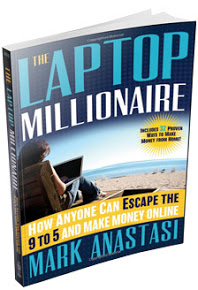
Because of globalization and technology, the privilege of being born in North America may no longer be sufficient advantage for those who don’t embrace The Shift. Books like The Laptop Millionaire describe how those with wealth can take advantage of outsourcing: for example, hiring English-speaking Filipinos as full-time virtual assistants for something like $250 or $300/month.
There is a dark side to these shifts: those not equipped to embrace change increasingly will have to compete for jobs or contracts with people half a world away who are technologically sophisticated and willing and able to work for much less than North Americans.
Gratton devotes big chunks of the book to fictional scenarios of the near future of work, some of them pessimistic, some of them optimistic. All in all, it’s well worth reading. It reinforced my own belief that “If you’re not sure whether you should retire or can afford to do so, then just keep working, preferably in a congenial line of work you can continue to practice well into your 70s.”
Today’s blog title comes from Chapter 14 of The Upside of Aging, a book we mentioned several weeks ago at sister site FindependenceDay.com. This is recommended reading for anyone nearing the traditional retirement age. It consists of 16 essays from various experts, all of whom look at the topic of longevity through various lenses: urban planning, global demographics, healthcare and pharmaceutical research and so on. For example, Ken Dychtwald of Age Wave pens an interesting essay titled “A Longevity Market Emerges.”
Pictured below is Dan Houston, president of Retirement, Insurance and Financial Services for the US-based Principal Financial Group, who wrote the chapter I flagged in the title.
Retirees can expect one spouse to reach 90
Dan Houston
Houston begins by observing that because of longer expected life spans, the mind-set around retirement is evolving, and for the better. “Couples age 65 now have a 45 per cent chance that at least one will live to age 90,” Houston says, citing the Society of Actuaries, “This may be the first time in history where someone spends more years in retirement than in a traditional working career.”
The downside is of course financial: living another 20 to 40 years after leaving the workplace comes with a “substantial cost,” Houston says, “one that has to be funded. It’s an increasingly challenging prospect given inflation, the high cost of health care, and the risk of outliving savings.”
Try living on $400/month
The statistics, at least in the U.S., are not encoring. Fewer than four in ten pre-retiree households (aged 55 to 70, not yet retired) have financial assets of US$100,000. And even if they did have that amount on the nose, it would generate guaranteed lifetime income of just $400 a month.
Many think they’ll need less income in later life than recommended and many plan to draw down on assets at such high rates (9% a year on average) that assets will be depleted within 13 years. The recommended “safe” annual withdrawal rate is closer to 4%. They underestimate the cost of unreimbursed health care costs: in the U.S. Houston estimates a moderately health retired couple will need US$250,000 just to cover health care expenses and premiums throughout retirement. This is one area that Canadians may be ahead because of our universal health care system.
Don’t count on working in retirement
I’ve said before that the solution to this is to “just keep working,” but of course this may not always be an option. It’s a sad fact that agism still prevails in the workplace and costly older workers may be asked to leave before they’re ready to do so; and eventually body or mind may not permit full-time work even if one can find a willing employer. Houston says pre-retirees tend to overestimate their ability to work for income in retirement: more than two thirds expect to be able to supplement retirement income with some work but in reality, only one in five retirees actually works. That statistic, Houston observers, “reflects availability of work, as well as ability to work.”
Just as disturbing is the fact that 55% of American workers, and 39% of retirees, report having a problem with their level of debt. And those who do manage to save are not saving enough: 43% of workers report that neither they nor their spouse is currently saving for the future, while 57% report the total value of savings and investments is under US$25,000.
Four key investment risks
Even where there is ample savings to invest, Houston lists for key risks: inflation, market volatility, income and longevity. These are all linked: the longer you live, the more inflation can cut into your income. Consider this alarming stat on inflation’s power to erode savings: a dollar invested int he S&P500 in 1971 grew to $2.27 by 1982 but on an inflation-adjusted basis, that dollar depreciated to 96 cents. Houston notes that even annual inflation of 3% will cut a retiree’s purchasing power in half.
This calls for investments that have a fighting chance against inflation: Houston mentions Treasury Inflation-Protected Securities (TIPS, known in Canada as Real Return Bonds or RRBs); commodities, global REITs, natural resource stocks and Master Limited Partnerships.
As if that’s not all enough to keep a retiree awake at night, Houston reminds readers that the “insolvency” date for America’s Social Security system keeps moving closer: 2033, according to Washington’s May 2013 estimate. Meanwhile the over-65 population will double between 2010 and 2050.
As has been noted elsewhere, every day 10,000 baby boomers turn 65. While Canada’s combo of CPP and OAS seems on relatively solid ground, I continue to believe the best way to prepare for a long-lived retirement is to spread your income sources around: employer pensions, savings in RRSPs, TFSAs and non-registered plans, the government plans mentioned above, some part-time work or business income and perhaps rental income from investment real estate.