Building Wealth

For the first 30 or so years of working, saving and investing, you’ll be first in the mode of getting out of the hole (paying down debt), and then building your net worth (that’s wealth accumulation.). But don’t forget, wealth accumulation isn’t the ultimate goal. Decumulation is! (a separate category here at the Hub).

When to rebalance Stocks in Retirement and the Accumulation stage


By Dale Roberts, Retirement Club/Cutthecrapinvesting

Special to Financial Independence Hub

Most Canadian Do-it-yourself (DIY) investors are hybrid. They own a basket of Canadian stocks and largely manage U.S. and international diversification by holding ETFs. The ETFs are managed for you; that means the holdings (stocks and bonds) are rebalanced for you. When you hold a portfolio of individual stocks you will have to manage your own rebalancing.

When to rebalance your stocks in retirement offers its own considerations. It can be a different ball game when we consider RRSPs and TFSAs where there are no tax ramifications, compared to taxable accounts where every buy and sell is a taxable event. In the Globe & Mail, Norm Rothery offered up a wonderful study of rebalancing schedules. We can start with which rebalancing strategies might create the greatest total return over time.

We’ll start with the good news. Canadian blue-chip stock portfolios have historically outperformed the market over longer periods. Here’s the chart, once again courtesy of Norm Rothery …

As a measure of blue chip we can start with the strategy of investing in the 100 largest stocks with out-performance of almost 2.5% annual compared to the TSX. That advantage increases as we move to the low-volatility strategy that I have suggested for consideration (from the beginning of this blog in 2018). As always this is not advice. But investors who create their own stock portfolios might prosper from understanding the history of Canadian stocks.

The Canadian low-volatility portfolio

When you build a low-volatility portfolio in Canada you will gravitate towards the Canadian banks, insurance companies, pipelines, utilities, railways, the grocers and other consumer staples. You might argue the ‘safest’ stocks in the Canadian market.

The good news for those who do not want to create their own stock portfolio is that BMO has you covered with the BMO Low Volatility Canadian Equity ETF – ticker ZLB-T. Who doesn’t like out-performance with lower volatility?

As always: past performance does not guarantee future returns.

For those who create their own stock portfolio you’d simply buy enough of ’em from the various sectors. You might end up with a portfolio in the area of 20 stocks.

How often should you rebalance?

Here’s the Globe & Mail article from Norm (sub required) – How often should you update your portfolio?

Norm looked at several successful Canadian stock portfolio models …

We see that monthly rebalancing offered a benefit in six out of the seven models. I’m more than surprised by that. Rebalancing monthly or quarterly was a benefit in all of the models, compared to annual rebalancing.

Here’s the numbers for the stable-dividend (low-volatility) portfolio.

  • Monthly rebalancing – 14.2% average annual
  • Quarterly rebalancing – 13.84% average annual
  • Annual rebalancing – 11.59% average annual

The positive effect of regular rebalancing is MASSIVE according to this study. Remember, rebalancing is the process of selling your winners and moving money to your ‘losers’ or underperformers to keep your original allocation consistent.

Buy low, sell high

If you have 20 stocks and begin at an equal-weight allocation of 5% in each stock, you’ll sell the high-performance stock that is now 7% of your portfolio. You’ll move that money to a few of the stocks that are now only 3% of your portfolio (for demonstration sake). You’ll bring them all back to a 5% weight.

Of course, Norm’s evaluation is based on a time period calling for regular rebalancing. Ironically, ZLB is rebalanced twice a year: maybe they need to ramp that up?

Of course with regular rebalancing we have to consider transaction costs. Fortunately the trend for many discount brokerages such as Questrade and the investing app from Wealthsimple is to offer free trades. Some of the big bank brokerages will still have considerable trading fees.

Rebalancing your stock portfolio in retirement

The lesson from Norm’s study is: take the money and run. Or in retirement, you might take the money and fly to the Caribbean … your call. Continue Reading…

The move to STANDUP Portfolios

John De Goey/STANDUP Advisors/Designed Securities Ltd.

By John De Goey, CFP, CIM

Special to Financial Independence Hub

One thing I do constantly is think about risk exposure and uncertainty. I try to actively think ahead on behalf of clients. What do they want and need? In doing that, I aim to be realistic in how I assess options, accepting that no one can be truly certain about anything.

In addition, I know that many investors seek relief from decision fatigue, volatility anxiety, and the burden of constant monitoring. I set out to address those challenges. Coming to a working framework has taken awhile.

In fact, it took until a few years ago for the regulatory framework in Canada to truly make sense. Until then, client suitability revolved around the concept of Strategic Asset Allocation. How much money was in cash, how much in bonds, and how much in stocks?

Taking no more Risk than is absolutely necessary

It has only been in the past few years that the way regulators think about portfolio construction has been brought in line with the way most people intuitively think about market instability and investment suitability. The goal is to get people the return they need while experiencing risk they can handle, but no more than absolutely necessary.

Until recently, portfolio managers were obligated to write investment policy statements that spell out a client’s strategic asset allocation based on discrete asset classes. Now, regulators assess suitability through the dual lens of risk tolerance in risk capacity. Tolerance is a matter of psychographic disposition. Capacity is a matter of investable asset levels and cash flows through income.

Portfolios need to be constructed to reflect the more conservative of those two tests. Accordingly, products that are rated as low-, medium-, or high-risk can be combined to create portfolios that correspond to a client’s risk appetite. Regulators have even added two intermediate risk profiles: low-to-medium and medium-to-high. Think of all products rated on a scale of 1 to 5, with low risk as a one and high risk as a 5. Investors can mix and match based on risk/return characteristics rather than clumsy asset class depictions.

Using 2022 as a case study, we can all see how this more contemporary approach is of great value to retail investors. Under the old model, a traditional balanced portfolio (60% stocks; 40% bonds) would have been forced to lose money when considering rate hikes that everyone knew were on the horizon. Being forced to have a 40% allocation to bonds in what was almost certain to be a short-term bond bear market is simply inconsistent with the principle of responsible risk management. The system was failing people, but mercifully, those days are over. Continue Reading…

Canadian equity ETFs for your portfolio


By Dale Roberts, cutthecrapinvesting

Special to Financial Independence Hub

Today we’ll look at the core Canadian equity ETFs that you might use when you build a global ETF portfolio. The Canadian stock market is dominated by financials and energy. It is not a well-diversified index. It might be a case of pick your poison, a level of ‘undiversification.’

That said, the weakness of the Canadian stock market is quickly picked up by U.S. and International market ETFs. Also, Canadian stocks can add a layer of inflation protection that is missing from the U.S. market. Once again, we’re coming back to the beauty of a global ETF portfolio, on the Sunday Reads.

Off the top, what do we mean by buying the stock market of a country or region? Have a read of … What is index investing?

Building your global ETF portfolio

For an overview of ETF portfolio building, check out the ETF model portfolio page. We’re going to build around the core assets …

You can certainly add more assets such as gold, REITs (real estate) plus U.S. and international bonds, but many Canadians will stop with a simple but effective core ETF portfolio.

The core models are offered at Tangerine Investments where I was an investment advisor and trainer for several years.

Canadian Core Equity ETFs

The most popular index used to capture the Canadian stock market is the TSX Composite. To buy the ETF that tracks the index you could use the ticker XIC-T.

The index holds 300 of the largest publicly traded companies in Canada across many sectors.

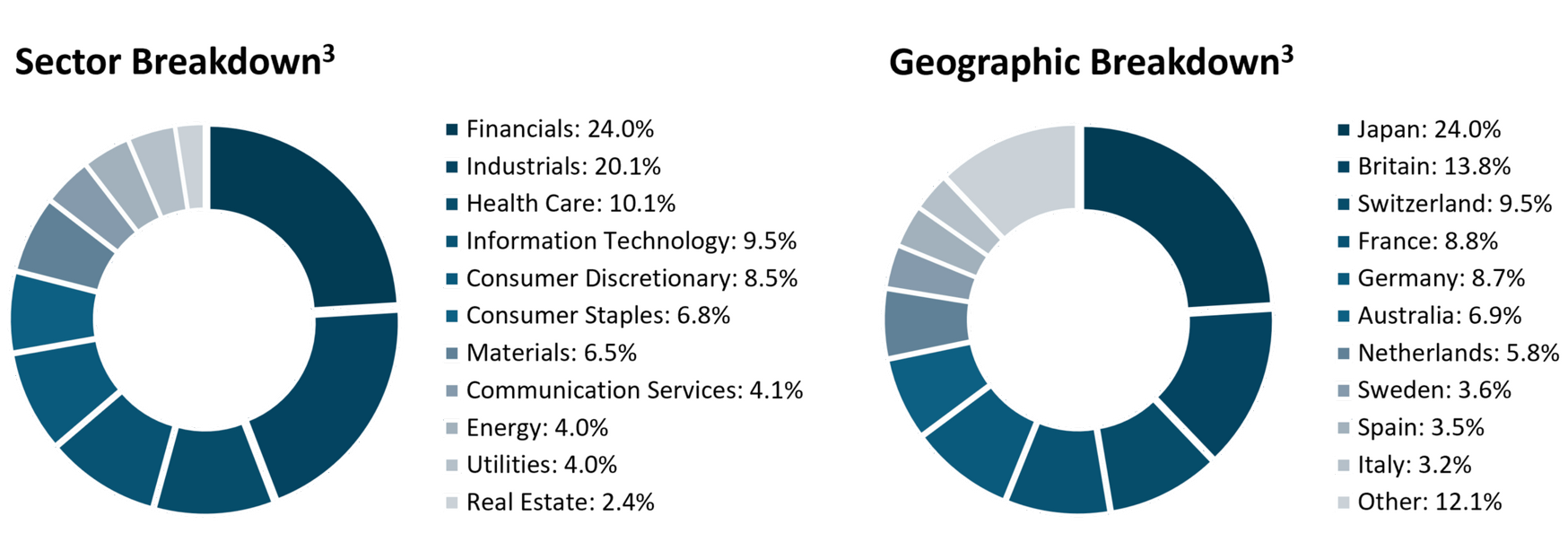
We can see that the index is dominated by Financials, Energy and Materials. It is not a well diversified index / stock market. That said, the index plays to Canada’s strengths by design. We have one of the strongest banking and insurance industries in the world, and we have the oil and gas and materials that North America and the world needs. Canadian banks have historically outperformed just about everything over the longer term (even including U.S. stocks, the S&P 500), but that doesn’t mean that you necessarily want to go all in on Canadian financials.

Another popular index for Canada is the TSX 60 ticker XIU-T. The index holds 60 of the largest companies in Canada. Here is the sector breakdown.

XIC is moving to a period of outperformance, says Morningstar due to greater exposure to materials, and less reliance on financials compared to XIU. We can say that XIC is more “diversified.” The materials index includes gold and other mining stocks that are on a tear.

Here’s the materials ETF vs XIC.

Gold and materials are very inflation-friendly. You can see the spike in the COVID period as well when we had a brief inflation scare.

iShares Core S&P/TSX Capped Composite Index ETF XIC

Here’s the overview from Morngingstar. Continue Reading…

Consider all your Retirement Investment Management Options for a Financially Sound Future

Here’s a look at some of your best retirement investment management options and choices. These include pensions, RRSPs, RRIFs and more.

TSInetwork.ca

Your retirement investment management plan should build in contingencies for long-term medical needs and supplemental health insurance. As well, you should factor in caring for loved ones who are unable to take care of themselves.

When you work out a plan for your retirement, make sure that you aren’t basing your future income on overly-optimistic calculations that will end up leaving you short. Retirement income can come from many different sources, such as personal savings, Canada Pension Plan, Old Age Security, company pensions, RRSPs, RRIFs, and other types of investment accounts.

Learn how your retirement investment management works in a Canada Pension Plan (CPP)

The Canada Pension Plan, or CPP, is the name for the Canadian national social insurance program. The program pays out based on contributions, and it provides income protection for individuals or their survivors in the instance of retirement, disability or death. Since 1999, the CPP has been legally permitted to invest in the stock market.

Nearly all individuals working in Canada contribute to the CPP, unless they live in Quebec, where the Quebec Pension Plan (QPP) exists and provides comparable benefits.

Applicants can apply to receive full CPP benefits at age 65. The CPP can be received as early as age 60 at a reduced rate. It can also be received as late as age 70, at an increased rate.

Here’s a look at some of the pensions or benefits provided by the Canada Pension Plan:

  • Retirement pension
  • Post-retirement pension
  • Death benefit
  • Child rearing provision
  • Credit splitting for divorced or separated couples
  • Survivor benefits
  • Pension sharing
  • Disability benefits

Use a Registered Retirement Savings Plan (RRSP) as a starting place when you look into retirement investment management

An RRSP is a great way for investors to cut their tax bills and make more money from their retirement investing.

RRSPs were introduced by the federal government in 1957 to encourage Canadians to save for retirement. Before RRSPs, only individuals who belonged to employer-sponsored registered pension plans could deduct pension contributions from their taxable income.

RRSPs are a form of tax-deferred savings plan. They are a little like other investment accounts, except for their tax treatment. RRSP contributions are tax deductible, and the investments grow tax-free.

You might think of investment gains in an RRSP as a double profit. Instead of paying up to, say, 50% of your profit to the government in taxes and keeping 50% to work for you, you keep 100% of your profit working for you, until you take it out.

Convert an RRSP to a RRIF to create one of the best investments for retirement

A Registered Retirement Income Fund (RRIF) is another good long-term investing strategy for retirement.

Converting your RRSP to a RRIF is clearly one of the best of three alternatives at age 71. That’s because RRIFs offer more flexibility and tax savings than annuities or a lump-sum withdrawal (which in most cases is a poor retirement investing option, since you’ll be taxed on the entire amount in that year as ordinary income). Continue Reading…

UMVP: Investing beyond Traditional Utilities

Image courtesy Hamilton ETFs

By Hamilton ETFs

(Sponsor Blog)

Utilities have long played an important role in investor portfolios, often valued for their stability and diversification benefits. As providers of essential services such as electricity, natural gas, and infrastructure, these businesses tend to exhibit steady demand across economic cycles. In terms of investing, how investors access the utilities sector can matter just as much as the characteristics of the sector itself.

Many traditional utilities ETFs track market-cap-weighted benchmarks designed to own the entire utilities universe. While this approach provides broad exposure, it can also introduce structural inefficiencies. Market-cap weighting can overweight the largest companies, resulting in portfolios where a small number of names dominate overall exposure (i.e. concentration risk). In addition, market-cap weighting continues to increase allocations to companies as their market values grow, reinforcing exposure to recent top performers rather than maintaining a more even distribution across the sector.

The HAMILTON CHAMPIONS™ Utilities Index ETF (UMVP) follows the Solactive Canadian Utility Services High Dividend Index GTR (“Utilities Index”), which was designed to take a more selective approach. Rather than owning the entire utilities universe, the Utilities Index expands beyond traditional utilities to include pipelines and telecommunications companies, focusing on the largest companies across each sub-sector. These sub-sectors share similar business characteristics, including infrastructure-heavy operations and relatively stable demand. By equally weighting its holdings and rebalancing semi-annually, UMVP aims to provide a more balanced and diversified way to access essential services at a low management fee of 0.19%.

Why Invest in Utilities

Investors often allocate to utilities to help diversify their equity portfolios and moderate overall volatility. Demand for essential services tends to be less sensitive to economic cycles, which can make utilities a stabilizing component within a broader portfolio. Over time, these characteristics have made utilities a popular core allocation for investors seeking reliability alongside growth.

UMVP’s Utilities Index builds on this role by broadening the opportunity set beyond traditional utilities. By including pipelines and telecommunications companies, the Utilities Index captures a wider range of essential service providers while maintaining a focus on businesses with similar operating profiles.

Outperformance through a more Balanced Portfolio

The Solactive Canadian Utility Services High Dividend Index GTR, which UMVP tracks, has historically delivered stronger total returns than the S&P/TSX Capped Utilities Index[1], as illustrated by the growth of $100,000 invested since 2011.

This performance reflects a more balanced approach to essential services investing. By expanding beyond traditional utilities and avoiding the overconcentration that can arise in market-cap-weighted indexes, the index UMVP tracks has benefited from exposure to proven companies across a broader opportunity set for low cost (0.19% management fee).

UMVP — Index Outperformance¹

The Limits of Traditional Utility Indices

Most traditional utility indices are built with two structural features that can limit their effectiveness:

First, market-cap weighting can lead to concentration risk, as the largest companies in the sector receive the largest weights. Over time, this can result in a portfolio where a small number of holdings account for a disproportionate share of total exposure.

Second, market-cap-weighted indexes tend to increase allocations to companies as they grow larger, reinforcing exposure to recent top performers. This structure can limit the opportunity to maintain balanced exposure across the sector, particularly when leadership shifts over time.

UMVP’s Utilities Index addresses both shortcomings with three key differences:

  • Expanding the universe beyond traditional utilities to include telecoms and pipelines
  • Selecting the largest companies in each sub-sector: utilities (6), telecoms (3), pipelines (3)
  • Equally weighting the 12 holdings to minimize overconcentration (rebalanced semi-annually)

Where UMVP Fits in a Portfolio

We believe UMVP can serve as a low-cost core utility holding within a diversified equity portfolio. By focusing on the largest companies across essential service providers, UMVP provides exposure to businesses that tend to exhibit more stable demand while participating in long-term equity growth, all at an annual management fee of 0.19%. Continue Reading…