Tag Archives: Financial Independence

Stocktrades.ca’s author interview on Findependence and Victory Lap Retirement

By Dylan Callahan, Stocktrades.ca

Special to the Financial Independence Hub

We’re constantly reaching out to financial authorities we feel would benefit our audience the most. From Mark Seed, to Xiaolei Liu, to Rob Carrick, we are always looking to compile information and pick the brains of experts in the industry. This is why we were ecstatic to hear that Jon Chevreau was willing to do a little interview with us about his most recent book. (Highlighted link is to original post at Stocktrades.ca)

A little bit about Jon before we start

snippetpicture-150x150Jon has long had our attention here at Stocktrades from his writing at Moneysense and the Financial Post. He is the owner of FinancialIndependenceHub, the author of Findependence Day and the co-author of Victory Lap Retirement, which is what this interview will be about. He was a columnist for the National Post from 1993 to 2012 and was Editor-in-Chief for Moneysense Magazine from 2012 to 2014. If we had to choose some financial authorities on the internet today that we’d follow, Jon would be near the top of the list.

We hope you enjoy this interview, and if you’re interested in purchasing Jon’s book, head on over Victorylapretirement.com to see what it’s all about or purchase it from Amazon here.

WHAT INSPIRED YOU TO WRITE THIS BOOK?

Jon: Co-author Mike Drak approached me with the idea of a book about Retirement/Victory Laps after he encountered my website, the Financial Independence Hub, and my financial novel, Findependence Day. We thought we could marry the two concepts since Findependence gets you to the point you can launch a proper Victory Lap.

COULD YOU BRIEFLY DESCRIBE THESE FOLLOWING TERMS IN YOUR OWN OPINION, OR AS THEY RELATE TO THE BOOK?

What is Findependence?

JonathanChevreauJon: Findependence is simply a contraction of the phrase Financial Independence. And so Findependence Day is the day you achieve financial independence, which we define as the moment when all sources of passive income (pensions, investments, royalties etc.) exceed your monthly expenses nut (rent/mortgage, food, clothing, utilities etc.)

Explain a Victory Lap Retirement?

Jon: Victory Lap Retirement can be described variously as semi-retirement, self-employment, an encore career or launching a creative career (writer, artist, musician) that lets you monetize what was previously a hobby. Normally, the Victory Lap is made possible by first achieving Financial Independence. It differs from traditional full-stop retirement in that you may still be working, albeit not for a single employer.

Rather you have multiple streams of income, some of which may be passive (pensions, investments) and some of which may be active (part-time work, contracts, an online business). This allows you to pursue the inner creative dreams you may have harbored when you were young, and which you may have put aside during the decades you worked in a traditional “Job” and raised a family. In your Victory Lap, you work because you want to, not because you have to (financially speaking).

Lastly what is an Encore Career?

Jon: An Encore Career or Legacy Career is a late-life reinvention of your career, as described by the website encore.org and the book Encore by Marc Freedman. Its subtitle says it all: Finding Work that Matters in the Second Half of Life.

snippetpicture-150x150IN YOUR OPINION, HOW IS A VICTORY LAP RETIREMENT MORE BENEFICIAL THAN THE TRADITIONAL RETIREMENT?

Jon: We think it’s crazy to go from the 100% work mode of traditional salaried employment to 100% non-stop leisure, which is the traditional “full-stop” retirement that often occurs at age 65. By the way, I turn 65 next April and don’t expect to slow down much if at all. I’m in the fourth year of my own Victory Lap and am as productive as ever, and probably in much better physical and mental health.

Continue Reading…

Two notable books to guide your ‘Retirement’ journey

“Books are the bees which carry the quickening pollen from one to another mind.” — James Russell Lowell, poet and author

This week I highlight one of my best recommendations for Retirement. Invest in self-education with some quality reading. The critical factor is how to select just a couple of books.

Investors have a thirst for knowledge about their precious retirement journey. They seek detailed information to assist in navigating the capital accumulation process to achieve retirement. Then comes the desire of making that capital outlast the spending phase.

Walk into any well-stocked bookstore and the retirement section will seem like a maze. There are plenty of titles competing to become permanent occupants of your precious bookshelf space.

My two book selections provide insight and understanding into the design and management of the retirement nest egg. The authors are well known. The books complement one another.

The emphasis is understanding long-term principles, policies and best practices that steer the family’s retirement goals from dreams to realities. Getting fully acquainted with these two books helps craft better decisions about retirement. Something for everyone’s retirement toolbox.

Photo: Kia Meiklejohn

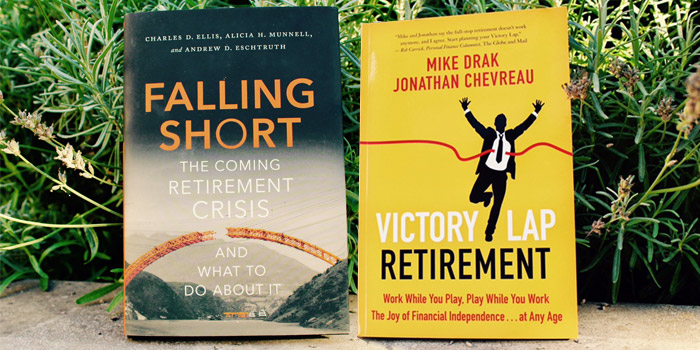
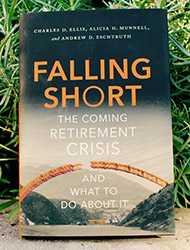
Falling Short: The Coming Retirement Crisis and What To Do About It, by Charles D. Ellis, Alicia H. Munnel, and Andrew D. Eschtruth

This century has clearly shown that we are living longer, health costs are rising and employer pensions are diminishing. That is the big picture applicable to retirees in the USA. However, similar arguments also exist for the Canadian retirement landscape.

The good news is that what is seemingly a dire retirement situation can be easily rectified by implementing a few coordinated steps. This book makes you appreciate the scope of that big picture. Working a little longer, saving a bit more, judicious use of government benefits and being smart about portfolio draws are some of the key answers that deliver.

The message for every retiree is that a successful retirement is about being empowered to look after the personal situation. At age 60, it is not unusual for retirement to last into the 90’s for at least one spouse.

Yes, long term retirement that spans decades is expensive. Sensible and methodical decision making is sound advice for all ages. It renders the scope of the big picture into realistic solutions.

Retired Money: Cashing RRSP to pay off debt is a poor strategy

Should you cash in your RRSP to pay off debt? While some prospective retirees may be tempted to do so, this is one of a score of damaging financial myths, according to insolvency trustee and author Doug Hoyes.

I mention this in my latest MoneySense Retired Money column, which has just been published. You can retrieve it by clicking on the highlighted headline here: The wrong way to pay off Debt.

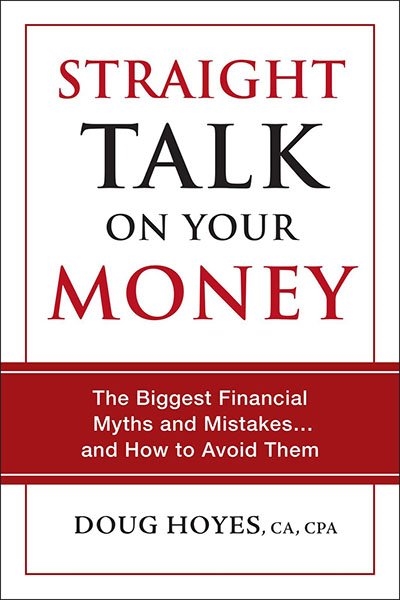
As I say in the article, Cashing in your RRSP to pay off debt is Myth #9 of 22 common financial misconceptions outlined in Hoyes’ new book, Straight Talk on Your Money (cover shown adjacent: we share a common publisher.)

Hoyes is particularly concerned about senior debt in Canada and how these myths can affect their retirement. Myth #10 often afflicts retired seniors: that Payday Loans are a Short-term Fix for a Temporary Problem.

Seniors racking up debt faster than other age groups

Earlier this week in the Financial Post, columnist Garry Marr reported that Seniors in Canada are racking up debt faster than the rest of the population. Over the past year, senior debt grew by 4.3%, according to a survey published Tuesday by Atlanta-based Equifax Inc. Continue Reading…

5 planning options to help you reach your Retirement goals

There are lots of unknowns when it comes to retirement planning. Most of us focus on how much we need to save for retirement without giving much thought as to how much we’re going to spend in retirement.

A $1 million dollar nest egg can provide you with $30,000 to $40,000 to spend each year with reasonable assurance that you won’t run out of money. But if your ideal retirement lifestyle costs $60,000 per year, your million-dollar portfolio won’t be enough to last a lifetime.

Once you determine your magic spending number, the rest of the variables start falling into place. The earlier you can identify the amount of income you need to live the retirement you want, the easier it is to make your retirement plan and adjust course, if necessary.

Let’s say you’ve analyzed your retirement income needs and find, based on your current financial situation, that you won’t be able to fully fund your desired lifestyle. What to do?

Here are five retirement planning options to help you adjust course and reach your retirement goals:

1.)  Reduce your lifestyle

A $60,000/year retirement might be out of reach based on your current situation, but maybe reducing your goal to $45,000/year can still provide a great lifestyle in retirement.

This lifestyle adjustment could mean travelling less often, making sure you retire debt free, downsizing your home, replacing your vehicle less often, reducing your hobbies, or a combination of all the above.

Don’t forget to include government benefits such as CPP, OAS, and/or GIS when projecting your retirement income. It’s worth sitting down with a retirement planner to figure out the best way to draw down your assets and when it makes sense to apply for CPP and OAS.

2.)  Work longer

It can be difficult to picture yourself working longer once you’ve got retirement on the brain, but a few extra years on the job can drastically alter your retirement projection.

The longer you work, the more you can save (or add to your pensionable service if you’re so lucky to have a workplace pension). But also the more years you’re working and earning a paycheque the fewer years you have to withdraw from your nest egg.

Are you healthy and willing to grind it out at work for a few more years? If so, you might be able to reach that $60,000/year retirement goal after all.

3.)  Earn more return from your investments

This is a tricky one because you might take it to mean investing in riskier assets (i.e. an all-equity portfolio), when in fact you can earn higher returns by reducing the overall cost of your portfolio. That’s the first place to start.

Imagine your $300,000 retirement portfolio is invested in a typical set of mutual funds that together comes with a management expense ratio (MER) of 2 per cent. The cost is $6,000/year but you don’t see the charge directly; instead, it comes off your returns.

Switching to index funds and going the do-it-yourself route might reduce your costs to 0.5 per cent, or $1,500 per year. That’s an extra $4,500/year staying in your retirement account instead of going into the hands of your advisor.

There might also be a case for increasing the risk in your portfolio. Say, for example, you tend to hold a lot of cash in your portfolio: you’re not fully invested. Or you hold a bunch of GICs and other fixed income products.

Dialling up your investment risk to include a portion of equities could help you achieve an extra 2-3 per cent per year. The power of compounding can make a huge difference to your retirement portfolio and holding even a small portion of equities in retirement can help your nest egg last longer.

4.) Save more

This one is so obvious it should be first on the list. If you’re not able to fully fund your desired retirement lifestyle based on your current projections then you need to save more.

Hopefully your final working years can give you the opportunity to boost your retirement savings. Big expenses, such as paying down the mortgage and feeding hungry teenagers, are behind you.

But an empty nest and paid-off home might tempt you to increase your lifestyle now rather than doubling-down on your retirement savings to boost your lifestyle later. That’s fine; see options 1-3.

That said, there’s no better time to enhance your nest egg by maxing out your RRSP contributions, including unused contribution room, and doing the same with your TFSA, in the years leading up to your retirement date.

Be mindful here, though, of strategies to reduce your taxes in retirement. It makes little sense to go wild making RRSP contributions in your final working years without considering how withdrawals will impact taxes or OAS clawbacks in retirement.

5.)Supplement your retirement income

Much like working longer can increase your nest egg, supplementing your retirement income with a part-time job derived from a passion or hobby can prolong the life of your portfolio.

Continue Reading…

How to plan for a Victory Lap Retirement: Advice from the authors

By Richard Eisenberg, Work Editor, Next Avenue.org

Special to the Financial Independence Hub

Mike Drak and Jonathan Chevreau, authors of the new book, Victory Lap Retirement, are on a crusade to change the way society thinks about retirement. Their book is actually, as Drak says, “a retirement book about not retiring.”

A Victory Lap Retirement — Drak, 62, coined the term — means spending years combining work and leisure between the time you quit a full-time job and stop work entirely. In the book, the authors say a Victory Lap Retirement lets people change from a “surviving mentality” to a “thriving mentality.” The Toronto-based duo would know: They’re both taking Victory Laps right now.

Previously, Drak spent nearly 40 years working in commercial banking. He quit in 2014 to protect his health and personal well-being. Now, when he works, he  is a retirement coach, public speaker and writer (next up: a retirement transition guide). Chevreau, 64, is a veteran financial columnist, blogger and author of the book Findependence Day; I interviewed him for Next Avenue in 2013 about “findependence” — his term for having enough money so you can work because you want to, not because you have to. He still writes about personal finances, but on his schedule.

I recently spoke with Drak and Chevreau about how and why to have a Victory Lap Retirement. Highlights: Continue Reading…

Powered by the Financial Independence Hub.
© 2013-2026 All Rights Reserved.
Financial Independence Hub Logo

Sign up for our Daily Digest E-Mail!

Get daily updates from the FindependenceHub.com straight to your inbox.