Tag Archives: Financial Independence

Millennials say financial independence defines Adulthood

 When asked to define what constitutes adulthood, 40% of of millennials (aged 18 to 26) cited Financial independence, according to a Bank of America report issued on October 6. it was reported by Reuters under the headline “For millennials, adulthood now defined by financial freedom.

As Bank of America executive Michele Barlow puts it, “It’s not so much that young adults are having trouble with adulting: they’ve simply redefined it.”

With so many millennials still living at home (often because they can’t afford to leave), it seems they view adulthood as being able to land a job and not depend on their parents for financial help. About 14% surveyed named moving out on their own as their top priority, while getting married, starting a family and getting an education were all cited by 7%.

This study is music to our ears here at the Financial Independence Hub. Of course, our definition of Financial Independence (or the contraction, “Findependence”) is a bit stricter than merely landing a job and no longer being financially dependent on parents. We tackled this early on: see the highlighted post, Merely leaving the nest does NOT constitute true Financial Independence.

Still, getting rid of debts, landing a job and no longer being dependent on the Bank of Mum and Dad is a huge step TOWARDS Financial Independence and ultimately what we used to call Retirement. While not quite synonymous with the outdated term Retirement, we view Findependence as having sufficient financial resources that you do not have to depend on employment income to make your daily and monthly expenses.

How do you know when you’re truly findependent? Continue Reading…

Work while you play, play while you work

img_83811
“Playing” at Dublin’s oldest pub (photo J. Chevreau)

As I write an early draft of this blog, I am in Dublin, Ireland, at the midpoint of the second week of a two-week holiday. Readers may recognize this blog’s headline as the subtitle of the new book I’ve recently published, Victory Lap Retirement. It was written with ex-banker Mike Drak, whose blogs have been regularly posted or republished here at the Hub.

I believe it was our editor, Karen Milner, who came up with this inspiring subtitle but whoever first articulated it, we all agreed on it once it came up. I often think of it when I’m working and really playing, or vice versa.

img_8422
“Working” CIFFA executives at FIATA 2016 World Congress in Dublin this week.

For example, right now I’m working on writing this blog while officially “Playing” at being on holiday. The ostensible reason for the trip was to tack on a week’s vacation to a business trip my wife took to attend the FIATA 2016 World Congress in Dublin. That’s Ruth  on the extreme right of the photo, along with colleagues and a spouse at a reception at Dublin’s Trinity College.

Such “Work” came at the end of a solid week of being a tourist elsewhere in Ireland, with the couple with whom we’ve been travelling.

I suggested to them in jest that the job of being a “tourist” would be a tough one if it meant 49 weeks a year, eight hours a day of “touristing,” however much it might seem to be a dream job. Come the end of any week of touring historical sites, art galleries and such – much of it on one’s feet, either walking or standing – you’d greet the arrival of the weekend and the cessation of tourism for a few days with some relief! (If you happen to be a Facebook friend, you can see about 40 photos of the trip under Ireland, here.)

It’s all relative really: if you were a writer for a Tourist guide book like Lonely Planet, you’d no doubt regard tourism as “work.”

Playing while you Work

Continue Reading…

Do you live next door to a Millionaire? Or is it you?

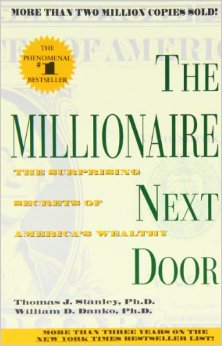
51es1dfibl-_sy344_bo1204203200_Two decades ago, Thomas Stanley and William Danko set out to interview wealthy people for their best-selling book The Millionaire Next Door. They started out in the affluent neighbourhoods on streets dotted with extravagant homes with luxury vehicles parked out front and in-ground swimming pools in the backyards.

They were shocked to find out that the people living in these homes were not wealthy at all. Many of these upscale homes had huge mortgages. The luxury cars were leased and, while the occupants had high salaries, they had very little net worth. They only seemed wealthy.

Instead, they found millionaires in modest homes in reasonably priced neighbourhoods, working and living next door to people who have a fraction of their wealth. They were living well below their means and not calling attention to themselves. They didn’t have the big-spending lifestyle most of us associate with rich people.

To be clear, for this purpose a wealthy, or high net worth, individual is described as someone who has at least $1 million in investable assets that is not inherited. These assets do not include their home or cottage.

Also not included are the ultra-high-net-worth, super wealthy individuals with a bankroll of more than $100 million who actually represent only a small minority of Canadians.

The road to riches

What can the average Canadian learn from the habits of the wealthy? Danko and Stanley found these factors common to wealthy people:

1.) They live well below their means

When I first read this book years ago I thought – what a bunch of cheapskates with their Timex watches, $50 suits, and 10-year-old Ford trucks! If I had that kind of money, I’d at least upgrade a little. I’ve known a few people who had a large amount of assets and spent hardly anything, ultimately leaving their wealth to relatives, and often distant ones at that.

I understand now that the millionaires mentioned do tend to be frugal, but they enjoy luxuries that are meaningful to them, and only once they are well on the road to security and financial freedom.

2.) They chose the right occupation

Many are small business owners or entrepreneurs, but you don’t have to own a business to get into this circle. Often they are hard-working, well-educated, middle-to-high income earners.

I’m not suggesting you choose a career primarily for the high salary. But, it’s obvious that if a person is educated and trained in some sort of profession, they will do much better than say, a cashier or shipper-receiver.

3.) They have a good marriage

Dual incomes enable couples to get ahead financially much more quickly. However, even more important are spouses who have similar values and goals and are willing to resolve any differences and work together in building their wealth.

There is no quicker way to lose half the assets of a household than to go through a divorce.

4.) They are skillful in targeting opportunities

People shouldn’t worry about the doom and gloom reporting on the news and things they can’t control. Instead, have a long-term view of investing and don’t let emotions sway your decisions. Have cash available to buy when markets are down and to take advantage of any bargain opportunities.

Start saving and investing in your early years to take advantage of compounding and reinvested dividends.

Pay less for purchases by shopping for bargains and learn to negotiate. Avoid high-interest credit-card debt. Use smart tax reduction strategies.

Allocate your time, energy, and money efficiently, in ways conducive to building your wealth.

5.) Their adult children are economically self-sufficient

Children are taught money management at an early age and encouraged to enrol in secondary education. As adults, they don’t ask their parents for money or bail-outs or help with the bills.

Final thoughts

Danko claims that it’s really about buckling down and living on less:

“How in the world can you be an investor and let compounding work for you if you are not a saver? And how can you be a saver if you are in debt? Many people who are strapped with debt are looking for a magic bullet, but continue the free-spending ways they have become accustomed to. Live on 80% of what you make, and save and invest 20%. Let the time value of money work for you.” 

Calculate how much money you will earn over your working life. Most people will earn well over a million dollars in their lifetime, but very few will become millionaires.

Accumulating wealth takes discipline and hard work.

We all want a sense of long-term security and peace of mind as well as the comfortable lifestyle that wealth provides.

Saving diligently, being frugal, setting aside a portion of your income for the future and investing wisely are the strategies to becoming the millionaire next door.

Do you think you live next door to a millionaire? Or, is it you?

MarieEngenMarie Engen is the “Boomer” half of Boomer & Echo. In addition to being co-author of the website, Marie is a fee-only financial planner based in Kelowna, B.C. This article originally ran at the Boomer & Echo site on September 20, 2016 and is republished here with permission.

Time: your most valuable asset

Everyone is born with an expiry date; the problem is that date is kept hidden from us, and when it happens, it just happens. But everyone also has a best-before date, a date up to which you are still physically able to do most things you enjoy: studies have shown this period can be influenced to a large extent by a person’s lifestyle.

When I think about the word “retirement,” and my definition for retirement is admittedly very narrow, I tend to think about that period that lies after a person’s best-before date up to their expiry date. This is the period where a person is no longer capable of being independent, and are dependent on others for care and support for their remaining years.

My main focus in my own Victory Lap is to make good investments of my time to create an optimal lifestyle with the goal of pushing back as far as possible my own best before date.

Each day has only 24 Hours – Use them well!

It’s important to understand how limited our hours are on this planet and to get a good feel for the problem watch the You Tube video “You have 28,835 days. Here’s how you will spend them.”

The video was a real eye opener for me. After watching it, I began to really appreciate the value of my remaining time. I promised myself  I would take the appropriate corrective actions, but habit change is never easy and it is a work in progress for me. Please be assured that I will talk more on this important subject in future posts.

It takes ten years to become an overnight success

One day at a yard sale, I bought some old poker chips with the intent of using them to help track the time invested in pursuit of some of my goals. I came up with this idea after reading the book “Outliers” by Malcolm Gladwell and his chapter on the 10,000 hour rule, which is the hours of practice required to achieve mastery in anything.

A key component of my Victory Lap is the job I created for myself (my reason for getting out of bed in the morning) and creating the VLR community. To succeed, I need to improve my writing, blogging and public speaking skills. I also need to get healthy again so I will have the energy to get it all done.  I have committed to investing 10,000 hours on this project, which equates to 1,000 hours per year over a 10-year period.

Those poker chips I bought? I counted out 520 chips, which represent the number of weeks covering a 10-year period and keep them in a glass jar in my home office. Each Sunday night after reviewing what I accomplished with my time that week I throw that week’s chip away and replace it with another one from the jar.

Watching that jar of chips shrink over time makes me focus on the important things in my life. It creates awareness especially as I carry the current week’s chip around in my pocket. When I hold it, it reminds me to focus on doing what I need to do in order to make things happen.  Sometimes I might write something on the chip to serve as a theme for the week. It helps me to focus on what’s important and to forget about the rest.

The most important decision that you make each day is how you are going to invest your time. If you can’t see a reasonable return from your time investment don’t make the investment period.

Drak 2014Mike Drak is an author, blogger and speaker based in Toronto. He can be reached at michael.drak@yahoo.ca. Victory Lap Retirement, co-authored with Hub CFO Jonathan Chevreau, is now available for is now available for orders online. It’s also available now as a Kindle e-book, and on KoboThe paperback edition will be available in bookstores in the second week of October. This blog is reprinted from Mike’s site with permission.  

Millennials may need to save 22% of income just to retire by 70

chart-1As my Financial Post blog today recaps, a new study being released today by the San Francisco-based personal finance site NerdWallet warns that just to retire by age 70, today’s millennials would have to save a whopping 22% of yearly income. Click on the highlighted text for the FP piece: Millennials may have less time on their side, U.S. retirement study shows.

The adjacent chart shows the math and how much millennials would need to save every year, depending on whether the stock market generates its historic 7% annual rate or the more pessimistic projections of 5%.

“Era of supernormal returns is over”

Continue Reading…

Powered by the Financial Independence Hub.
© 2013-2026 All Rights Reserved.
Financial Independence Hub Logo

Sign up for our Daily Digest E-Mail!

Get daily updates from the FindependenceHub.com straight to your inbox.