Tag Archives: investing

Three key investment strategies hidden in plain sight; #1 — Being There

paul_2-1500x994
Paul Philip CLI, CFP

By Paul Philip, CLU, CFP Financial Wealth Builders Securities

Special to the Financial Independence Hub

If you’ve ever dabbled in graphic design, you’re familiar with the concept of white space. When viewing an illustration, we typically pay the most attention to the visible ink on the page, such as a paragraph of text, a bar chart or an entertaining illustration. White space is the essential empty areas in between that are hidden in plain sight. We barely notice them … until they’re not there:

Pretty cheerful girl pointing white space over hands
Where’s the white space? (Deposit Photos)

When making investment decisions, most people likewise assume that the most eye-catching ink matters the most: an alarming economic forecast, an exciting Initial Public Offering, hot trading tips. But there’s a catch. This evident assumption does not hold up under evidence-based scrutiny. In reality, you have little or no control over how the most obvious news impacts your investments. The most exciting action has already been priced into any trade you might make well before you decide to make it.

Stop fixating on headlines

Instead of fixating on the headline news, consider that liberating financial white space. There, hidden in plain sight, you’ll find a number of powerful investment strategies that are freely available and far more within our control. In this series, we’ll introduce three of our favorite “plain sight” investment strategies:

  1. Being there
  2. Managing for market risks
  3. Controlling costs

Continue Reading…

How pairing fee-only planners and robo-advisers can save you money

Woman meeting financial adviser in officeCute Robot

By Robb Engen, Boomer & Echo

Special to the Financial Independence Hub

The financial services industry would have you believe that individual investors don’t want to pay upfront for investment advice – in fact, the industry claims that investors prefer to pay for financial advice through fees that are part of their mutual funds.

But we all know mutual funds in Canada cost too much and the relationship between investors and financial advisors is mostly transactional in nature. Embedded commissions and trailer fees might make sense for investors who are just starting out, but over the long term this conflict of interest will be expensive and lead to poorer outcomes for investors.

An unconventional pairing

With the relatively new arrival of fee-only financial planners – advisors who don’t sell products but offer unbiased and objective financial advice for a set fee – and the emergence of robo-advisors – online investment management services – there is an opportunity for Canadians to access a better form of financial advice that costs less than the traditional bank advisor-mutual fund model.

That’s right, pairing a fee-only financial advisor with a robo-advisor (or DIY, if that’s your thing) can actually save you money and lead to better investor outcomes.

Here’s an example Continue Reading…

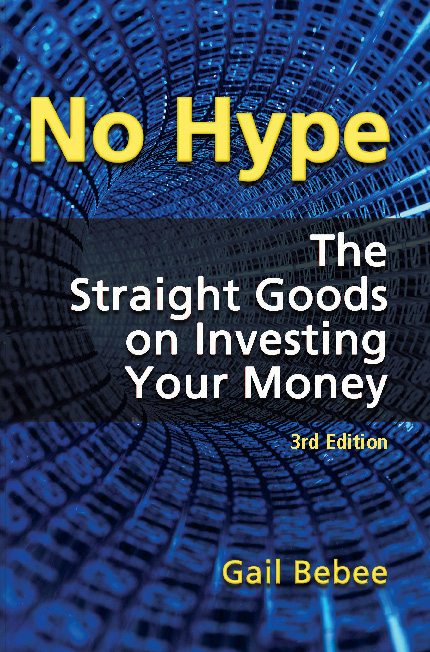
Gail Bebee releases third edition of No Hype book

NoHypeCoverToday’s Hub review is a bit unusual in that we’ve allowed an author to review her own book. I originally reviewed No Hype: The Straight Goods on Investing Your Money when it came out almost a decade ago and found it a useful addition to the genre, seeing as so many financial books these days are written by financial professionals.

It was refreshing to see a book written by a pure financial consumer like Gail, who like the rest of us has to sort the financial wheat from the chaff and has no real axe to grind. As she says on her web site, she’s an independent voice.

Hopefully we’ll review it in the more traditional manner over the coming weeks or months but in the meantime, it’s nice to know the book is still out there and has been revised.

Incidentally, and as noted in Saturday’s weekly wrap, Gail and I are among six speakers at The Financial Show in Mississauga later this month. Joining us will be Gordon Pape,  Pat Bolland, Jim Ruta and Scot Blythe. — Jonathan Chevreau

By Gail Bebee,

Special to the Financial Independence Hub

Gail_Bebee_Soft_editing_copy
Gail Bebee

When I set out in 2006 to write the original No Hype – The Straight Goods on Investing Your Money, my goal was to create a readable book that set down all the investing basics for Canadians, without a financial industry bias. It was born from my frustration at not finding such a book when I decided to take control of investing my money.

Thousands of books and two sold-out editions later, the students taking my Investment Planning night school course at Toronto District School Board still need a good reference, and retail investors are still looking for an objective, understandable book on all the investing basics written expressly for Canadians. Continue Reading…

ETFs: the next 25 years

vcm_s_kf_m160_160x141
Mark Yamada

By Mark Yamada, PUR Investing Inc.

Special to the Financial Independence Hub

From zero assets in 1989, to $79 billion in 2000, to $2.7 trillion into 2015, it has been quite a ride for global exchange-traded funds (ETFs). Few financial sectors have approached the over 25% compounded annual growth that ETFs have enjoyed. Yet many industry observers are disappointed.

ETFs’ value proposition is well known: diversification, professional management, shared expenses, all the benefits of mutual funds at a fraction of the price plus better transparency and continuous intraday trading. Yet ETFs represent only 12% of US and 6% of Canadian mutual fund assets (10% if US-traded ETFs owned by Canadians are included). If ETFs are so much better than mutual funds, why haven’t they replaced them by now?

Adopting new ideas Continue Reading…

A saving & spending plan you can live with

robb-engen
Robb Engen, Boomer & Echo

In many ways, Elizabeth Warren’s 2005 bestseller All Your Worth was ahead of its time. Warren, a relentless consumer advocate, eschews mindless frugality and focuses instead on finding the right balance so you always have enough to pay your bills, have some fun, and save for the future.

The author suggests a simple formula for spending your after-tax dollars on needs, wants, and savings:

  • Allocate 50 per cent to needs: These must-haves include housing, transportation, groceries, insurance, and clothes that you really need.
  • Spend 30 per cent on wants: Wants include cable television, clothing beyond the basics, restaurant meals, concert tickets, hobbies, etc.
  • Set aside 20 per cent for savings: This includes both short- and-long term savings, as well as debt repayment.

Warren encourages saving AND having fun rather than scrimping and pinching pennies on the things that make you happy. That means saving money on big-ticket items like housing and transportation – effectively reducing the amount you spend on needs to free up money to save for the future and spend on wants.

“If you can’t afford to have fun, you can’t afford your life.” 

When I applied this formula to my own spending I found the following breakdown:

Needs took up 53.5 per cent of our monthly budget, including the mortgage payment, property taxes, car payment, insurance (life, home, car), groceries, gas, utilities, cell phone, hair cuts, prescriptions, and clothing.

Related: What will it take for you to save more this year?

Wants made up just 18 per cent of our monthly spending, including cable and internet, restaurants, alcohol, children’s activities, hired cleaners (bi-weekly), credit card annual fees, subscriptions and memberships, gifts, summer vacation, and discretionary spending.

Finally, savings accounted for 28.5 per cent of our monthly budget. This amount includes repayment to our line of credit, contributions to my employer pension, RESP deposits, plus RRSP contributions.

Our car will be paid off late next year, which will free up $10,000 per year and reduce our “needs” allocation from 53.5 per cent down to about 44 per cent. Ideally, I’d prefer to shuffle that money over to savings and build up our TFSAs;  however, I’ll keep the idea of balance in mind and consider adding a few thousand dollars into our “wants” allocation.

Final thoughts

A balanced financial plan will ultimately lead to a happier and more fulfilling life.

Too many of us are living close to the edge financially because they’ve over-extended themselves on house and car payments and can’t afford to live.

Continue Reading…