Tag Archives: investing

The six phases of financial independence [Revisited]


By Mark Seed, myownadvisor

Special to the Financial Independence Hub

I’ve recently updated this post to include more links to related content. I hope you enjoy it. 

The term “financial independence” has many meanings to many people.

To some, it means not working at all.

To others, financial independence covers all needs and many wants.

To others still, it means the ability to work on your own terms.

Where do I stand on this subject?

This post will tell you in my six phases to financial independence.

Retirement should not be the goal, financial independence should be

Is retirement your goal?

To stop working altogether?

While I think that’s fine I feel the traditional model of retirement is outdated and quite frankly, not very useful.

As humans, even our lizard brains are smart enough to know we need a sense of purpose to feel fulfilled.  Working for decades, saving money for decades, only to come to an abrupt end of any working career might work for some people but it’s not something I aspire to do.

With people living longer, and more diverse needs of our society expanding, the opportunities to contribute and give back are growing as well. To that end, I never really aspire to fully “retire” – cease to work.

Benefits of financial independence (FI)

In the coming years, I hope to realize my desired level of financial independence.

We believe the realization of FI will bring about some key benefits:

  1. The opportunity to regain more control of our most valuable commodity: time.
  2. Enhanced opportunities to learn and grow.
  3. Spend extra money on things that add value to your life, like experiences or entrepreneurship.

Whether it’s establishing a three-day work week, spending more time as a painter, snowboarder, or photographer, or whatever you desire – financial independence delivers a dose of freedom that’s hard to come by otherwise.

More succinctly: financial independence funds time for passions.

FI concepts explained elsewhere

There are many takes on what FI means to others.

There is no right or wrong folks – only models and various assumptions at play.

For kicks, here are some select examples I found from authors and bloggers I follow.

  • JL Collins, author of The Simple Path to Wealth, popularized the concept of “F-you money”. This is not necessarily financially independent large sums of money but rather, enough money to buy a modest level of time and freedom for something else. I suspect that money threshold varies for everyone.
  • Various bloggers subscribe to a “4% rule”* whereby you might be able to live off your investments for ~ 30 years, increasing your portfolio withdraws with the rate of inflation.

Recall the rule:

*Based on research conducted by certified financial planner William Bengen who looked at various stock market returns and investment scenarios over many decades. The “rule” states that if you begin by withdrawing 4% of your nest egg’s value during your first year of retirement, assuming a 50/50 equity/bond asset mix, and then adjust subsequent withdrawals for inflation, you’ll avoid running out of money for 30 years. Bengen’s math noted you can always withdraw more than 4% of your portfolio in your retirement years however doing so dramatically increases your chances of exhausting your capital sooner than later.

In some ways, the 4% rule remains a decent rule of thumb.

Are there levels of FI?

For some bloggers, the answer is “yes”:

  • Half FI – saved up 50% of your end goal (e.g., $500,000 of $1M).
  • Lean FI – saved up >50% of your end goal; income that pays for life’s essentials like food, shelter and clothing (but nothing else is covered).
  • Flex FI – saved up closer to 80% of your end goal (e.g., $800,000 of $1M). This provides financial flexibility to cover most retirement spending including some discretionary expenses.
  • Financial Independence (FI) – saved up 100% of your end goal, you have ~ 25 times your annual expenses saved up whereby you could withdraw 4% (or more in good markets) for 30+ years (i.e., the 4% rule).
  • Fat FI – saved up at or > 120% of your end goal (in this case $1.2M for this example), such that your annual withdrawal rate could be closer to 3% (vs. 4%) therefore making your retirement spending plan almost bulletproof.

There is this concept about “Slow FI” that I like from The Fioneers. The concept of “Slow FI” arose because, using the Fioneers’ wording while “there were many positive things that could come with a decision to pursue FIRE, but I still felt that some aspects of it were at odds with my desire to live my best life now (YOLO).

They went on to state, because “our physical health is not guaranteed, and we could irreparably damage our mental health if we don’t attend to it.

Well said.

My six phases of financial independence

With a similar line of thinking related to Slow FI, since we all have only one life to live, we should try and embrace happiness in everything we do today and not wait until “retirement” to find it.

After reviewing these ideas above, among others, I thought it would be good to share what I believe are the six key phases of any FI journey – including my own.

Phase 1 – FI awakening. This is where there is an awareness or at least an initial desire to achieve FI even if you don’t know exactly how or when you might get there.

FI awakening might consider self-reflection questions or thoughts like the following:

  • I would love to retire early or retire eventually…
  • I can never seem to get off this credit card treadmill…
  • I wish I had some extra money to travel…
  • Wouldn’t it be nice to buy X guilt-free?

(I had my awakening just before I decided to become My Own Advisor, triggered by the financial crisis of 2008-2009.)

Phase 2 – FI understanding. This is the phase where people are getting themselves organized; they start to diligently educate themselves on what their personal FI journey might be.

In this phase, they might set goals or get a better handle on what goes into their financial plan. Even if your plan is not perfect, it’s a start.

They might start asking some deeper questions like:

  • Why is money important to me?
  • What is my money for?
  • How do I know I’m doing it right?

I would say it took me until my mid-30s to get my financial life in order through more financial education and improved financial literacy. It was a process that took a couple of years although I’m always continuously learning and improving. I don’t pretend to know it all.) Continue Reading…

Making investing better for every type of trader

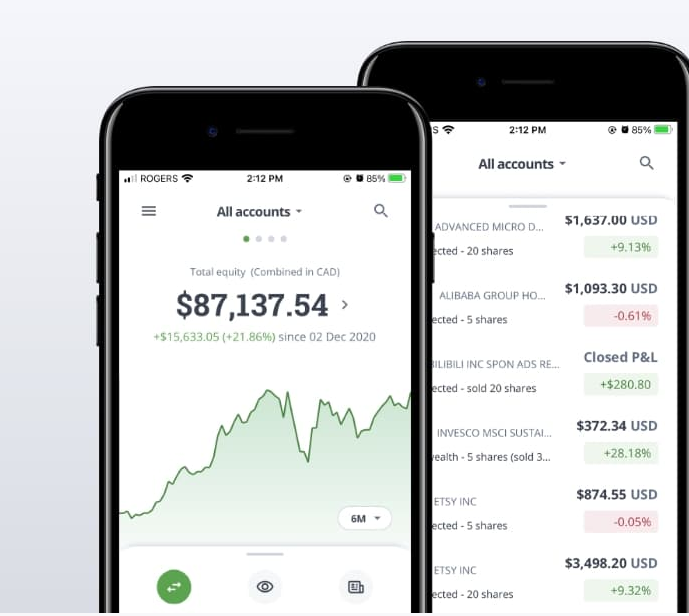
New QuestMobile app from Questrade

By Scarlett Swain, Director, Investment Products at Questrade

Special to the Financial Independence Hub

It’s no secret that over the past few years more and more people have started trading and investing. Maybe it’s more time on their hands, maybe they’re becoming more focused on their future and want their money to work harder for them. Regardless of the reason, at Questrade we’ve seen a real increase in the influx of new customers and have heard loud and clear from them that they need trading to be less complex. This is their money, their future, and they don’t want to make mistakes while they learn or want a busy platform full of things they don’t use.

On the other hand, we’ve also heard very experienced and active traders tell us, they want more. More order types, more tools, greater speed, and they want it all in the mobile app. So, we dove deep into customer feedback and conducted a ton of research, through all this emerged themes which created the crystal clear path we’re on today: we need a platform and mobile experience for customers that only want to do basic investing AND we need an even more sophisticated mobile experience for our advanced and option trading customers. One tool could not do it all, so we got to work on building three.

Two new platforms launched

Two of our three new platforms launched on September 27: the new Questrade Trading, a web-based platform specifically designed for those who just opened their first self-directed account and also for people who want to stick to the basics of investing, and its mobile companion, QuestMobile. Screen by screen, we worked to implement the features that gave investors the information they needed to make good decisions. Continue Reading…

Should you own a lot or a little in Canadian stocks?

By Steve Lowrie, CFA

Special to the Financial Independence Hub

It’s not easy being a Canadian investor, is it?  Given recent elections, we’re unlikely to see a pro-business surge anytime soon … to say the least. (It’s not investable info, but did you notice I happened to accurately forecast this?)

Plus, we’ve had to watch other countries’ stock markets beat the pants off our own during the past decade.  U.S. glamour or FAANG stocks (Facebook, Amazon, Apple, Netflix and Google) have been living especially fat and larger than life lately.

It’s no wonder I’ve been fielding questions about how to best allocate among the global equity markets these days.  How much is too much in Canada? Should we just dump everything into the U.S. market?  Is diversification dead?

My short answers are:  It depends. No. And, I wouldn’t bet on it. This is an admittedly incomplete response, so let’s consider four points and counterpoints to fill in the blanks.

1.) Canada’s market cap is tiny, and concentrated

While we’re rich in land mass, Canada represents just 3% of the world’s stock market capitalization. Plus, that 3% isn’t very well-diversified, with relatively heavy exposures to banking and natural resources.

2.) Canadians and everyone else have a home bias

Home bias means we prefer familiar objects close to home.  If (like me) you’re rooting for your kid’s hockey team, cheer on. But in the markets, this tempts most investors – and many financial professionals – to pile too heavily into their own countries’ stocks.

For example, despite recent underperformance, the typical Canadian still allocates 60% of their investments to Canadian stocks.  The Behavioral Investor author Daniel Crosby reports that U.S. investors typically allocate 90% of their holdings to the U.S. market; U.K. investors allocate about 80% of their holdings to the U.K.  No matter where you roam, home bias is right at home.

3.) Markets are unpredictable

Before you ship all your investments across the border or overseas, remember:  Markets can turn on you, abruptly and without warning.   While it might seem like a distant memory, it should be noted, from 1999–2009, Canadian stocks (S&P/TSX composite) returned 7.7% per year, whereas U.S. stocks (S&P 500 in Cdn$) seemed cursed in the new millennium, delivering  –2.5% per year … yes that is a negative return for 10 years! Continue Reading…

Meeting a Market Wizard

Noah Solomon and Larry Hite

By Noah Solomon

Special to the Financial Independence Hub

Last month, I had the privilege of meeting legendary investor Larry Hite.

Larry was born into a lower middle-class family, had a major learning disability, did poorly in school, and was completely blind in one eye and half blind in the other. In his own words, “I was not handsome. I was not athletic. Whatever I did, I sucked at it badly.”

In 1981, after dabbling as a music promoter, actor, and screenwriter, Hite founded Mint Investments. Mint was a true pioneer, eschewing human judgment and instead basing its investment decisions on a purely systematic, rules-based approach rooted in statistical analysis.

By 1988, Mint registered average annual compounded returns of over 30%. In its best year, Mint registered a gain of 60% (1987, the year of the stock market crash), and in its worst year, it produced a gain of 13%. By 1990, Mint was the biggest hedge fund in the world, with a record-breaking $1 billion under management.

When it awarded Larry the Lifetime Achievement Award, Hedge Fund Magazine wrote:

Larry Hite has dedicated the last 30 years of his life to the pursuit of robust statistical programs and systems capable of generating consistent, attractive risk/reward relationships across a broad spectrum of markets and environments and has inspired a generation of commodity trading advisers and systematic hedge fund managers.”

Although Hite began his investing career in the early 1980s, his philosophy of markets and approach to investing are remarkably similar to our own, which are summarized below.

Failure: A Foundation for Success

Hite maintains that his early failures were instrumental in his eventual success. He believes that accepting that failure is sometimes inevitable led him to develop an investment strategy that would limit losses.

In his book, The Rule, he wrote:

“I believe the success I’ve had arrived because I always expected to fail big. Solution? I engineered my actions so that a failure could not kill me. I won because I expected to lose. Failure became my advantage. Once you understand your potential for failure – that is, there are times you can’t win – you know when to fold your cards and move on to the next. You will do this more quickly than others who stay in the game too long, hanging on and hoping that their losing bet will turn around.”

It’s not all about Being Right

Many investors focus on being right as much as possible – on maximizing their ratio of winning vs. losing investments. On its face, this seems like a good idea – all else being equal, if you win more than 50% of the time, then over time you will make money.

Hite takes a different approach. Whereas he has no issue with trying to be right as often as possible, he is far more focused on maximizing the average magnitude of his winning positions relative to that of his unsuccessful ones, asserting that:

“Becoming wealthy and successful isn’t simply about being right all the time. It’s about how much you win when you are right as well as how much you lose when you are wrong…. The Mint trading system did not prioritize being right all the time. We prioritized not losing a lot when we lost but winning big when we won. But as a result, we were frequently wrong. We understood and expected this and taught our clients the wisdom too.”

Risk: A No Fooling Around game

Hite places a greater emphasis on risk management than on generating profits, claiming that mistakes regarding risk can lead to catastrophic results. He asserts that, “Risk is a no fooling around game; it does not allow for mistakes. If you do not manage the risk, eventually it will carry you out.”

His approach to investing clearly reflects his respect for risk. Specifically, Hite divulges that “We approach markets backwards. The first thing we ask is not what we can make, but how much we can lose. We play a defensive game.

One of my favorite anecdotes regarding risk is Hite’s reflection on a conversation he had with one of the world’s largest coffee traders, who asked, “Larry, how can you know more about coffee than me? I am the largest trader in the world. I know where the boats are; I know the ministers.” Larry responded, “You are right. I don’t know anything about coffee. In fact, I don’t even drink it.” The coffee mogul then inquired, “How do you trade it then?”, to which Larry answered, “I just look at the risk.”

Five years later, Larry heard that this magnate lost $100 million in the coffee market. Upon reflection, Hite states, “You know something? He does know more about coffee than I do. But the point is, he didn’t look at the risk.

Larry Hite

Market Predictions, Storytelling, & Good Copywriters

Larry is skeptical that anyone can predict markets. He in no way bases his approach to investing on making predictions, which he believes is an exercise in futility. In his own words:

“I respect the sheer intelligence and devotion of economists who have attempted to develop a unifying theory of market dynamics. But I don’t believe any such theory will hold up to scrutiny in the real world of money on the line. When you start believing you have remarkable market predicting powers, you get into trouble every single time.”

Hite is also critical of Wall Street research reports, claiming that they possess little investment value and are designed to exploit people’s natural tendencies to listen to entertaining narratives, stating:

“Stories began at the dawn of human society to entertain and instruct the next generation. We are wired to learn from well told stories. And unfortunately, Wall Street preys off our basic human weakness to want stories.”

In his typically blunt and straightforward manner, he adds, “When you start following slick reports filled with predictions, you’re just finding out who has good copywriters.”

A Computer can’t get up on the wrong side of the bed in the morning

Larry was a pioneer in his exclusive reliance on a data-driven, systematic approach, using statistical analysis of historical data to develop trading rules, which are the basis of his investment decisions. When he launched Mint Investments in 1981, his goal was “to create a scientific trading system that would remove human emotion from buying and selling decisions and rely instead on a purely statistical approach built on pre-set rules.” Continue Reading…

Canadian Financial Summit 2021 next week


Kornel Szrejber’s Canadian Financial Summit 2021 is a virtual event that will go live next Wednesday, Sept. 22. There are dozens of financial speakers featured, including many well-known financial bloggers, including Yours Truly.

My 45-minute Zoom interview with Kornel was pretty wide-ranging but focused on Retirement Income, as opposed to Wealth Accumulation. The working title for the discussion was Semi-Retirement: the Halfway House between Employment and Full Retirement. Or as Doug Dahmer and other retirement gurus have dubbed it, the “Work Optional” phase of our working careers.

Certainly our chat was informative and entertaining: I certainly revealed a lot of how our family’s own personal finances are handled and I learned that Kornel — like Michael James and Robb Engen — has long been a “pure” indexer as opposed to a hybrid investor who mixes core ETFs with a bit of dividend investing and speculation in individual stocks.

We will reprise the full interview and supply a link once the event goes alive. In the meantime, check out Robb Engen’s preview of the event that ran on the Hub earlier today.


Powered by the Financial Independence Hub.
© 2013-2026 All Rights Reserved.
Financial Independence Hub Logo

Sign up for our Daily Digest E-Mail!

Get daily updates from the FindependenceHub.com straight to your inbox.