New year, same movement. The FIRE (Financial Independence, Retire Early) movement remains a big thing.
How can millennials find financial independence?
Can millennials find FI via leverage?
What questions are millennials asking themselves when it comes to wealth building, saving and investing?
This post explores some answers: how millennials can find financial independence.
What do millennials want? Some millennials want financial independence!
While some age ranges will vary depending on the report you read, the millennial cohort (GenY) was born between 1981 and 1995, which puts millennials in the age range of 27-41 in 2022.
As you well know from my site, and my own journey, I believe your 30s are critical years to define your financial wellbeing. Many important life decisions are made during this period of life, such as career selection, buying a house, potentially getting married, starting a family, and much more.
The lifestyle and consumption decisions you make in your 30s could very well define your 40s and future decades, including how much wealth you can build.
In the succinct and well-written book If You Can – How Millennials Can Get Rich Slowly by William Bernstein, there is a simple five-step formula to help millennial investors realize some financial independence dreams. I encourage any 20- or 30-something reading this site to download and read that FREE e-book from my link above or below. I think it will be impactful.
While some millennials will be the major recipients of some of the largest wealth transfers in history, now underway from a mix of older GenX and Boomer parents, via large financial gifts, I suspect some millennials will not have that luxury to rely on for their financial footing.
This means many millennials will need to do what I have done: make their financial independence dreams happen on their own.
Personally, I’m a huge believer in charting your own financial path and not relying on others to do it for you. Sure, you’ll make money mistakes along the way (I have) but you’ll also learn to think for yourself and hopefully hone some critical thinking skills along the way.
Further Reading: My lessons learned in diversification.
Millennial investor profile – Liquid from Freedom 35 Blog
For many years now, I’ve been inspired and motivated by financial independence. So have other investors that I’ve had the good fortunate to connect with by running this blog. So, in that light, I’ve also been inspired by their stories and what they do differently.
You can read many of those stories on this dedicated Retirement page here. I’ll link to some others below.
One blogger in particular that has an interesting story and some lessons to share is “Liquid” from Freedom 35 Blog.
Liquid moved out of his parent’s basement when he was 21 and hasn’t looked back – paying off some small student loans and building up his net worth recently (now in his mid-30s) to $1.5 million. His long-term goal was always to be “financially free before his 35th birthday”. That goal is now achieved. He ’got there’ by controlled leverage, value investing, taking advantage of market corrections, swing trading, dividend investing, alternative investing and more.
I thought it would be fun to have Liquid on the site, share a bit of his story, and discuss how he used leverage wisely to realize some financial independence dreams far earlier than most.
Liquid, welcome to the site and thanks for your time!
My pleasure Mark and very happy to spend time with you and your readers!
When it comes to our financial journey in general, I know we’re just ‘not there yet’ and I’ve got a few years on you! We are I believe, on a decent path – saving, investing and killing mortgage debt at the same time. Folks are quite familiar with my plan but maybe not so much about you!
Tell us about yourself? In what field do you work, did you work in?
Thanks Mark. Well, I have been enamored with finance and business since I was 18. But despite my best efforts to get into business school I was rejected because of my poor grades. I ended up taking applied sciences instead. But that was a mistake. The program was so difficult I failed all my classes. I was forced to drop out after the first year.
After flunking college, I found a job at Safeway, making minimum wage. Luckily, I was still living with my parents at the time.
One day in 2007 I noticed a local art school was offering a one-year program in graphic design. I’m clearly not academically gifted. But maybe I can draw. I thought it was worth a shot. So, I enrolled.
I received my diploma the following year at age 21 and began my career as a graphic designer. My starting annual salary was $35,000.
Today I’m a senior designer at a large entertainment firm making $75,000 a year. Although it wasn’t my first choice, I am happy with my career decision and how it turned out. The pay is decent. And I can save money to pursue what I’m truly passionate about – finance and investing.
Great stuff. You have found your passion with investing for sure. How did you get started with investing? When did you start investing? What is your investing approach?
In 2009 I wanted to move out of my parents’ basement. After considering my options I concluded that buying was better than renting. So, I purchased a 2-bedroom apartment in Vancouver for $230,000.
This was my first investment, and my first home. At this time, I had $15,000 in personal savings. Not much. But it was enough to cover the downpayment and closing costs. Then I began to invest in the stock market, and other asset classes.
My investing approach can be broken down into 2 parts.
The first part is to mimic the strategies used by the best investors.
Allan Mecham was a college dropout like me. But he managed a fund that compounded at 30% a year.
Activist investor Bill Ackman produced a 70% investment return in 2020. But his long-term record is more like 20% a year, which is still pretty good. Macro investor George Soros managed a fund that returned 30% a year on average for many decades. And of course, value investors like Mohnish Pabrai and Warren Buffett have outstanding long term track records as well.
These public figures in the investment sphere have written books, appeared in interviews, and spoken on podcasts to discuss their ideas, strategies, and outlooks on the markets. Bill Ackman even has a list of 8 core principles that he uses to screen investments. Whenever he deviates from those principles his performance suffers. Furthermore, it’s easy to find exactly what these investors are buying because they have to submit 13F filings regularly to disclose their holdings publicly.
By understanding what these successful investors are doing with their money, I can essentially copy their methods and buy the same stocks as them. This naturally leads to my portfolio having the same kind of high returns as them.
Often the top performing investors will like the same stocks. But sometimes their strategies diverge so I have to decide which one works the best for my situation.
This brings me to the second part of my investing approach, which is to document my investment transactions and track the results. I like to use a spreadsheet for this. I also like to track my thought process, and the reason for making my decisions. This allows me to go back, review what happened, keep what worked, and throw away what didn’t so I can improve my process for next time. This experience has helped me become a better investor over time.
Copy the best, or at least tailor what the best do for you. Good stuff. So Liquid, like some other millennial bloggers are you a fan of FIRE? Why or why not? Have you achieved FIRE or FI? What is the key difference in your opinion between FIRE / retired early or FI or are they same to you?
As a kid I was constantly being told what to do (or not do) by others, and it was frustrating. Despite all the guidance I still felt a lack of direction. However, once I grew up and started to live on my own terms, I began to discover more purpose in life. I was free to make my own decisions and it was liberating. There was just one problem. I still had to work to put food on the table. That’s when I discovered financial independence.
I deeply value freedom so I made it a priority to become wealthy. I’m a fan of FI, but I don’t know about FIRE. I achieved financial independence in 2020 so I consider myself to be FI right now. I’m turning 35 later this spring. And that’s when I will hand in my letter of resignation and quit my 9 to 5 job permanently. Although I will be retired from full time work, I wouldn’t consider myself to be “retired.” There is no universal consensus on what retirement means anymore as the world embraces Web 3.0 and the gig economy.
You’ve had some interesting investments over the years on your path to FI. Can you highlight some investing successes or mistakes along the way? What did you learn from those lessons to help you move forward that might help other millennials reading this?
I’ve been very fortunate to see high returns investing in exotic assets such as Zimbabwe’s banknotes and Playboy magazines.
(Mark: that’s funny but good!)
But I often learn the most from the investments that didn’t do well.
One of my earlier investing mistakes was buying a leveraged volatility ETF that makes trades in the futures market. I knew this fund was risky, but I didn’t really understand what made it so. I initially wanted to make a quick swing trade. But when the ETF’s price fell, I held on – waiting for a reversal instead of cutting my losses. That was the wrong decision. Eventually a lower VIX and the adverse effects of contango wiped out 99% of my position, and I lost $2,000. From then on, I only invest in things that I actually understand. I learned the importance of knowing what I own. Today I can explain any investment I have to a 4th grader, and I can delineate why I own it. Continue Reading…


 Posted By
  By Noah Solomon
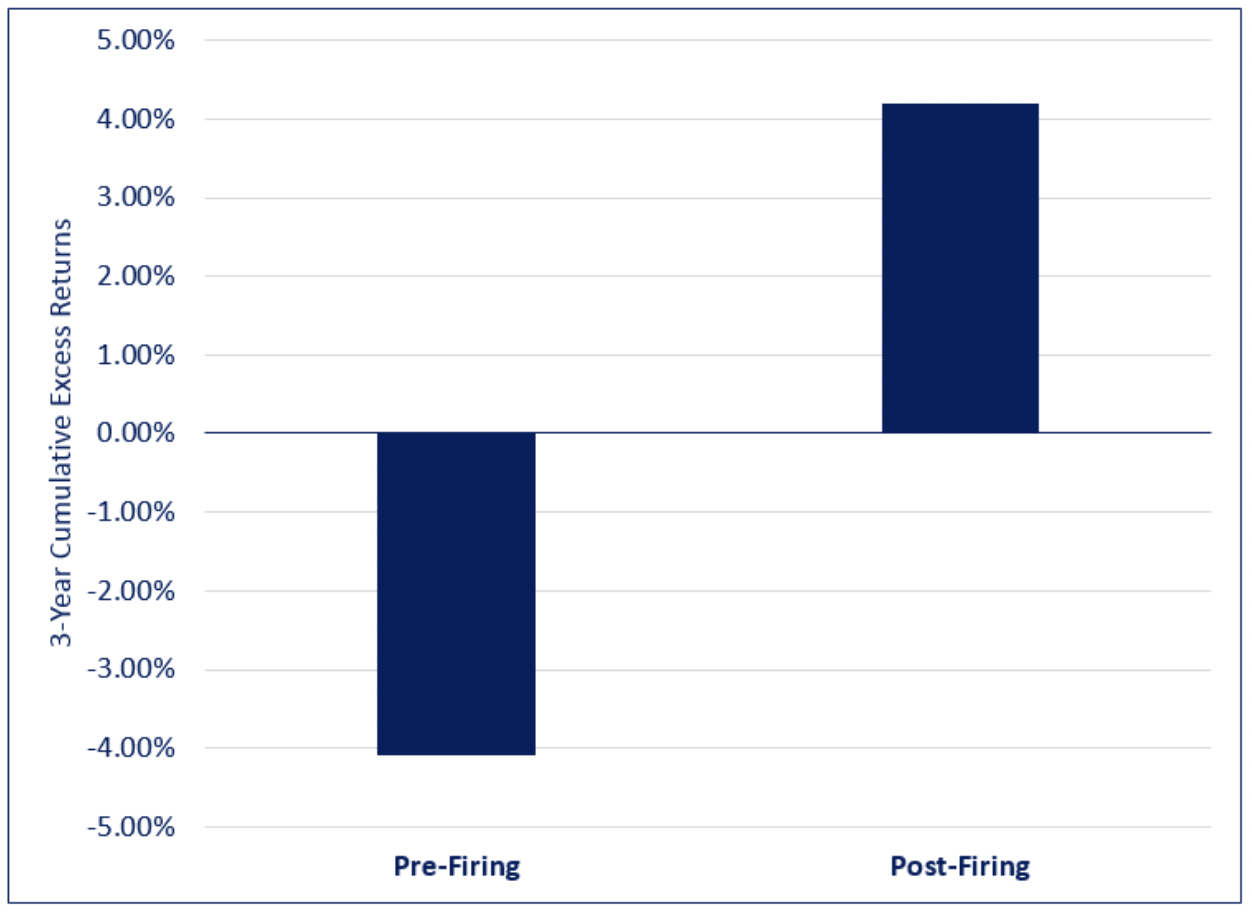 On average, fired managers had poor performance in the three years preceding their termination, with average annual underperformance of 4.1% vs. their benchmarks. This figure should come as no surprise, as you wouldn’t expect that they were fired for knocking the lights out! However, what may be counter-intuitive to many is that these managers tended to subsequently outperform, with average annual outperformance of 4.2% over the three years following their termination.
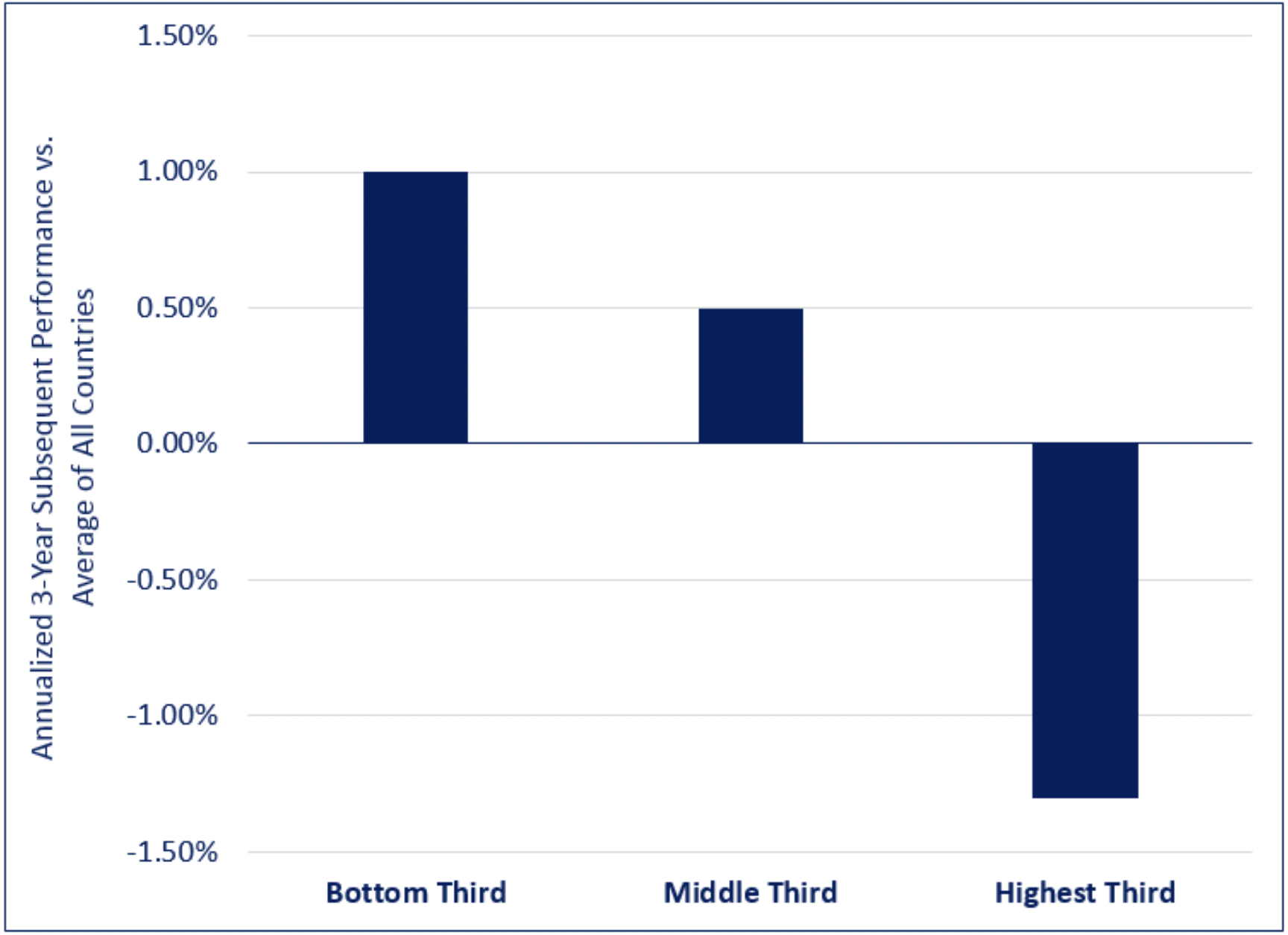 The chart brings fresh perspective to the standard regulatory disclosure language in the marketing materials of investment funds, which states that “Past performance is no guarantee of future returns.”