For the first 30 or so years of working, saving and investing, you’ll be first in the mode of getting out of the hole (paying down debt), and then building your net worth (that’s wealth accumulation.). But don’t forget, wealth accumulation isn’t the ultimate goal. Decumulation is! (a separate category here at the Hub).
Back in March 2020 after stock markets had crashed, I expressed my disgust with the chorus of voices saying that this was the time to re-evaluate your risk tolerance. That advice was essentially telling people to sell stocks while they were low, which makes little sense. After the crash it was too late to re-evaluate your risk tolerance.
I suggested “we should record videos of ourselves saying how we feel after stocks crashed” and watch this video after the stock market recovers. Well, the stock market has long since recovered. Now is a great time to recall how you felt back in March 2020. Did you have any sleepless nights?
Now that markets are near record levels, it’s time to consider whether permanently lowering your allocation to stocks would be best for you in anticipation of future stock market crashes. Unfortunately, this isn’t how people tend to think. It’s while stock prices are low that they want to end the pain and sell, and it’s while stock prices are high that they feel most comfortable.
Michael J. Wiener runs the web site Michael James on Money, where he looks for the right answers to personal finance and investing questions. He’s retired from work as a “math guy in high tech” and has been running his website since 2007. He’s a former mutual fund investor, former stock picker, now index investor. This blog originally appeared on his site on Jan. 19, 2022 and is republished on the Hub with his permission.
A “perfect storm” of challenges faces Canadian investors this RRSP season, according to a a national online study conducted on the Angus Reid Forum Panel for Co-operators, released Tuesday. Jan. 25.
After surveying financial professionals across the banking and wealth management sectors, the panel believes this “perfect storm” can be attributed to the uncertainty of this past year and to DIY [Do It Yourself] investing strategies.
2022 is poised to be a unique RRSP season because of multiple unique market conditions, the study finds: 58 per cent agree that in the face of rising consumer debt, natural disasters (climate change), Omicron, and looming hikes in interest rates, we are approaching a “perfect storm” of challenges, a figure that jumps to 65 per cent in Quebec.
Key findings
80 per cent percent of respondents say that when people experience financial mishaps or losses, many feel overcome with doubt, which leads to indecision and in-action.
76 per cent hypothesize that for many Canadians living in urban centres, home ownership is increasingly feeling out of reach, and because of this, many are looking for DIY investment strategies.
93 per cent say the majority of Canadians have unleveraged opportunities in that they haven’t maximized their RRSP planning and TFSAs.
“By initiating a much-needed national conversation around financial literacy, the hope is that more Canadians will feel empowered to seek counsel from a financial advisor and develop a strategic financial plan to help achieve their goals,” Co-operators said in a press release.
Conducted in January 2021, “Canadian Attitudes on RRSPs” was designed to examine the state of RRSPs, TFSAs and retirement planning strategies that Canadians are using to secure their financial futures – all from the perspective of industry professionals with their ears to the ground across the country.
Consumer confusion appears to be rampant when it comes to understanding the different roles of RRSPs and TFSAs. 90 per cent of financial professionals believe most Canadians” have a lot of confusion” about those two key retirement savings vehicles.
This is reflected in similar confusion about Saving versus Investing: 70 per cent say they see Canadians declining in their ability to differentiate between saving and investing.
The study also sees what it calls “unleveraged opportunities”: 93 per cent think the majority of Canadians haven’t yet maximized their opportunities with RRSP planning, TFSAs, and other programs.
A majority (85%) of industry pros attribute the influence of today’s “culture of now” as hindering people from seeing retirement planning as a priority.
The venerable Registered Retirement Savings Plan (RRSP) also seems to be suffering from the challenge of an “old school image”: 57 per cent say too many Canadians today see RRSPs as “an investing tool of the past” that is no longer as attractive today.
Adding to the angst is the continuing decline of availability of Defined Pension [DB] plans offered by employers: 85 per cent think defined benefit pension plans are going extinct. They too are viewed as a thing of the past: something Canadians don’t expect to have when they retire.
No surprise then that Early Retirement is largely regarded as a myth: 92 per cent of advisors believe that because most Canadians aren’t saving enough for retirement, concepts like “early retirement” are becoming more elusive.
What’s holding Canadians back
When it comes to identifying the causes for Canadians holding back on retirement saving, the survey found financial losses generally contribute to indecision: 80 per cent of advisors say when Canadians experience financial mishaps or losses, many become overcome with doubt, which then leads to indecision and in-action. In addition, 73 per cent see a stigma of shame among many Canadians around financial mishaps or losses.
Just the fact they feel they are not saving added to their stress: 80 per cent see many Canadians feeling paralyzed from the stress of not having enough savings to meet their long-term needs. And many also feel pressure to be perceived as “financially in-the-know.” 65 per cent think there is social pressure among Canadians to appear “financially savvy.” Continue Reading…
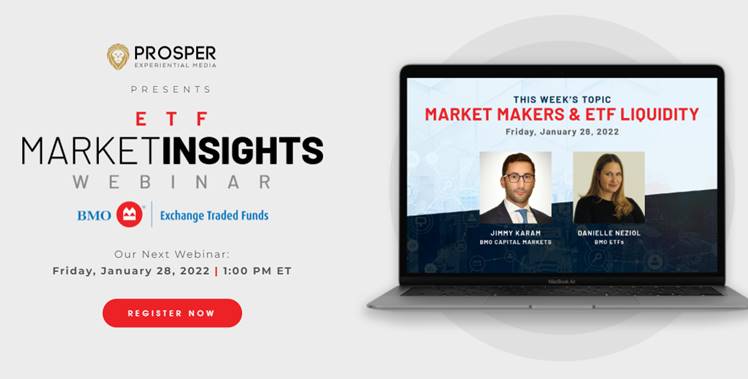
One of the most common questions we get from investors is, “If a certain ETF doesn’t trade often, or it has a low ETF trading volume, will I be able to sell the ETF when I need to?” The quick answer is yesyou can, and I’ll explain why.
This liquidity concern makes sense when we think about trading stocks. A stock which is thinly traded will be much less liquid than a large cap, blue chip stock. Therefore, the less liquid stock could be difficult to sell if there is not demand for it.
However, ETFs work differently than stocks in this way. The true liquidity of an ETF has three layers. These three layers are something we can’t easily see. In fact, most volume data available to investors online is only showing the tip of the liquidity iceberg.
1.) Natural Liquidity: Buyer/Seller
The first layer that most investors are familiar with is between the natural buyer and the natural seller, who get matched on the exchange. Think of this like going to Facebook Marketplace or Kijjiji to sell your car. These marketplaces will match a buyer with a seller. Both will agree on a predetermined price and the transaction is made. This layer of liquidity is mostly present among the largest and most liquid ETFs in the market (usually those with a billion or more in assets).
2.) Market Makers: Buyer/Market Maker/Seller
The second layer of liquidity uses market makers. Marker makers are dealers or brokers who hold an inventory of ETFs and will either buy ETFs or sell ETFs depending on supply and demand. A market maker is trade agnostic which means they are always willing to buy and sell; they make their money in trading volumes (earning commissions on each trade). This trading strategy would be like going to a car dealership to buy or sell a car. The dealer acts as a market maker, who will buy your car and sell to someone else, and they usually earn a spread on this transaction. Market makers are often who you will “meet” on the other end of your ETF trades and they play a huge part in a healthy and liquid ETF ecosystem!
3.) Creations & Redemptions: ETF Provider/Buyer or Seller/ETF Provider
The third layer of liquidity is called the Creation and Redemption Process. ETFs have this ability because they are open-ended funds. The process occurs when there is an imbalance in supply or demand for a specific ETF. If demand is high, there will be more creations. This means the ETF provider (for example, BMO ETFs) will create more shares of an ETF to match demand. This is simply done by purchasing the stocks that the ETF holds, turning it into an ETF, and then passing it on to the buyer. If supply is high and demand is low, there will be more redemptions. This means that the seller will send their ETF back to the ETF provider, the provider will disassemble it and sell the underlying stocks in the market, sending cash back to the ETF seller. Think of this trading strategy like ordering a car directly from the auto manufacturer; they will go and buy all the parts for the vehicle, build it, and deliver you the car. A redemption would be the opposite where a car would be sold back to the auto plant and disassembled and sold off for parts (this is of course not how things are done in the auto world but a good example to visualize the process!). This last layer of liquidity is important to understand because it demonstrates that an ETF is as liquid as its underlying holdings of stocks or bonds.
Because of these three layers of liquidity, an ETF can sometimes be more liquid than its underlying holdings. We typically see this in less liquid asset classes such as preferred shares and fixed income, where the ETF will be easier to trade than the underlying holdings. Therefore, the increased liquidity of an ETF is just another of the many benefits of using ETFs in your portfolio!
Danielle Neziol has been part of the BMO ETF Team for over five years working in ETF product development, strategy, and most recently in ETF education for direct investors. In the past she has been engaged with with the exchanges, capital markets desks, index providers and portfolio managers to bring ETFs to market and today she is focused mostly on applying her expertise in the ETF business to support and educate investors.
Photo: Towfiqu barbhuiya on Unsplash with modifications by LowrieFinancial.com
By Steve Lowrie, CFA
Special to the Financial Independence Hub
As a personal financial advisor, I am often asked about “the secret” to attaining financial freedom. Not to go all metaphysical on you, but to improve your long-term outcomes, try looking inward. After all, you are among the few drivers you have much control over. One great way to sharpen your financial acumen is by combining behavioural finance with an evidence-based perspective. Together, these disciplines offer reams of insights on how tending to your own best practices is often the best-kept secret to enjoying wealth management success.
“Emotional centers of the brain that helped guide primitive behavior like avoiding attack are now shown by brain scans to be involved in processing information about financial risks. These brain areas are found in mammals the world over and are blunt instruments designed for quick reaction, not precise thinking. Rapid, decisive action may save a squirrel from an owl, but it certainly doesn’t help investors. In fact, a large body of research suggests that investors profit most when they do the least.”
As early as the 1970s, Nobel laureate Daniel Kahneman was a driving force behind the formation of behavioural finance (along with Nobel laureate Richard Thaler and the late Amos Tversky). In his landmark book, “Thinking, Fast and Slow”, Kahneman describes this same quick vs. precise thinking as System 1 vs. System 2 thinking:
“System 1 [thinking] operates automatically and quickly, with little or no effort and no sense of voluntary control. System 2 [thinking] allocates attention to the effortful mental activities that demand it, including complex computations.”
Long before the term “behavioural finance” was a thing, wise academics and practitioners alike were suggesting investors are best off avoiding their fast-thinking instincts in favor of slower-thinking resolve. As billionaire Warren Buffett said decades ago:
“Success in investing doesn’t correlate with I.Q. … Once you have ordinary intelligence, what you need is the temperament to control the urges that get other people into trouble in investing.”
Buffett is correct. And yet, from what I see every day, fast, reactionary thinking continues to dominate most investors’ actions. What else could explain the never-ending parade of people chasing after FOMO (fear of missing out) investment trends instead of following the simple investing strategies, an evidence-based mindset prescribes?
Your brain’s take on Wealth Management
What’s actually going on in our heads when we allow our instincts and emotions to overcome our higher reasoning? Wall Street Journal columnist Jason Zweig’s “Your Money & Your Brain” takes us on a fascinating tour inside the mechanics in our own heads.
For example, Zweig warns us:
“…the amygdala [in your brain] can flood your body with fear signals before you are consciously aware of being afraid … [and] the nucleus accumbens in your reflexive brain becomes intensely aroused when you anticipate a financial gain.”
In this related piece, “It’s the Little Things That Can Color an Investor’s Outlook,” Zweig describes how even seeing the same financial numbers in red vs. a neutral color can unwittingly change our feelings about the data. Additional “insidious influences” include whether we’re hungry or full, sleepy or awake, or experiencing a cloudy or sunny day.
These sorts of overcharged emotions and unconscious biases can steer you wrong when you’re deciding whether to buy, sell, or hold your investments. They can also knock you off course from your holistic financial planning.
Nudging your way to Cost Savings
By adding academic rigor to our thinking, behavioural finance improves our ability to identify and manage our behavioural weaknesses. We can then apply that knowledge toward not reacting to the quick tricks our brain plays on us. Better still, we can learn how to play tricks right back on our brain: turning otherwise adverse instincts to our advantage. Continue Reading…
Now more than ever, offering the best customer service that you can is essential. Even though most business owners are aware that it is important to provide quality service, they still may not understand how big of a difference it can make for their business, or just why it is so necessary.
The reality is that over time, customers’ opinions and thoughts about businesses have become increasingly important. Not only that, but because the internet makes it so easy for them to share their thoughts, business owners need to find more ways to make sure that their thoughts about their companies are positive. If you are looking for some ways to help ensure you are building a strong connection with your customers that will help your business flourish, here are some things to think about:
Doing Research is Key
When it comes to offering great service, research should be your first step. From making sure that you have a solid knowledge of CDP [Customer Data Platform] to taking the time to look deeply into your analytics, doing your research will help guide you in the right direction when you are looking to offer better service. Not only will it help you to get to know your customers better, but it will also allow you to know what areas your business needs the most work in. The more research you do at the beginning of the process, the less work you will have to do later on.
Use your Social Media wisely
If you are looking to improve customer service, then social media is your best friend. Social media isn’t just a great way to spread information about your company, it is also great for getting to know your customers better, and for offering them service in a way that works for them. More and more, customers are spending their time on social media and looking to connect with businesses and brands there, as well. This means that you need to be active on social media, and make sure that you are there to connect with them, too. Continue Reading…


 Posted By
 Michael J. Wiener runs the web site Michael James on Money, where he looks for the right answers to personal finance and investing questions. He’s retired from work as a “math guy in high tech” and has been running his website since 2007. He’s a former mutual fund investor, former stock picker, now index investor. This blog originally appeared on his site on Jan. 19, 2022 and is republished on the Hub with his permission.
  Posted By